 October 6, 2007 - Professor John Britton, chair of the Royal College of Physicians (RCP)tobacco advisory group, believes smokers should be able to buy a lower risk alternative to cigarettes. British American Tobacco is quick to agree with Professor Britton and the RCP that smokers should be able use a tobacco product like SNUS which the Royal College has said is significantly less harmful than smoking.(Doctors call for new nicotine products, London (Reuters), news.scotsmen.com, 10/5/2007) But Who's listening to Professor Britton?? - NOT - at the 1st National Conference for the British Association for Stop Smoking Practitioners (BASSP) in Manchester on September 26, 2007 with an audience of over 100 smoking cessation specialists from hospitals, primary care and management within the National Health Service from all over the UK, voted strongly against the proposal to make SNUS more available in their practice - see related news brief: October 2, 2007. Dr. Britton implies that it is not nicotine that kills but it's the hundreds of other toxic chemicals that come with it. IS THIS TRUE!!Nicotine alone is an extremely toxic; 60 mg of nicotine (about the amount in three or four cigarettes will kill an adult). Not enough is known about smokeless tobacco. As pointed out by Marita Broadstock in her systematic review (Systematic Review of the health effects of modified smokless tobacco products, NZHTA Report, February 2007, Volume 10 Number 1), the number of studies on smokeless tobacco is relatively slight compared to the wealth of literature published relating to smoking.) More and more studies are surfacing about the dangers of nicotine, e.g., a new study from Weill Cornell Medical College provides evidence that nicotine may accelerate atherosclerosis and may be as dangerous as tar. A recent by Dr. Stephen Hecht and colleagues suggests that smokeless tobacco is not a good option for reducing health risks from smoking Considerable more quality research and product regulation is necessary prior to considering smokeless tobacco as a harm reduction method (Drs. Dorothy Hatsukami, Charlotte Lemmonds and Scott Tomar, Prev Med 38(3):309-317, 2004). Even Professor Britton agrees that more research into the long-term health effects of SNUS would be helpful. (TobaccoWatch.org) Regarding the availability of tobacco products. In the past, Dr. Britton has said, "At the moment we have the absurd situation that kids can easily get a hold of cigarettes...." (BBC News, Nicotine therapy for young smokers, 10/2/2001) How about kids easily obtaining and using SNUS - promoted for use anywhere, anytime, no one will ever know?? (TobaccoWatch.org)
 Saturday, October 6, 2007
Professor John Britton, chair of the Royal College of Physicians (RCP)tobacco advisory group,
October 6, 2007 - Professor John Britton, chair of the Royal College of Physicians (RCP)tobacco advisory group, believes smokers should be able to buy a lower risk alternative to cigarettes. British American Tobacco is quick to agree with Professor Britton and the RCP that smokers should be able use a tobacco product like SNUS which the Royal College has said is significantly less harmful than smoking.(Doctors call for new nicotine products, London (Reuters), news.scotsmen.com, 10/5/2007) But Who's listening to Professor Britton?? - NOT - at the 1st National Conference for the British Association for Stop Smoking Practitioners (BASSP) in Manchester on September 26, 2007 with an audience of over 100 smoking cessation specialists from hospitals, primary care and management within the National Health Service from all over the UK, voted strongly against the proposal to make SNUS more available in their practice - see related news brief: October 2, 2007. Dr. Britton implies that it is not nicotine that kills but it's the hundreds of other toxic chemicals that come with it. IS THIS TRUE!!Nicotine alone is an extremely toxic; 60 mg of nicotine (about the amount in three or four cigarettes will kill an adult). Not enough is known about smokeless tobacco. As pointed out by Marita Broadstock in her systematic review (Systematic Review of the health effects of modified smokless tobacco products, NZHTA Report, February 2007, Volume 10 Number 1), the number of studies on smokeless tobacco is relatively slight compared to the wealth of literature published relating to smoking.) More and more studies are surfacing about the dangers of nicotine, e.g., a new study from Weill Cornell Medical College provides evidence that nicotine may accelerate atherosclerosis and may be as dangerous as tar. A recent by Dr. Stephen Hecht and colleagues suggests that smokeless tobacco is not a good option for reducing health risks from smoking Considerable more quality research and product regulation is necessary prior to considering smokeless tobacco as a harm reduction method (Drs. Dorothy Hatsukami, Charlotte Lemmonds and Scott Tomar, Prev Med 38(3):309-317, 2004). Even Professor Britton agrees that more research into the long-term health effects of SNUS would be helpful. (TobaccoWatch.org) Regarding the availability of tobacco products. In the past, Dr. Britton has said, "At the moment we have the absurd situation that kids can easily get a hold of cigarettes...." (BBC News, Nicotine therapy for young smokers, 10/2/2001) How about kids easily obtaining and using SNUS - promoted for use anywhere, anytime, no one will ever know?? (TobaccoWatch.org) 
Friday, October 5, 2007
NO Tobacco Ads appeared in the What's Up Section of the Raleigh News & Observer.

October 5, 2007 - NO Tobacco Ads appeared in the What's Up Section of the Raleigh News & Observer. It's because individuals and anti-tobacco groups continuously voiced their opinion to the publisher of this newspaper. People can still band together for a good cause and make a positive difference. Here's the ads that appeared in previous weeks. Just about every week a Kool XL ad appears. See related Kool XL Newsbriefs: July 8, 2007 and September 7, 2007. Camel Snus related Newsbriefs: September 14, 2007 August 31, 2007 August 24, 2007 August 17, 2007, August 14, 2007, August 10, 2007,August 3, 2007, July 27, 2007, July 23, 2007, July 13, 2007, July 12, 2007 and July 2, 2007. (TobaccoWatch.org)
FDA Head: 'No' to Tobacco Cigarettes too "inherently dangerous" to regulate; would "undermine mission."
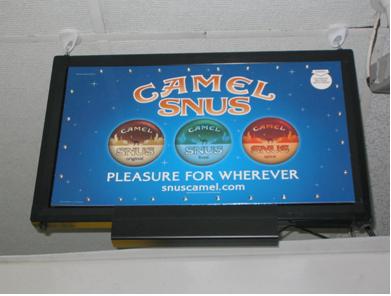
 October 5, 2007 - FDA Head: 'No' to Tobacco Cigarettes too "inherently dangerous" to regulate; would "undermine mission." The head of the federal Food & Drug Administration (FDA) Dr. Andrew von Eschenbach, the FDA commissioner said that his agency should not be required to regulate tobacco, but that it is open to some expanded role in the fight against smoking. Dr. Andrew von Eschenbach, the FDA commissioner, did not attend the hearing Wednesday on legislation to authorize his agency to determine how tobacco products should be made, marketed and sold, said the report. In a statement sent to the House Energy & Commerce Committee’s Subcommittee on Health, von Eschenbach said: "Associating the agency with the approval of these inherently dangerous products would undermine the agency’s mission.” He added that the legislation would not give the FDA—which is responsible for such things as pharmaceutical safety—adequate money to establish a new regulatory structure for tobacco and that the bill sets unrealistic deadlines to make progress against smoking. (CSP News) Without regulations that strictly limit the distribution of SNUS we will end up with another generation of nicotine addicts. from SNUS.biz: Even Chris Proctor, Head of Science and Regulation for British American Tobacco has stated, “We’re also responding to public health stakeholders who told us they believe snus, PROPERLY REGULATED, can contribute to reducing the impact of tobacco on public health. We hope more stakeholders, including governments, will agree.” Hyland et al. (Addictive Behaviors 31:1190-1200, 2006) have concluded that only under strict regulations the increase in low-nitrosamine smokeless tobacco use could reduce overall smoking prevalence yielding potentially substantial health benefits. Well - at the present time it looks like we are NOT going to have a federal agency to regulate tobacco products in the USA. . At least in the U.S.A. we'd never have strict restrictions that were enforced, e.g., Camel SNUS the tag line and an ad - Do you think they're appealing to inveterate (hard-nosed, long established, deep-rooted) cigarette smokers that refuse to consider trying to quit smoking tobacco?? Get Real!! (TobaccoWatch.org)

Thursday, October 4, 2007
British American Tobacco (BAT) feels its their corporate social responsibility ..

October 4, 2007 - British American Tobacco (BAT) feels its their corporate social responsibility to continue to press European regulators to lift the ban on snus, the smokeless tobacco, arguing that the use of snus helps to reduce tobacco-related harm. (It is important to note that sucking tobacco like SNUS is prohibited for import and sale in all the European Union countries and permitted only in Sweden and non-EU Scandinavian countries - Norway.)Tobacco companies have warned public health professionals if they don’t support the smokeless tobacco alternative they’ll be at fault for the suffering from chronic sickness and death of tobacco smokers. The European Commission is reviewing the EU’s tobacco legislation, but it made clear that a relaxation of the ban was unlikely. “We will be guided by the advice of our scientific committee. It has already produced its report ... and this clearly sets out the harm snus does to health,” a spokesman said. At the 1st National Conference for the British Association for Stop Smoking Practitioners (BASSP) in Manchester on September 26, 2007 with an audience of over 100 smoking cessation specialists from hospitals, primary care and management within the National Health Service from all over the UK, voted strongly against the proposal to make SNUS more available in their practice - see related news brief: October 2, 2007. SNUS is outlawed by the European Union (except Sweden) mainly because it was deemed an attraction to children, who would become easily hooked and move on to cigarettes. Imperial Tobacco Canada (a wholly owned indirect subsidiary of British American Tobacco(BAT)) announced that it will test market a reduced harm product, as compared to cigarettes, with the introduction of Swedish-style snus in Edmonton retail outlets - see related news brief:September 12, 2007. BAT accounts for about 10 per cent of sales in the Swedish snus market. BAT is the largest stockholder in Reynolds American with approximately 42% of shares. Camel SNUS now being test marketed in at least eight cities in the U.S. is manufactured in conjunction with BAT in Sweden. From snuz.biz: In about May 2005 BAT introduced two new snus products – one an extension of its Lucky Strike cigarettes and the other of its Peter Stuyvesant cigarettes--in Johannesburg, South Africa and Stockholm, Sweden. ( BAT calls for ban on ‘snus’ to be lifted, Rory Watson, The Times, 10/3/07 - part; also TobaccoWatch.org)


We need more tobacco like a hole in the head - the world does not need: smokeless, chewless and spitless tobacco.
October 4, 2007 - We need more tobacco like a hole in the head - the world does not need: smokeless, chewless and spitless tobacco. Imperial Tobacco Canada Ltd.,is now test marketing in about 230 retail outlets in Edmonton, SNUS under the brand name du Maurier. Look for it in the fridge, near the Red Bull. Canada has 4.5 million smokers, and about 80 per cent of them are addicted to nicotine. The widespread availability of snus would create more nicotine addicts, and provide a marginal benefit to smokers. Despite the whitewashing and the soft-peddling by Imperial Tobacco, the reality is that snus is not designed to replace cigarette sales, but as an add-on. Smokers will likely stuff these little nicotine-laced bags in their mouths when they are craving a smoke and it's too cold to go outside, or when they are in public places where there are smoking restrictions. If smokers are looking to quit, there are many proven methods. This isn't one of them. Snus is not a smoking cessation aide, it's a smoking prolongation aide. It's also a fairly blatant method of recruiting young people to tobacco. Sell them this seemingly innocuous product that tastes good and provides a nicotine buzz, and in no time they will be lighting up. ( Andre Picard, Public Health Reporter, GlobeandMail.com) See related news brief:September 12, 2007.

Wednesday, October 3, 2007
President Bush vetoed a bipartisan bill expanding a popular children's health insurance..

October 3, 2007 - President Bush vetoed a bipartisan bill expanding a popular children's health insurance program Wednesday, setting up an override battle with Congress. The White House sought little attention for Mr. Bush's action, with the president casting his veto behind closed doors without any fanfare or news coverage. The program is a joint state-federal effort that subsidizes health coverage for 6.6 million people, mostly children, from families that earn too much to qualify for Medicaid but not enough to afford their own private coverage. The Democrats who control Congress, with significant support from Republicans, passed the legislation to add $35 billion over five years to allow an additional 4 million children into the program. It would be funded by raising the federal cigarette tax by 61 cents to $1 per pack. Democratic congressional leaders said they may put off the override attempt for as long as two weeks to maximize pressure on Republican House members whose votes will be critical.( Bush Vetoes Children's Health Bill President Says Expansion Of Popular Kids' Health Insurance Program Is Too Costly, CBS News, Oct. 3, 2007 3:31pm). As pointed out by Senate Minority Leader Mitch McConnell (R-Ky.) if the S-CHIP bill is defeated, there is nothing to prevent lawmakers from resurrecting the tobacco tax increase as part of some other legislation. ( Tobacco Tax Still Seaworthy - Federal increase could still set sail even if Bush’s S-CHIP veto torpedoes legislation, CSP Daily News, September 27, 2007) The Campaign for Tobacco-Free Kids estimates the following benefits from a 61-cent federal cigarette tax increase: Pack sales decline in the US: -1.855 billion, Percent decrease in youth smoking : 9.2%, Increase in total number of kids alive today who will not become smokers: 1,873,000, Number of current adult smokers in the US who would quit: 1,171,000. The group also points to millions of dollars in health savings from fewer smoking-affected pregnancies and births. Add to that hundreds of millions in savings from fewer smoking caused heart attacks and strokes. The Campaign sees nearly $44 billion dollars in long-term health care savings from overall smoking declines. Of course there is no way to estimate the decreased emotional toll on loved ones of people who would quit smoking and avoid the agony of lung cancer and other smoking- related illnesses. (S-CHIP Up in Smoke, Peter Maer, CBS News) See related news briefs stories:September 27, 2007 September 21, 2007 September 19, 2007 July 28, 2007 July 18, 2007 and July 9, 2007.
Tuesday, October 2, 2007
The first National Conference for the British Association for Stop Smoking Practitioners (BASSP)..
October 2, 2007 - Be the 1st to know.. The first National Conference for the British Association for Stop Smoking Practitioners (BASSP) in Manchester on September 26, 2007, the topic: whether 'harm reduction techniques affect a smokers health.' The presentations concentrated around the potential for Swedish moist tobacco (SNUS) in harm reduction. Speaking for a greater use and its potential role in harm reduction was Professor John Britton who heads the Royal College of Physicians Tobacco Committee in the UK. He argued that it has potential in a carefully legislated and controlled way and should not be discounted. Speaking against the use of SNUS, Dr Keir Lewis, Senior Lecturer in Swansea School of Medicine and a Respiratory Physician from South Wales (UK) argued that the science to date is flawed, with no prospective, randomised controlled trials that show it's usefulness in smoking reduction and you cannot extrapolate retrospective, cross-sectional and often old data from one country into another. He contrasted this lack of good scientific evidence for SNUS in helping smokers quit cigarettes with the clearly known dangers of SNUS and highlighted some of the current advertising and subversive strategies used by it's manufacturers. The audience of over 100 smoking cessation specialists from hospitals, primary care and management within the National Health Service from all over the UK, voted strongly against the proposal to make SNUS more available in their practice. The British Thoracic Society supported the meeting and the keynote speaker (and patron of the newly formed BASSP) was the Member of Parliament Mr Kevin Barron, who is Chairman of the House of Commons Health Select Committee and the man mainly responsible for driving through most of the recent legislation against smoking in enclosed spaces in England. To obtain a copy of Dr. Lewis' presentation.
Monday, October 1, 2007
Price of Marlboro SNUS in the test market area of Dallas/Fort Worth. .
 October 1, 2007 - Price of Marlboro SNUS in the test market area of Dallas/Fort Worth. FROM Yahoo ANSWERS: The price of Marlboro Snus is around the same as a pack of Marlboro. The average price range that I have seen is between $4.29 to $4.49. It varies store to store. The cheapest price I have seen is at Murphy Oil (in front of many Wal-Mart stores), the price there is $3.54, they are practically giving it away. You can go to marlborosnus.com to sign up for free coupons. If you are on a Philip Morris mailing list( which includes the Marlboro, Virginia Slims, Parliament, and Basic mailing lists), you should receive 2 coupons for a free pack on Snus in the mail. There will also be a coupon for a free pack of Snus in select Marlboro cigarette packs in the coming months. A Marlboro product promotion( like "Buy One, Get one Free") will also be coming out soon. It will be buy a pack of Marlboro, Lights, Ultra Lights, and Select Menthol packaging and get a sample of Snus (4 pouches of each flavor, Rich, Mild, Mint, and Spice for a total of 16 pouches. A normal pack of Snus only contains 12 pouches). See related news briefs stories:September 18, 2007 August 30, 2007 August 22, 2007 August 21, 2007 and August 18, 2007.
 Sunday, September 30, 2007
Maine - ban on flavored tobacco products..
 September 30, 2007 - Maine has enacted two new laws to restrict the sale of candy- and fruit-flavored tobacco products to minors, and to ban tobacco from school premises at all times. Governor John E. Baldacci at a ceremony to publicize the new restrictions at the start of the academic year said he had been "outraged" when he first learned of tobacco products with candy and fruit flavors being pitched to juveniles.
The new laws are LD 1361, "An Act Concerning Certain Flavored Cigarettes and Cigars," and LD 184, "An Act to Protect Children's Health on School Grounds". The school grounds law makes schools tobacco-free environments, including when school is not in session, such as during sporting events.
The governor warned policymakers and advocates that continued vigilance is necessary because tobacco companies are demonstrating they can be "relentless in their pursuit of addicting new-and often young people" as customers. "Tobacco companies focus on young people because they know that two-thirds of smokers start by the age of 18," said Baldacci. "Not surprisingly, the tobacco companies are becoming more and more aggressive with their flavored tobacco products and other means to target youth."
Although Maine has earned top ratings from the Lung Association's Annual Tobacco Report Card, the governor said 16 percent of high school students in the state smoke.
The flavored cigarette and cigar ban prohibits the sale or distribution of such products beginning July 1, 2009. The tobacco-free rule for school grounds is in effect now.
Reference: Governor Celebrates Ban on Flavored Cigarettes, Maine Governor John E. Baldacci, Governor''s Office, 9/25/2009; MAINE PROHIBITS SALE OF FLAVORED TOBACCO, Juvenile Justice Digest - BNET, 9/28/07.
Click on image to enlarge..