 August 9, 2009 - A recent paper by Peter Lee and Jan Hamling, of P.N. Lee Statistics and Computing Ltd, carried out a meta-analyses using data from 89 smokeless tobacco studies from the US (62) and Scandinavia (18).
The meta-analyses were conducted using all available estimates, smoking-adjusted estimates, or estimates for never smokers. For seven cancers, smoking-attributable deaths in US men in 2005 were compared with deaths attributed from introducing smokeless tobacco into a population of never-smoking men. According to Lee, "It is clear that any effect of smokeless tobacco on risk of cancer, if it exists at all, is quantitatively very much smaller than the known effects of smoking". They conclude that products used in the past in the USA may have increased the risk, but any effect that exists now seems likely to be quite small. An increased risk of oropharyngeal cancer is evident most clearly for past smokeless tobacco use in the USA, but not for Scandinavian snuff. Some meta-analyses suggest a possible effect for oesophagus, pancreas, larynx and kidney cancer, but other cancers show no effect of smokeless tobacco.
PAPER: Systematic review of the relation between smokeless tobacco and cancer in Europe and North America; Peter N Lee email and Jan S Hamling, BMC Medicine 2009, 7:36doi:10.1186/1741-7015-7-36, published 7/29/220, ABSTRACT...
The interpretation of a meta-analysis is potentially subject to an author’s bias by what inclusion and exclusion criteria is selected, the type of statistical evaluation performed, decisions made on how to deal with disparities between the trials, and how the subsequent results are presented, e.g., in this study when the authors decided to use studies published after 1990 the risk of oropharyngeal cancer disappeared.
It seems this tobacco study and others carried out by P.N. Lee Statistics and Computing Ltd are funded by European Smokeless Tobacco Council (ESTC). (European Smokeless Tobacco Council, was established in 1989 and represents the interests of smokeless tobacco manufacturers and distributors as well as tobacco trade associations.)
As pointed out by Marita Broadstock in her systematic review ("Systematic Review of the health effects of modified smokeless tobacco products," NZHTA Report, February 2007, Volume 10 Number), the number of studies on smokeless tobacco is relatively slight compared to the wealth of literature published relating to smoking.
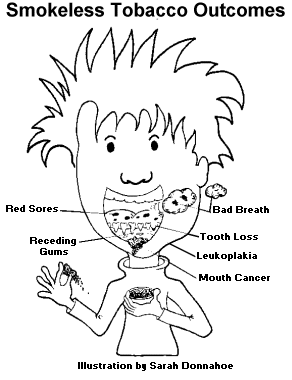 In May 2008 study Peter Lee and associates confirmed the strong association of current use of smokeless tobacco, particularly snuff, with prevalence of oral mucosal lesions. It provides suggestive evidence of an association of snuff use with gingival recession and attachment loss, and of chewing tobacco with dental caries. (Systematic review of the relation between smokeless tobacco and non-neoplastic oral diseases in Europe and the United States; Gerd Kallischnigg, Rolf Weitkunat and Peter N Lee; BMC Oral Health 2008, 8:13doi:10.1186/1472-6831-8-13; published May 1, 2008; Full Text...)
 In December 2008 Peter Lee and associates' systematic review of studies from North America and Europeon the use of smokeless tobacco and the increased risk of pancreatic cancer. They conclude at most, the data suggest a possible effect of smokeless tobacco on pancreatic cancer risk. More evidence is needed. If any risk exists, it is highly likely to be less than that from smoking. (Systematic review of the relation between smokeless tobacco and cancer of the pancreas in Europe and North America Zheng Sponsiello-Wang, Rolf Weitkunat, and Peter N Lee BMC Cancer. 2008; 8: 356. Published online 2008 December 1) With smokeless spitless tobacco like SNUS you suck on the bag meanwhile the poisonous juices are slowly leaking into your gastrointestinal tract eventually causing pancreatic cancer - the most painful and dreadful of all cancers - most everyone that gets it dies.
The expert group of the International Agency for Research on Cancer has concluded that smokeless tobacco is carcinogenic to humans, and the European Commission report cites studies by the Swedish Institute of Public Health and the Karolinska Institute as evidence that snus is carcinogenic. (Head to Head Should doctors advocate snus and other nicotine replacements? No, Sir Alexander W Macara, president, National Heart Forum, BMJ 2008;336:359 (16 February))
More studies of smokeless tobacco products are needed before it can be established that these products do not carry a significant risk of carcinogenesis.
Reference: Smokeless Tobacco Safer Than Smoking, Study Suggests, Science Daily, 7/29/2009.
Some related news brief: Snus does not save lives: quitting the use of tobacco does!; Smokeless tobacco increases stroke risk..; http://snus-news.blogspot.com/2008/04/snus-causes-premature-death_19.html; NO - don't even consider legalizing SNUS in Australia...
No comments:
Post a Comment