Substantial scientific evidence shows that higher cigarette prices result in lower overall cigarette consumption...


June 26, 2007 - Substantial scientific evidence shows that higher cigarette prices result in lower overall cigarette consumption. Most studies indicate that a 10% increase in price will reduce overall cigarette consumption by 3% to 5%. Youth, minorities, and low-income smokers are two to three times more likely to quit or smoke less than other smokers in response to price increases.(Reducing Tobacco Use: A Report of the Surgeon General - 2000).

Did you ever wonder what's the cheapest pack of cigarettes at your local convenience store??? Maybe it's Bailey's, Basic, Pyramid, Niagara, Pyramid or USA Gold. I'm afraid that large tobacco companies already control, this aspect of the business in most cases. Take for example one c-store - an R.J. Reynold's Tobacco Co. controlled store. There's an agreement that no pack of cigarettes can sell below the price of Doral. (TobaccoWatch.org)
Read more...

Tobacco ads now even appears in PC Magazine (June 5, 2007)...


June 24, 2007 - Tobacco ads now even appears in PC Magazine (June 5, 2007). - UST's latest Skoal Flavor - Citris Blend - also comes in pouches. President Nixon on April 1, 1970 signed the act banning cigarette advertisng on TV and Radio. The Master Settlement Agreement (MSA) of November 1998 prohibited participating tobacco companies from directly or indirectly targeting youth in marketing. The tobacco industry response to the MSA was at best modest, reducing proportional allocations of advertising to youth magazines but increasing the absolute amount of such advertising (Hamilton etal., Tobacco Control 11:ii54-ii58, 2002). Studies show that tobacco ads continued to reach large numbers of youth but it's difficult to determine if tobacco companies were actually violating the MSA youth-targeting ban. The European Union Tobacco Advertising Directive took effect in July 2005. This EU Directive bans tobacco advertising in the print media, on radio and over the Internet. Tobacco advertising on television has been banned in the EU since the early 1990s. The United States should also ban tobacco advertising in the print media to eliminate tobacco companies excuses that they weren't advertising to youngsters. It is still true in 2007 just as it was in 1973 - if tobacco companies are to survive and prosper, over the long term they must get their share of the youth market (14-24).(Claude Teague, Assistant Chief in R&D at RJ Reynolds, writes a paper: "Some Thoughts About New Brands of Cigarettes for the Youth Market") Click on Image to Enlarge.
Read more...

Fire - Safe Cigarettes for all 50 states - NOW...


June 23, 2007 - Fire - Safe Cigarettes for all 50 states - NOW.. The Charleston, SC fire that took the lives of 9-firefighters may have been caused by a discarded lit cigarette. Texas legislators have mandated that all cigarettes sold in Texas by 2010 be designed to snuff out after the last puff. Why wait for 2010??? New York, which has required "fire-safe cigarettes" since 2004, was the trendsetter. Its legal standard has become the boilerplate for 15 other states, affecting nearly half of the American public. The cigarettes employ two or three bands of special paper that act as tiny firewalls to self-extinguish if the user isn't actively smoking. The only difference of opinion between the tobacco industry and fire safety activists seems to be what to call them. Cigarette makers don't like "fire-safe" because it implies a guarantee. They prefer "reduced ignition propensity cigarettes," often ironically shortened to "RIP cigarettes." Similar legislation is pending in an additional 15 states, including tobacco-centric North Carolina. Momentum is building in part because some in the industry support a national standard, although no federal action is forthcoming. Similar legislation is pending in an additional 15 states, including tobacco-centric North Carolina. According to a 2005 Harvard School of Public Health report, cited in Connecticut legislative research documents, the new cigarettes didn't affect prices or sales in New York. (Mark Babineck, Houston Chronicle)
Read more...

Egypt Passes National Anti-Smoking Law..


June 22, 2007 - Egypt's People's Assembly has passed anti-smoking legislation banning the sale of tobacco to minors under 18 and from smoking in indoor areas. The law, which goes into effect immediately, also includes a ten percent increase in the cost of cigarettes.

"The price hike is important in order to discourage youngsters from smoking and to decrease smoking in general and reduce tobacco sales," Hamdi El Sayed, chairman of the People's Assembly Health Committee and head of the Doctor's Syndicate in Cairo, said in a statement.

Smoking will now be prohibited in health and educational organizations, youth centers, legislative associations and all governmental authorities and clubs. A fine between 1,000 EGP ($175 USD) and 50,000 EGP ($9,000 USD) was also added to the new law for violations of the new tobacco law.

According to a report by the Health Committee, Egyptians smoke roughly 19 million cigarettes each year, spending around 3 billion EGP ($520 million USD). It added that smokers in the country increase by six to nine percent every year as compared to only one percent in the West.

Raising prices are believed to be one of the main ways of decreasing new smokers. In 1992, a ten-piaster (2 cents USD) increase in a pack of cigarettes generated 200 million EGP ($30 million USD) in revenue, but did not stop new smokers from manifesting.

Egypt is one of the cheapest countries in the world to purchase cigarettes.

About image: Cleopatra Cigarettes produced in Egypt by Eastern Company are the most popular cigarettes in The Middle East. More than 100,000,000 People in The Middle East smoke Cleopatra Cigarettes.

Reference: Egypt Passes National Anti-Smoking Law, vitabeat.com, 6/21/2007.

Read more...

The word on the street – no doubt R.J. Reynolds Tobacco (RJR) was surprised Marlboro SNUS entry..


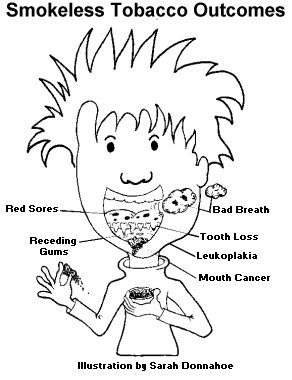
June 18, 2007 - The word on the street – no doubt R.J. Reynolds Tobacco (RJR) was surprised Marlboro SNUS entry (see 6/9/2007 below) would be available in 4-flavors: rich, mild, mint and spice. Executives from Philip Morris (PM) had indicated the company has learned a lot from the test marketing of Taboka Toabbcopaks. Meaning using various flavorings will help disguise the actual nasty taste of the tobacco. Just take a look at USST's Skoal, now with 11 flavors: wintergreen (the original flavor), straight, mint, cherry, classic, spearmint, berry blend, vanilla blend, apple blend, peach blend and the new citrus blend. Most be a flavor just about anyone would like. We have to remember that RJR on 7/13/2006 - see SNUS.biz, signed an agreement with Norwegian SNUS company called Taboca - a name very similar to the PM's Taboka. Need a job - RJR is still stationing representatives in c-stores just waiting to give a free pack of smokes to a person that happens to purchase a Marlboro. One more item: Don’t forget the tag for Skoal Dry - use is discreet so others wouldn’t notice you’re enjoying it.. Just what our kids want to hear. Remember the many negative consequences of going smokeless - the disgusting mouth syndrome. By the way at least in Indonesia there's a PMI product called Marlboro kretek (a Marlboro cigarette made of a mixture of tobacco and clove).Click on Image to Enlarge. (TobaccoWatch.org)
Read more...