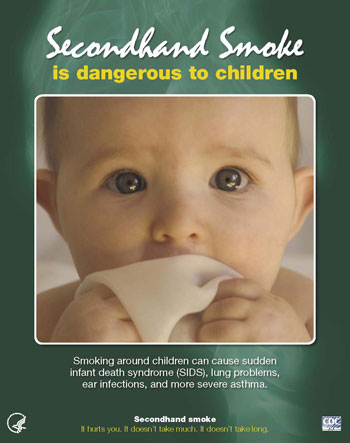
In a decision that could apply to many other child-custody and visitation cases, the Ohio 12th District Court of Appeals in Middletown, Ohio upheld the Warren court's decision forbidding anyone from smoking around Victoria Anderson, 9. Since she was a baby, she has lived with her great-grandmother in suburban Dayton, Ohio; she gets "parenting time" with her divorced mom and dad.
In April 2008, Victoria's paternal great-grandmother, Marilyn Anderson, objected to the child's mother, Racheal Hill, smoking around Victoria during visits. The child returned home "smelling of cigarette smoke as a result of Racheal smoking in her home and car," court records say.
Eight months later, the court ordered all parties to protect Victoria from second-hand smoke; the appeals court, which oversees an eight-county area, upheld the smoking ban Oct. 26.
Disputes over parental smoking have been cropping up in family-court cases nationwide, legal experts say, and the cases highlight two competing interests: A parent's right to smoke versus a child's right to breathe smoke-free air.
Courts appear to be deciding such clashes based on the "best interest of the child," rather than whose "rights" win out, Kansas lawyer Jeanette Igbenebor wrote in a 2002 article, "Smoking as A Factor in Child Custody Cases." The article recommends: "As a simple truism, parents who wish to retain custody of their children should not smoke in front of them."
Action on Smoking and Health, a non-smokers' rights group in Washington, D.C., says courts in at least 18 states have ruled that "subjecting a child to tobacco smoke is a factor which should be considered in deciding custody."
In the Warren County case, even with no evidence that Victoria suffers specific reactions or health issues from exposure to smoke, the court ruled that a smoking ban was in the child's best interest.
To reach that conclusion, the court did something unusual. It "took judicial notice" - without anyone presenting proof in court - of an "avalanche of authoritative scientific studies" that say second-hand smoking poses risks to children.
Reference: Court bans mom from smoking near child by Janice Morse (jmorse@enquirer.com), Cincinnati.com, 11/8/2009.
Read more...
Second-hand smoke poses risks to your children..
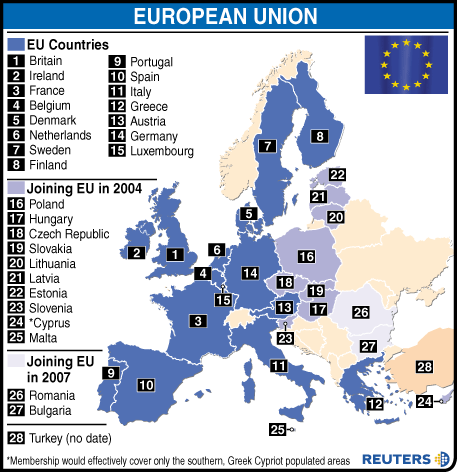
European Union - finance ministers will meet to agree on a minimum tax on tobacco and to eliminate loopholes..

This week (on November 11th) EU finance ministers will try to agree an increase in the minimum rates of excise duty on cigarettes and other tobacco products. The proposal under discussion would raise the minimum excise rate to €90 (135.04 USD) per 1,000 cigarettes, compared to €64 (96.03 USD) today. The legislation would also close loopholes that have allowed companies to market cigarettes as cigars and cigarillos, and some fine-cut tobacco as pipe tobacco. Tobacco companies have exploited these loopholes to benefit from lower tax rates applied to those products.
The European Commission proposed the changes in July 2008 to reduce the variations in the price of tobacco in different national markets. (European Commission is responsible for proposing legislation, implementing decisions, upholding the Union's treaties and the general day-to-day running of the Union.)
It said that these variations were a stimulus to illegal cross-border trade, as it was often cheaper for people to buy cigarettes that had been smuggled in from other EU countries than to buy those legally for sale. The Commission said that this trade undermined government attempts to wean people off smoking and helped to fund organised crime.
According to Commission figures, the amount of excise duty in 2008 per 1,000 cigarettes varied from €37.36 (56.06 USD) in Latvia to €249.99 (375.15 USD) in the UK. Excise as a percentage of total cost varied from 51.6% in Latvia to 77.6% in Slovakia. The UK government is believed to lose around £3 billion (€3.35bn) a year in tax revenue from tobacco smuggling. The Commission has estimated that 13% of all tobacco sold in the EU is sold outside the market where it is taxed.
The finance ministers failed in May to reach an agreement to raise minimum rates. Member states on the EU's eastern border were concerned that the move could encourage cross-border smuggling of cigarettes from Russia, Belarus, and Ukraine, where prices are much lower.
But diplomats said that these concerns had largely been addressed by a proposal from the Swedish presidency that Poland, Hungary, Slovakia, Romania, Bulgaria, Lithuania, Estonia, Latvia and Greece would be given until 1 January 2018 to apply the new rates, instead of the 1 January 2014 deadline for the rest of the EU. This is more generous than the extension proposed by the Commission, which had suggested that Poland, Hungary and Slovakia should apply the new rates from the start of 2015, while Romania, Bulgaria, Lithuania, Estonia and Latvia should be given until January 2016.
Diplomats said that discussions between governments were now focused on temporary restrictions that should be placed on cigarette sales to foreigners in the countries that would benefit from the January 1, 2018 deadline.
Some governments believe that caps on sales should be used to minimise the competitive advantage that countries with an extended deadline will enjoy. A compromise text, drawn up by the Swedish presidency and discussed by national ambassadors yesterday (4 November), would allow member states to charge people extra excise duty at the border if they try to bring back more than 300 cigarettes from a country benefiting from the extended deadline.
The draft legislation needs unanimous agreement before it can be adopted.
Reference: Closing the tobacco loopholes by Jim Brunsden, EuropeanVoice.com, 11/5/2009.
Read more...

Reynolds American in Talks to Buy Maker of Smoking-Cessation Products..

November 8, 2009 -
Tobacco giant in talks to buy a Swedish company which is known as Niconovum, company makes nicotine replacement therapy products nicotine-replacement therapies such as Zonnic pouch and Zonnic gum that are not currently sold here in the United States.
Niconovum says its products are designed to give people better control of their cravings.
Reynolds Is in Talks to Buy Maker of Smoking-Cessation Products by DAVID KESMODEL And VANESSA O'CONNELL, The Wall Street Journal, 11/9/2009.
Read more...
U.S. - November is Lung Cancer Awareness Month..
November 8, 2009 - Smoking is still the leading cause of preventable death and disease in the United States. Current or former cigarette smokers make up approximately 90% of patients with lung cancer. Lung cancer accounts for approximately 32% of cancer deaths in men and 25% in women. Of the 180,000 people diagnosed with lung cancer in the United States alone each year, 86% will die within 5 years of diagnosis. (Quit Smoking Stop - Lung Cancer - Smoking Related Facts)
More information from the U.S. Center for Disease Control (CDC) and Prevention..
November 19, 2009 -Great American Smokeout.. Great American Health Challenge.. To help raise awareness about smoking cessation, the American Cancer Society has scheduled the 28th annual Great American Smokeout for Thursday, November 19, to encourage smokers to quit for a day in hopes that some will quit for a lifetime.
Listing of lung cancer awareness and education events.




Read more...
Canadian survey - women unaware of all the dangers of smoking..
Click to enlarge: 
The survey, conducted by Angus Reid on behalf of nicotine replacement therapy brands Nicoderm and Nicoette, reveals the majority of Canadian women who smoke are not necessarily aware of the host of other effects smoking can have on their immediate and longer-term health. Eighty-three percent of female smokers say lung cancer was most strongly attributed to smoking, 62 percent say premature aging of skin, 61 percent say dental problems such as yellowing of teeth or tooth loss and 60 percent say heart disease.
Fewer than two in 10 female smokers surveyed were aware of the link between lighting up and increased risks of developing health issues such as infertility, early onset of menopause, menstrual irregularities, osteoporosis, baldness, premature grey hair, weight gain, hearing loss and incontinence.
Of the female smokers surveyed 78 percent say they tried to quit the habit two or more times. Sixty-nine percent cited health concerns as their primary reason for trying to quit, 14 percent said motivation by family, 8 percent say societal pressure, 6 percent say financial reasons and 5 percent say motivation by friends.
The survey of 1,061 adult female Canadian smokers or former smokers was conducted Oct. 20 to Oct. 23 has a margin of error of 3.1 percentage points.
Reference: Women smokers unaware of smoking impact, UPI.com, 11/5/2009.
Read more...


To Provide Public Awareness
Purpose
About Us
Contact Us
2008 HIGHLIGHTS
TOPIX PAPERS - 2008 & 2009..