
Sanford's communications director Ben Fox said Wednesday that the governor will carefully review the bill to raise the tax by 50 cents on a pack of cigarettes. His comments came after the Senate voted 41-1 to give the bill final approval. "We've repeatedly expressed grave concerns about raising the overall tax burden on South Carolinians without corresponding tax relief," Fox said.
South Carolina has the lowest state cigarette tax in the nation at 7 cents a pack. The national average is $1.41 a pack.
Most of the $136 million raised would go toward future Medicaid expenses. About $10 million would be set aside for smoking cessation and prevention and cancer research at the Hollings Cancer Center at the Medical University of South Carolina for lung cancer research. It also would give $1 million to marketing agriculture products.
Sanford is expected to veto the legislation, as he did two years ago. In May 2008 the House fell 20 votes short of the total needed to override a veto on a 50-cent increase. The same could happen this year. The House showed lukewarm support for a 50-cent increase that eventually passed by a voice vote April 20. Many in the House pushed for a 30-cent increase, so it's unclear if the House will have enough support to find the 83 members needed to override the expected veto.
But the prospects may have brightened with legislators weary of annual battles on the issue. "People are tired of dealing with that issue in the Legislature and want to get it behind them" Cooper said. The Senate's vote on Wednesday shows enough support to overturn a veto. Sen. Lee Bright, R-Roebuck, was the only senator to vote against the bill.
Kelly J. Davis, spokeswoman for the South Carolina Tobacco Collaborative, said advocates are trying to build more support. "Poll after poll over the years shows that the vast majority of South Carolinians would support a cigarette tax increase of $1 a pack," Davis said. "The public support is there for this legislation."
Research by the Campaign for Tobacco-Free Kids shows that a 50-cent cigarette tax increase would prevent 23,300 South Carolina children from becoming smokers and would prompt 12,800 adult smokers to quit, according to Davis.
Smoking has become more expensive around the nation, with the average smoker paying $5.28 a pack when taxes are included. South Carolina's average price would be $4.28 a pack with the increase. The federal tax last year jumped 62 cents a pack to $1.01.
If the increase becomes law, Missouri would then have the nation's lowest tax at 17 cents a pack. Rhode Island's tax is the highest at $3.46 per pack.
The Associated Press contributed to this report.
Reference: Senate passes cigarette-tax boost Measure goes to Sanford; veto is expected by Yvonne Wenger, The Post and Courier, 5/6/2010.
Related news briefs:
South Carolina - state senate could send 50-cent cigarette tax increase to governor soon..;
South Carolina - senators try to write bill on cigarette tax increase to override Governor Sanford's veto..;
South Carolina - increase in cigarette tax still NOT likely..;
South Carolina - cigarette tax, State Superintendent of Education Jim Rex speaks up..;
South Carolina - among the worst states in the nation in smoking prevention efforts..;
South Carolina - among the worst states in the nation in smoking prevention efforts..;
South Carolina - most residents support raising the tobacco tax..;
South Carolina - with Gov. Sanford still in office most likely no tobacco tax increase in 2010..;
South Carolina - low cigarette pricing, smuggling, higher insurance premiums, etc..;
Lexington County, South Carolina has a workplace smoking ban..;
South Carolina - governor disappears, maybe its time to slip through a cigarette tax..;
South Carolina - next legislative session starts June 16th..;
South Carolina - lawmakers may disappoint again on cigarette tax increase..;
SC tobacco tax increase - doubt exists maybe NOT this year..;
South Carolina - can we expect a tobacco tax increase this year??;
South Carolina a magnet for cigarette black market..;
South Carolina - legislators eager to pass cigarette tax increase - the odds are against them??;
South Carolina to spend NO money on tobacco prevention..;
South Carolina (SC) will NOT devote any resources to anti-smoking programs..;
In 2008 will the politicians do what's right for the State of South Carolina??;
South Carolina - Tobacco Tax Increase Killed - State House Fails to Override Governor's Veto..
Tobacco Tax Increase – What’s Wrong with South Carolina??
Read more...
South Carolina - tobacco tax increase bill goes to governor..

Romania - new strategy coming to cracking down on cigarette smuggling..

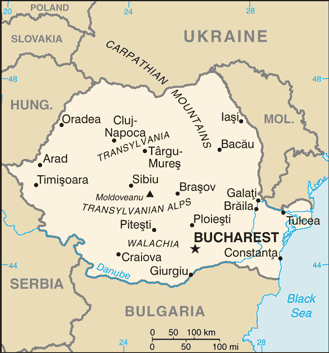
BAT, JTI and Philip Morris Romania firmly reject the idea of backing down from the local market, due to the latest increase of smuggling, and ask for dialogue with the authorities in the attempt to cut down on this phenomenon.
Directly related news brief:
Romania - cigarette smuggling decreased in March 2010..
The tobacco industry is one of the biggest state budget contributors. The three major companies provided the state with over EUR 2 billion in 2009, from VAT and other taxes.
Last year, the state confiscated more than 202 million smuggled cigarettes. One of three smoked cigarettes comes from smuggling; one of three cigarettes doesn’t pay state taxes.
The industry’s stakeholders took internal measures to fight smuggling. It seems these measures are not enough. Cigarette producers suggest the following measures in order to fight smuggling: Appointing an authority to coordinate the smuggling fight, preferably the National Customs Authority; Assigning resources for securing frontiers, especially those with the EU members; A better coordination between the fiscal and the monetary policy; Consolidating the industry-authority partnership.
Romania is not the only country facing this phenomenon. In the US, President Obama has recently signed a bill created (PACT) to stamp out tobacco smugglers, in an attempt to restore significant amounts of revenue lost because cigarette taxes are not being paid. In Ireland local Police cracks down on smugglers, as convictions for tobacco smuggling are up 100% at the end of March 2010. In Switzerland the World Health Organisation’s plan against tobacco smuggling is stalled over ways to trace products, duty free sales etc. The program would “Implement carton tracking in risk markets.” Examples on efforts to cut down smuggling could continue.
In Romania, in March 2010, the Official Monitor announced a new national strategy to fight cigarettes smuggling was to be implemented in 45 days. The Government formed a Work Group that would prepare the national strategic plan for fighting the illegal cigarettes traffic in the next two years. This order was also published in the Official Monitor. According to this document, ANAF will coordinate the new structure, which will include members of the National Customs Authority, the Financial Guard and of the police.
Fight against smuggling should go on with determination, as Romania loses EUR 1 bln every year due to this phenomenon. Romania needs that billion. With a fragile economic balance, Romania has gone further into a financial crisis due to the recession. One of the result was the country had to borrow more and more from the IMF. The story continues to get impressive media coverage whenever Romania has to pay a new part of its debt.
Reference: Cracking down cigarette smuggling would get Romania EUR 1 bln. Romania needs that bln! by: Nine oClock, Nineoclock.ro, 5/4/2010.
Some Romania related news briefs:
Romania - cigarette smuggling decreased in March 2010..;
Romania - PMI suspends cigarette production for two-weeks starting February 19th..;
Romania to increase excise tax on cigarettes April 1, 2009..;
Congratulations are in order: Netherlands, Romania & Alberta..;
Read more...

Netherlands - small bars can continue to ignore smoking ban..


The smoking ban, aimed at protecting employees' health, came into force in July 2008. Small bars, which are often unable to create the required separate zones for smokers and non-smokers, increasingly allow their clients to smoke indoors. The Supreme Court decided in April that a number of convicted owners who broke the smoking law should not be acquitted. They will have to re-appear before the court in June.
Figures collected by opinion pollster Intraval show that 41 percent of bar owners are flaunting the no-smoking law, and the percentage is increasing steadily. Bars are the exception, as hotels, fast food shops, restaurants and sports clubs are all obeying the rules.
The Dutch Food Safety Authority is checking whether patrons are allowed to smoke inside bars. The bar owner is cautioned twice and, if the smoking continues, the authority can impose successive fines rising from an initial 300 euros (385.35 USD) to 2,400 euros (3,082.91 USD).
Reference: Dutch minister admits smoking ban is partial failure, © Radio Netherlands Worldwide, 5/4/2010.
Netherlands - related news briefs:
Dutch government will change law to keep bars smoke free..;
Netherlands - lifted smoking ban for bars with no employees..;
Holland - smoking ban temporarily halted for smaller cafes run by their owners alone..;
Netherlands - spot checks on smoking in small cafes suspended temporarily..;
Dutch bar owners without staff when victory against smoking ban..;
Netherlands - Marijuana /Tobacco Cigarettes - Confusion..;
Netherlands - small bars/cafes with no staff could be exempt from smoking ban..;
Court spares small Dutch cafe over smoking ban..;
Netherlands - 1st court case for flouting smoking ban..;
Netherlands - ban on smoking in bars and restaurants NOT enforced..; Netherlands - ban on smoking in bars and restaurants NOT enforced..; Netherlands the smoking ban must be enforced - Ab Klink, Health Minister...;
Congratulations are in order: Netherlands, Romania & Alberta...
Read more...

World NO Tobacco Day, May 31, 2010..

In February, WHO chief Margaret Chan said that developing countries were the "new frontier" for tobacco marketing. "If Big Tobacco is in retreat in some parts of the world, it is on the march in others," she said in a speech on the fifth anniversary of an international convention on tobacco control. "In these countries as elsewhere, girls and women are a market with attractive and lucrative growth potential, and they are likewise being targeted," Chan said. In developed countries, tobacco companies have seen their marketing restricted or banned and sales are falling as public health campaigns and tight rules on smoking in public places hit profits. (Tobacco use in poor countries on the rise, says WHO chief, JamaicaObserver.com, 2/27/2010)
Women comprise about 20% of the world's more than 1 billion smokers. However, the epidemic of tobacco use among women is increasing in some countries. Women are a major target of opportunity for the tobacco industry, which needs to recruit new users to replace the nearly half of current users who will die prematurely from tobacco-related diseases.
World No Tobacco Day 2010 Posters..
Reference: World No Tobacco Day 2010 Theme: Gender and tobacco with an emphasis on marketing to women, WHO, 12/19/2009.
World NO Tobacco Day - May 31, 2009 - GET INVOLVED..
WHO World NO Tobacco Day 2008 - Tobacco Free Youth..
Read more...
Bangladesh - tobacco companies targeting women, also other developing countries..

"These are very ruthless advertisements," said Saifuddin, an associate professor at Bangladesh's National Hospital for Chest Diseases.
The promotion is being linked to an alarming rise in tobacco use in the impoverished South Asian country, particularly among women and the young -- a trend repeated across many developing countries, anti-tobacco groups say.
The World Health Organisation (WHO) warns that tobacco companies are targeting women in developing countries as a new growth market and Dhaka-based doctors treating lung diseases report they are seeing more female patients. Around 28 percent of adult Bangladeshi women now use tobacco, according to the latest WHO survey, and 43 percent of the adult population -- or 41 million people -- use tobacco in some form, up from 37 percent in 2004.
"(Tobacco use) has become an epidemic among rural women. It's a very serious health issue," a government advisor on health, Syed Mudasser Ali, told AFP, adding that anti-smoking laws were poorly enforced. Tobacco advertising was banned in Bangladesh in 2005, so the advertisements are usually fly-posters that do not specify the company behind the message. "Only a negligible number of people have been fined for breaching tobacco laws over the last few years," Ali said.
Officially 57,000 people die in Bangladesh of tobacco use annually, but that figure was likely a "huge underestimate".
The country fits a pattern emerging across the region of rising rates of female tobacco use, particularly in Southeast Asian countries such as Indonesia, the Philippines and Cambodia. This rise is largely because more Asian women are entering the workforce, have disposable income and see smoking as "modern and liberated," said doctor Mary Assunta, director of the International Tobacco Control Project.
"I've seen tobacco companies' marketing campaigns on my university campus and in residential dormitories," said one 25-year-old Bangladeshi female smoker who used to smoke a pack a day but is trying to quit on her doctor's advice. "They approach students with a questionnaire and ask them to fill it in to win T-shirts or lighters," she said, adding that she started smoking as her friends in class at Dhaka University all smoked.
Tobacco companies are encouraging the trend, viewing women in developing countries as their "largest unexploited market", according to the WHO -- which has chosen the theme of tobacco marketing to women for 2010 No Tobacco Day on May 31.
"We see clear marketing strategies targeting women in Asia such as lipstick-type cigarette packs in Indonesia, Malaysia and Laos," said Assunta. The pretty, small packets of ultra-thin cigarettes are designed to be something a woman would like to carry around with her at all times, just like her favourite lipstick. "These fit easily into women’s purses. Cigarette packs are coloured pink and there are even fruit flavoured cigarettes," Assunta said.
Tobacco companies in Bangladesh contacted by AFP all denied using illegal fly-posters or point of sales marketing, which the ministry of health hoped to stop with an amended version of the 2005 law.
The market is dominated by volume leader Dhaka Tobacco, which has a 40-percent share and monopolises low-end sales. British American Tobacco, which makes the popular Pall Mall and John Player Gold Leaf cigarettes, dominates the 140 million dollar premium tobacco market with its Benson and Hedges brand.
"BAT Bangladesh markets cigarettes in Bangladesh in full compliance of all applicable laws, rules, and regulations," company spokesman Shamim Zahedy told AFP, adding that their marketing only targeted existing smokers.
In developed countries, tobacco companies have seen their marketing restricted or banned and sales are falling as public health campaigns and tight rules on smoking in public places hit profits. As a result, developing markets are becoming "increasingly important" for transnational companies such as BAT and Philip Morris International -- which is aggressively expanding in the Philippines and Indonesia, said Assunta.
"Tobacco companies are definitely putting effort into consolidating their positions in low income countries," she said.
Even Bangladesh, where nearly 40 percent of the population of 144 million lives on less than a dollar a day, is a lucrative tobacco market, with annual sales estimated at around one billion dollars.
In Bangladesh's remote, rural areas, the health risks of tobacco use are not always well known, Bennoor said, making poor farmers -- particularly women who are generally less well educated -- an easy target. "It is a vicious cycle: people who are poor are more vulnerable to tobacco addiction, and then they are smoking, and it makes them poorer," he said.
For Bangladesh's rural poor, approximately 4.5 percent of household expenditure goes on tobacco, according to WHO estimates. In some areas, there have been signs of a fightback against the advertising, however.
At Dhaka University, one fly-poster claiming "smoking makes you smarter and more manly" prompted a student-run counter-campaign. "We are smart and we don't smoke," said handmade posters plastered over the original adverts on the university's city-center campus.
Reference: Tobacco firms take aim at Bangladeshi, Asian women by Cat Barton/ AFP, MySinchew.com. 4/29/2010.
Bangladesh - related news brief:
Bangladesh - tax increase on tobacco will be win-win situation..;
Bangladesh - consuming chewing tobacco is almost double than smoking tobacco..;
Bangladesh - nearly 70 percent of current smokers are planning to quit..;
Bangladesh - tobacco use among adults reaches 43.3 percent..;
Bangladesh - FCTC overtaxation hurts tobacco industry country depends on..;
Bangladeshi government will increase taxes on tobacco products..;
Marlboro to be Marketed in Bangladesh - One of the Poorest and Densely Populated Countries in the World..
Read more...


To Provide Public Awareness
Purpose
About Us
Contact Us
2008 HIGHLIGHTS
TOPIX PAPERS - 2008 & 2009..