
Background: Mexican lawmakers voted in February 2008 to ban smoking in bars, restaurants and other enclosed public spaces across the country, which counts some 65,000 cigarette-related deaths each year. (Mexico to ban smoking in eateries, public spaces, Reporting by Miguel Angel Gutierrez; Writing by Catherine Bremer, editing by Patricia Zengerle, Reuters, 2/27/2008)
Six establishments were affected by Federal Commission for the Protection of Sanitary Risks (Cofepris) raids on Sunday, May 30. The popular “Chess” nightclub on Lopez Mateos was temporarily closed as well as parts of the Casino Gran Nevada and the bar area of the “La Matera” restaurant. Two Oxxo’s and one Seven-Eleven in the city center were also fined.
The General Law for Tobacco Control will prohibit smoking in closed public spaces and violations will be punished with up to 36 hours of jail time. In addition, fines up to the equivalent of 100 to 10,000 minimum wage days [a common way of calculating fines in Mexico] and the temporary or permanent closing of businesses violating the law will be applied. For repeat offenders, the fine can go up to 1 million pesos.
The law also establishes new regulations for tobacco-related advertising, which from now on may only appear in publications geared toward adults or in places where only adults are allowed to enter, such as bars and nightclubs. (Mexico to Go Tobacco Free by Maegan La Mala, Vivirlatino.com, 2/26/2008.
Although some business owners complained about the economic impact of such closures, the laws are still poorly enforced, and many bars and restaurants do not have separate smoking areas.
Speaking on World No Tobacco Day, May 31st council officials said 3,200 deaths a year are caused by tobacco-related causes. Meanwhile, figures from the Global Adult Tobacco Survey show Mexico to have 10.9 million smokers, or 15.9 percent of the population – 8.1 million of which are men and 2.8 million women.
Reference: 16% of Mexicans hooked on tobacco, guadalajarareporter.com, 6/4/2010.
Read more...
Mexico - enforcement of smoking ban prior to World No Tobacco Day..
Mexico - results of GATS released..

Highlights from the GATS Mexico survey are as follows:
* 15.9 percent (10.9 million adults) currently smoke; 24.8 percent of men smoke, while 7.8 percent of women smoke
* 72.1 percent of current smokers are interested in quitting smoking
* 19.7 percent (3.8 million adult workers) were exposed to tobacco smoke in enclosed areas at their workplaces in the past month; 17.3 percent of Mexicans were exposed to smoke at home in the past month
* 50.6 percent adults noticed advertisements for cigarettes
* 84.5 percent of the smokers noticed health warnings on cigarette packages and 32.7 percent of current smokers thought about quitting because of warning labels.
More information: GATS: Fact Sheets: Mexico
Thirteen countries besides Mexico participated in the first round of GATS: Bangladesh, Brazil, China, Egypt, India, Philippines, Poland, Russian Federation, Thailand, Turkey, Ukraine, Uruguay and Vietnam. Results from GATS will assist Mexico and the other participating countries that will soon be releasing results. Results will enable countries to translate data into action through improved policies and programs.
Funding for GATS is provided by the Bloomberg Initiative to Reduce Tobacco Use..
Reference: Media Statement: Statement Regarding Release of Global Adult Tobacco Survey Results by Mexico, CDC Online Newsroom, 5/31/2010.
Read more...
FDA Regulation of Tobacco - what's happening..

FDA Regulation of Tobacco
One Year Later:
What has been accomplished?
Where are we going?
Click below to view slide presentation:
Slide Presentation..
(the file is in Adobe Systems Portable Document Format (PDF), approximately one megabyte in size)
Malta - graphic warnings on cigarette packs by the middle of next year..
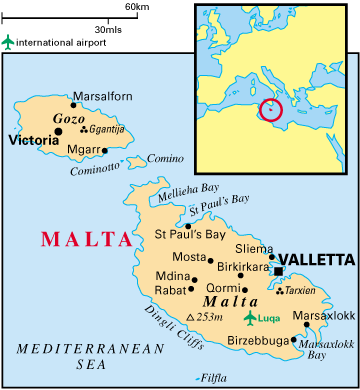

To comply with Article 11 of this treaty Malta will have images showing the effects of smoking printed on cigarette packs sold in local shops from the middle of next year. (Article 11 of the WHO Framework Convention on Tobacco Control (WHO FCTC) requires Parties to the Convention to implement large, rotating health warnings on all tobacco product packaging and labelling.)
The warnings will underline the increased risks of cardiovascular disease, cancer, infertility and impotence among smokers, and the harm done to unborn babies and children. Three in every four Europeans have said they support picture health warnings on cigarette packs, according to a Eurobarometer survey.
 Speaking at a press conference to mark No Tobacco Day yesterday, May 31, 2010 the Malta Health Promotion and Disease Prevention Department head Dr. Charmaine Gauci said there were 372 deaths attributable to smoking in 2008 (population of Malta - 411,950 in 2008).
 Despite the dangers, a fifth of respondents in the last Health Interview Survey, carried out in Malta in 2008, said they had smoked daily for at least a year. Smoking was most common among 45- to 54-year-olds.
A quarter of those interviewed, aged 18 and over, said they were still exposed to second-hand smoke, either at home or outside, despite a ban on smoking in public places introduced in 2004. Health Minister Joe Cassar said smoking in bars and other public places was a sign of disrespect towards others. "We do not need to enforce any law if we all showed respect," he said.
Dr Cassar said 1.3 million [billion] people around the world smoked and every year 4.9 million people died as a result. "Half of smokers risk dying because of smoking-related illness," he said.
He said health professionals were duty-bound to inform people about the dangers associated with smoking. Research had shown that even a short intervention by health professionals could be very effective in helping people stop smoking. Dr Cassar said that, apart from one-to-one help, professionals could also help on a community level by preparing plans in support of smoking regulations in public places and help smokers kick the habit. "Professionals should serve as a model and the Health Department is helping them to stop smoking," he said. Health care workers were also given courses allowing them to help others quit smoking. He said restrictions on smoking in public places had helped more people quit smoking, and other countries were adopting similar laws.
The Health Department yesterday announced the three winners of its biannual Quit And Win Competition. Joseph Magro, 34, Reuben Hayman, 23, and Claudine Psaila, 41, managed to stop smoking.
Reference: Cigarette packets to carry shocking images next year, Cynthia Busuttil, TimesofMalta.com, 6/1/2010.
Malta - related news brief:
Malta - e-cigarettes fall under smoking ban..;
Malta - full indoors smoking ban by 2013..;
Malta - adults smoking less but girls are smoking more..;
Malta - April 2004 Smoking Ban A Success..
Read more...
Lebanon - some trying to prevent youth from a life of nicotine addiction..
Lebanon - Coat-of_Arms..
Background: TFI association's main aims is to prevent the young Lebanese from the first cigarette. The main goal of this NGO (non-government organization) created by the family of Antoine Keyrouz, a lawyer who passed away in June 1999 because of a lung cancer, is to protect the young generation from tobacco devastation. This association, which includes businessmen and women, doctors, lawyers, psychologists, and journalists, has just been rewarded by the WHO for its struggle against smoking in the Middle East.Tobacco Free Initiative: because the first cigarette is the most dangerous by Élodie Morel, iloubnan.info, 9/14/2008.
“We are calling for a 100 percent ban on smoking in public,” said Rania Baroud, a former presenter with Future Television, and the vice-president of TFI. She dismissed suggestions to introduce non-smoking areas in bars and restaurants, saying that only a comprehensive ban would protect consumers from the dangers of passive smoking. “We don’t want smoking and non-smoking areas because they are totally ineffective,” she said. “After two minutes of a cigarette being lit, its ultrafine particles are everywhere. [Having designated smoking areas] is like have a section of a swimming pool where people are allowed to urinate.”
TFI’s anniversary comes after World No Tobacco Day on Monday, May 31st and the launch of a media campaign by the Health Ministry urging public support for a smoking ban.
Lebanon’s parliamentary Administration and Justice Committee is currently studying a draft law banning smoking in public, but activists say tobacco industry officials are stalling its adoption. The law seeks a ban on tobacco advertisement, promotion and sponsorship, graphic pictorial warnings on the pack of cigarettes and a comprehensive smoking ban in public.
Around 3,500 Lebanese die every year from tobacco exposure, which causes more deaths than tuberculosis, pneumonia, HIV/AIDS and car accidents combined, the Health Ministry’s National Tobacco Control Program has said. The numbers of smokers here is among the highest in the world: 45 percent of males and 34 percent of females are said to be regular users.
Some 75 percent of children are thought to be subject to second-hand smoke exposure, increasing their chances of suffering from asthma, chronic bronchitis, eye and ear infections, fatal lung and respiratory illnesses and cot death.
Lebanon signed the World Health Organization’s Framework Convention on Tobacco Control in 2005, and although it was ratified automatically, very little has been done to enforce it. So little has been done, in fact, that Lebanon risks failing to meet the convention’s obligations. It has already missed the deadline for Article 11, which states that within three years of adopting the convention, countries must implement effective health warning labels on tobacco products. Article 8, which obligates Lebanon to “strive to provide universal protection” within five years, has also not been implemented.
Weak regulation has given the tobacco industry in Lebanon a free reign to advertise and sponsor events, targeting mostly young people. This, coupled with almost non-existent taxation, has given Lebanon one of the highest youth smoking rates in the world. “Tobacco companies advertise by suggesting they offer freedom. But really what they want is for you to be addicted until the end of your life,” said Nadine Keyrouz, who founded TFI after her own father, a life-long smoker, died of lung cancer.
“Lebanon is the only country in the Middle East that still allows tobacco advertising and sponsorship,” Baroud said. She called for the introduction of pictorial warnings on the front and back of all tobacco products.
“They have been proven to be effective in encouraging smokers to quit,” she said.
She also said increased taxes on tobacco products would help dissuade youngsters from taking up smoking. “It’s unacceptable and unbelievable that 60 percent of Lebanese youth smoke, compared to only 6 percent in Great Britain,” she said. Lebanon also has the highest rates of women smokers in the world.
“If the current tobacco control policy status quo remains, [we estimate] that 150,000 children and 350,000 adults alive today will die prematurely in Lebanon because of smoking “ or second-hand smoking-related illnesses, Dr. Gregory Connolly of the Harvard School of Public Health said in a recent memo by AUB’s Tobacco Control Research Group (American University of Beirut Tobacco Control Research Group (AUB -TCRG).
References: Ten years on, tobacco initiative still lacking
by Dalila Mahdawi, Daily Star staff, 6/5/2010; Health Ministry launches campaign urging support for smoking ban by Dalila Mahdawi, Daily Star staff, 6/1/2010.
Lebanon - some related news briefs:
Lebanon - marketing tobacco products encouraged people to smoke with CNN Video..;
Lebanon - concerned citizens trying to introduce tobacco controls..;
Lebanon - a smokers paradise..;
BAT Middle East - conference on the illicit tobacco trade..;
American University Beirut (AUB) Lebanon and Virginia Commonwealth University (VCU) awarded $2.8 million from U.S. NCI to study toxin exposure and hea...;
Read more...


To Provide Public Awareness
Purpose
About Us
Contact Us
2008 HIGHLIGHTS
TOPIX PAPERS - 2008 & 2009..