
Read more...
WHO Report on the Global Tobacco Epidemic 2008..
Vindicating its move into smokeless tobacco products...
February 7, 2008 - Vindicating its move into smokeless tobacco products, strong sales of moist snuff helped offset lower cigarette volumes and higher settlement payments at Reynolds American (RAI) for 2007. Conwood has continued to post volume, earnings and margin growth since its acquisition in May 2006. During its first full year as a member of the RAI family, Conwood continued to lead growth in the moist-snuff category, and gained 0.9 share points in 2007 – with a full-year share of 26.0 percent. That growth was driven by an additional gain of 1.7 share points on Grizzly, which had a full year share of shipments of 21.1 percent. Despite higher pricing and heavy competition that included a number of new market entrants, Grizzly, the moist snuff deep-discount entry, grew at more than twice the industry rate. In 2007, Grizzly captured well over 40 percent of all volume growth in the moist-snuff category. Conwood’s leading premium entry – Kodiak – experienced volume and share declines last year in the face of heavy promotion by competitive brands. Camel Snus, represents the brand’s first foray into a new category: smoke-free tobacco products that are also spitless. Camel Snus provides adults with a discreet way to enjoy tobacco pleasure. In 2007, R.J. Reynolds expanded its test of Camel Snus to a total of eight markets, and the company plans to expand into additional markets in the second quarter of 2008. In the only cigarette growth segment menthols: Kool, R.J. Reynolds’ menthol growth brand, led by the growing popularity of Kool’s XL styles. Kool XL, a smoother, wider cigarette, was introduced in 2006 in 27 states. Last year, the company expanded Kool XL nationally, along with a new, milder style called XL Blue. That helped Kool maintain its overall market share of 3.1 percent despite intense competition in the menthol market and the above-average price increases we’ve taken to further strengthen Kool’s profitability.” The 3rd growth brand, Pall Mall, continues to gain share on the strength of its positioning as a great product at a great price. Pall Mall remained focused on volume and margin growth in 2007 as the brand added another 0.3 share points, for a full-year share of 2.1 percent. Filippe Goossens of Credit Suisse noted that cigarette volumes declined faster than expected, and growth rates for the smokeless segment decelerated.
Read more...
Further evidence that tobacco advertising in stores undermines attempts to stop smoking.. Professor Janet Hoek of Massey University...
February 7, 2008 - Further evidence that tobacco advertising in stores undermines attempts to stop smoking.. Professor Janet Hoek of Massey University, who led the study, said, "A strong theme of the 20 participants' views was that prohibiting retail displays of tobacco would protect young people." Nearly a third of smokers in the study agreed that removing the displays would help them to quit. There is international evidence that retail tobacco displays and other forms of retail marketing increase susceptibility to smoking, the commencement of smoking by children, and the establishment in children's minds of smoking as a "normal" behaviour. Australian research published last year found that 40 per cent of smokers who were trying to stop or reduce smoking were tempted to buy a pack when they saw a retail display. Click on image to enlarge.. - Some related news briefs: Youth exposed to smokeless tobacco ads despite settlement…, Ireland to ban tobacco displays.., an Nova Scotia (NS) - ban on point of sale tobacco advertising.. Cigarette retail marketing practices increase the likelihood of youth smoking.. . Click on image to enlarge..
Read more...

Ban on smoking in cars when children are present..
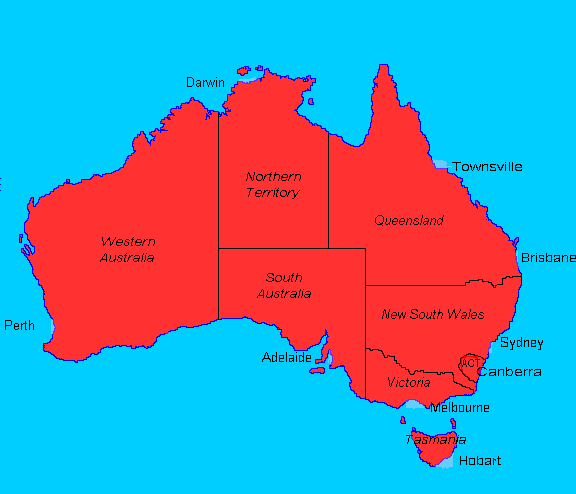
February 7, 2008 - Ban on smoking in cars when children are present.. Premier John Brumby told Parliament yesterday that he would consider introducing such a ban on smoking in cars when children are present. — long sought by anti-smoking campaigners. (John Mansfield Brumby, Australian Labor Party politician, is the 45th Premier of Victoria, assuming office in July 2007.) He was responding to Nationals leader Peter Ryan, who asked whether the Government would take up the rural party's suggestion to ban cigarette smoking in motor vehicles while a child was present. "As part of developing that strategy, the Government will consider all of the relevant views from stakeholders and interested parties, and the views which the leader of the National Party has offered up today would be considered as part of that discussion," Mr Brumby said. Quit Victoria says surveys of smokers have found that 90% would support such a ban. (The organization Quit Victoria is dedicated to eliminating the pain, illness and suffering caused by tobacco.) Some related news briefs: In 2008 will the politicians do what's right for the State of South Carolina??, N.S. Bans Smoking in Cars with Kids.. and California bans smoking in cars with kid. Click on image to enlarge..
Read more...

With less restrains PMI looks to the future..


To Provide Public Awareness
Purpose
About Us
Contact Us
2008 HIGHLIGHTS
TOPIX PAPERS - 2008 & 2009..