
"I'd say the most surprising [finding] is that the proportion who ever used [hookahs] is every bit as common as cigarette use," said Dr. Brian Primack, lead author. Perhaps more troublesome, though, was the finding that 35.4 percent of those who had smoked tobacco in a hookah had never smoked a cigarette.
Primack said: "[Hookahs] are reaching a group of young people who otherwise would have been nicotine- and tobacco-naive." 78.8 percent of the surveyed group that said it has smoked water pipes in the past year thought the devices were less addictive than cigarettes.
Paper: Primack BA, Sidani J, Agarwal AA, Shadel WG, Donny EC, Eissenberg TE
Prevalence of and Associations with Waterpipe Tobacco Smoking among U.S. University Students. Ann Behav Med 2008 Aug 22, ABSTRACT.
Reference: UPMC study shows smoking water pipes is popular with college crowd by Pohla Smith, Pittsburgh Post-Gazette, 9/5/2008.
Related news briefs: Hookahs on college campuses becoming growing public health issue.. Other related news briefs: Some related news briefs: April 8, 2008, March 6, 2008, March 4, 2008, December 29, 2007, December 28, 2007, December 27, 2007, December 19, 2007, November 7, 2007 and October 25, 2007.
Read more...
Hookah smoking popular among college crowd..
Boston To Ban Drugstore Tobacco Sales..

The Boston Health Commission approved the new tobacco control rules 4-0 after an hour long hearing. The public will now get to comment, both in writing and at a public hearing that will be scheduled later.
The campaign is to further reduce cigarette smoking in the Boston area, especially among young people and the poor. Just like San Francisco, the city decided to target sales at the 74 pharmacies in Boston because stocking tobacco, the leading cause of preventable death in the U.S., is incompatible with the mission of a drug store. The measure are opposed by drug store chains and tobacco companies, which argue the rules unfairly limit businesses' right to sell a legal product.
Reference: Cigarette sales ban receives initial okay from Boston board by Stephen Smith and David Abel, Boston Globe Staff, 9/5/2008.
Click on image to enlarge..
Read more...
Altria in advanced talks to buy UST, Inc..

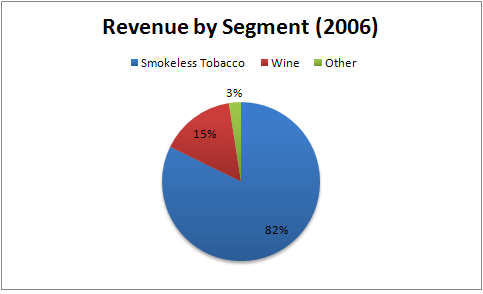
Back in February 4, 2004 the buyout was predicted: With organic (internal) development in the smokeless tobacco arena failing look for Philip Morris USA to expand through acquisitions.. Then the following day Altria (Philip Morris USA) - UST Deal Debate - Analysts differ on possible acquisition of smokeless tobacco company..
Reference: Altria in advance talks to buy UST, Inc.,
** - Altria owns approximately 28.5% of SABMiller (South African Breweries - Miller) plc.
Read more...


Cigarette Graphic Warnings Most Cover Most of Package..

Melodie Tilson, an expert in tobacco packaging and the director of policy for the Non-Smokers' Rights Association, said this is the most important finding. "What really stood out is going from 90 percent to 100 percent made a huge difference," said Tilson, characterizing the move to plain packaging and "eliminating the ability of the industry to promote smoking" as the "logical next step in tobacco control." André Calantzopoulos, the Chief Operating Officer of Philip Morris International (PMI), has stated that PMI is strongly opposed to generic packaging. (London, Tobacco Conference, 6/27/2008 - TW)
These results build on research released earlier this year, conducted by Environics on behalf of Health Canada, which found that the current graphic health warnings on cigarette packages covering half the pack are failing to encourage the majority of smokers to quit. (
Reference: Cigarette packs need to have horrific graphics to deter teens: research by Sarah Schmidt, Canwest News Service, 9/3/2008.
Countries which have picture based cigarette health warnings from
Also, from the Globalink Multimedia Center: World Tobacco-Control Image Database.
Some related news briefs: Britain to put picture warnings on ALL tobacco products.. and Horror photos go on New Zealand cigarette packs...
Click on image to enlarge.. TobaccoWatch.org
Read more...
Canada - Introduction of Tobacco Stamp to combat contraband ..

Trafficking in illegal tobacco provides cheap cigarettes, which encourages smoking, discourage quitting, increase average daily consumption, prompts relapse, and encourage youth initiation. Tobacco smuggling undermines the potential effectiveness of higher tobacco taxes reducing government revenues and encouraging adults to continue smoke and children to start smoking cigarettes. The availability of low-cost illegal cigarettes has particular implications for vulnerable populations such as young people and the economically disadvantaged. The Royal Canadian Mounted Police in April, 2008 said the underground cigarette industry costs the federal government as much as $2 billion in lost tax revenue per year.
A recent report, Contraband Cigarettes in Ontario by the Ontario Tobacco Research Unit finds that almost one-third of cigarettes currently purchased in Ontario are illegal. The Physicians for a Smoke-free Canada has shown that the contraband cigarette problem is most extensive in Ontario and Quebec. A private study by Imperial Tobacco has estimated that these two provinces account for 96.5% of all contraband purchases in Canada. Income from contraband tobacco can be reinvested to support other crime activities, to finance drug trafficking in Canada and to purchase illegal weapons.
A previous legislative response to the proliferation of contraband tobacco in Canada was to reduce taxes on legal tobacco in order to lower the price of cigarettes and thus discourage contraband production and distribution. - A Very Strange Move..
References: Revenue agency introduces new tobacco stamp to combat contraband, The Canadian Press, 9/4/2008; New security stamp aims to extinguish contraband tobacco sales, CBC News, 9/4/2008; Letter to Prime Minister Harper on Contraband Tobacco, Canadian Center for Addiction and Mental Health, 1/24/2008 and Contraband tobacco in Canada, BizAims.com, 7/30/2008.
Related news brief:Canada tobacco firms admit aiding smuggling..
Read more...


To Provide Public Awareness
Purpose
About Us
Contact Us
2008 HIGHLIGHTS
TOPIX PAPERS - 2008 & 2009..