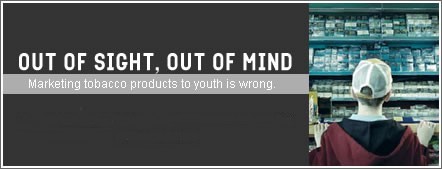
While cigarettes are still sold, they have largely disappeared from view — an effort by the nation’s provincial governments to discourage smoking among young people and help adults quit. “The principle is indeed out of sight, out of mind,” said Rob Cunningham, senior policy analyst with the Canadian Cancer Society.
“In convenience stores in the United States, we are bombarded with tobacco branding images,” said Paul Billings, vice president for national policy and advocacy at the American Lung Association in Washington. “These measures to reduce the attractiveness and reduce the availability of tobacco products do have a positive impact on reducing tobacco use.”
Matthew Myers, president of the Campaign for Tobacco-Free Kids: The new anti-smoking law passed by the U.S. Congress this year gives the federal Food and Drug Administration the authority to minimize tobacco-marketing tools that may affect consumption of the product, particularly by youths. “Much of the rest of the world is ahead of us in taking steps to minimize exposure to tobacco marketing,” he said. “All of the issues concerning marketing and displays in convenience stores are appropriate for FDA’s consideration.” (Family Smoking Prevention and Tobacco Control Act..
Concealing cigarettes ends a subtle but powerful form of advertising, said Michael Perley, director of the Ontario Campaign for Action on Tobacco. Perley: “If you have this product next to the candy, the gum, pop and newspapers in every store on every corner in every city and town in the province, young people wonder how can it be harmful — because it’s everywhere. Removing that message in large part is extremely important.”
The “out-of-sight” laws are Canada’s latest measure in the battle against smoking, a fight that has included bans on smoking in public places and graphic warnings — with color pictures of diseased hearts and lungs — on cigarette packs.
In May 2008 Ontario and Quebec (Ontario most populous province (roughly 40% of the population, Quebec, the second most populous province) required stores to put tobacco products out of sight, either in drawers or behind wall coverings that conceal cigarettes, which has prompted many convenience stores to install cabinets with solid doors. The other provinces and territories either already had similar bans or have since put restrictions in place — most recently this year in New Brunswick and Yukon. The last province to act is Newfoundland and Labrador, whose ban takes effect January 1, 2010.
Perley said that despite anti-smoking campaigns aimed at young people, the presence of a wall of cigarettes behind a convenience store cashier was a powerful counter-message from the tobacco industry. He said researchers found that many children who did not smoke and had no interest in it could name brands and colors.
“This is an audience that’s susceptible, that is aware, that is exposed to it in that (convenience store) setting frequently, multiple times a week,” Perley said. “And whether they smoke or not, the groundwork is laid when the time for possible experimentation comes along.”
Perley: Adults trying to quit smoking also found that seeing cigarette packs was a strong trigger either to keep smoking or restart the habit.
Canada’s federal health agency, Health Canada, has not evaluated how well the display bans are working.
Health Canada’s annual Canadian Tobacco Use Monitoring Survey shows that the nation’s smoking rate for the most at-risk group, those 15 to 24 years old, has dropped from 29 percent in 2000 to 21 percent in 2008.
Canada’s largest cigarette maker, Imperial Tobacco Canada, has seen no drop in sales since the display bans, according to spokesman Eric Gagnon. “It’s not preventing individuals from smoking,” he said. “If you are a smoker, you know the products are there.”
But for Canada’s convenience stores, which sell 86 percent of cigarettes in the country (drug stores and food stores are prohibited from selling tobacco products), the display ban has proved devastating. Convenience stores used to be paid by the tobacco companies for placing their products in prominent places and for introducing new brands to customers, and that money is now gone, said Dave Bryans, president of the Canadian Convenience Stores Association.
In Ontario alone, almost 9 percent of the province’s convenience stores (765 outlets) closed last year because of the retail display ban, he said. “We predict that 30 percent of all small stores will be gone in three years,” Bryans said.
Bryans: Health advocates, he said, ignored convenience stores’ concerns that the cost of complying with the ban were high and that sales clerks face additional dangers by having to turn their backs to customers to search for unfamiliar brands. “It hasn’t worked, it doesn’t work, and it won’t work” in cutting the smoking rate."
Canada is among a handful of countries restricting point-of-sale displays of cigarettes. Iceland imposed a ban in 2001 and Thailand did so in 2005. Ireland enacted a ban in July, and the United Kingdom is considering one. “We’re going to see more countries do this,” Cunningham predicted. “It’s the right thing to do.” Such as Norway strict tobacco display ban by October 2009...
The World Health Organization supports a display ban, as does the international tobacco control treaty (Framework Convention on Tobacco Control (FCTC)) signed by nations that include Canada and the United States (though the U.S. Congress has not yet been sent the treaty for approval).
Reference: In Canada, cigarettes have gone into hiding by James R. Carroll, Louisville Courier-Journal, 9/16/2009.
Read more...
Canada - cigarettes have disappeared from stores, just about...
Namibia - parliament considers tobacco products control bill..

Hotels, restaurants or coffee shops would also fall under the definition of “pubic place”, although the Bill does not mention these details. As usual, regulations will be drawn up once the Bill is passed, and then public spaces will be more clearly defined.
Introducing the Bill yesterday afternoon, Minister Kamwi told the House that a 2004 study undertaken in Namibia, showed that 17 per cent of school children between the ages of 10 and 12 had admitted they had a smoking experience.
“The Bill should not be delayed any longer,” Kamwi said.
The draft law provides for a tobacco product control committee which will advise the Health Ministry on matters relating to tobacco producers and efforts to reduce smoking. A tobacco products control fund will also be set up. Its money will be used to implement programmes to reduce smoking and to “contribute to the treatment of tobacco-related illnesses and diseases.
Minister Kamwi: “This harmful behaviour - smoking is practiced by far too many children too early in their lives and damages to their health will only become evident many years after they started smoking.”
Municipalities will have to appoint inspectors to monitor and enforce compliance with the law once it comes into force. The new law will impose a hefty fine of N$200 000 for advertising or branding tobacco products. No manufacturer, importer or distributor of tobacco products may organise activities to promote a tobacco product or make a financial contribution to organised activities promoting smoking. No person may sell any tobacco product to a person under the age of 18 years.
Minister Kamwi said that non-smokers who were exposed to smoking people around them also suffered.
The Tobacco Bill is Namibia’s step to become compliant with the Framework Convention on Tobacco Control (FCTC) of the World Health Organisation of 2003.
Namibia ratified it in 2005 and one of the obligations for each signatory country was to develop its own policies and legislation to be in conformity with the FCTC.
“The Bill should not be delayed any longer,” Kamwi said. The draft law provides for a tobacco product control committee which will advise the Health Ministry on matters relating to tobacco producers and efforts to reduce smoking. A tobacco products control fund will also be set up. Its money will be used to implement programmes to reduce smoking and to “contribute to the treatment of tobacco-related illnesses and diseases.
Tobacco smoking is highly prevalent in Namibia and causes diseases, including cancer and lung and heart diseases. A survey conducted by the Ministry’s Directorate of Social Services showed that 65% males and 35% females in Namibia smoke more than 10 cigarettes per day. It is estimated that 50% of the Namibian youth smokes regularly. (Namibia to Host SADC Ministers of Agriculture Meeting, MEDIA RELEASE FROM NAMIBAIN CABINET CHAMBERS, 10/3/2001 - though not current, note high prevalence of tobacco smoking.)
Reference: Bill bans public smoking by BRIGITTE WEIDLICH, Namibian, 9/17/2009.
Namibia's Coat of Arms
Read more...

U.S. - flavored cigarettes ban looms, how do you define 'characterizing flavor'..

The removal from the market of cigarettes that contain certain characterizing flavors is an important step in FDA’s efforts to reduce the burden of illness and death caused by tobacco products. But the new regulations apply only to ‘characterizing’ flavors; so while clove cigarettes will be banned, those that use, say, chocolate in a non-characterizing way presumably will be permitted.
Menthol is not included in the ban; so while mint will be banned, menthol will be permitted. In fact, mint will presumably become menthol.
The FSPTCA provides FDA with regulatory authority over the manufacture, marketing, and distribution of tobacco products. Specifically, section 907(a)(1)(A) of the Act, as amended by the FSPTCA, establishes a tobacco product standard special rule for cigarettes that states in part: ‘…a cigarette or any of its component parts (including the tobacco, filter, or paper) shall not contain, as a constituent (including a smoke constituent) or additive, an artificial or natural flavor (other than tobacco or menthol) or an herb or spice, including strawberry, grape, orange, clove, cinnamon, pineapple, vanilla, coconut, licorice, cocoa, chocolate, cherry, or coffee, that is a characterizing flavor of the tobacco product or tobacco smoke.’
Maine - law banning flavored tobacco products - July 1, 2009..
‘An Act Concerning Certain Flavored Cigarettes and Flavored Cigars and Hard Snuff’ "Characterizing flavor" was defined as a distinguishable taste or aroma that is imparted to tobacco or tobacco smoke either prior to or during consumption, other than a taste or aroma from tobacco, menthol, clove, coffee, nuts or peppers.
Reference: Menthol in, mint out – what’s in a name?, Tobacco Reporter, 9/17/2009.
Related news brief: U.S. - Importer tries to get around clove cigarettes ban..
Read more...
North Carolina - smoking ban simple details, January 2, 2010..

Staffers for the N.C. Commission for Public Health, which must ultimately approve the rules, held a hearing Thursday for public comments and questions on the rules. Only a couple procedural questions arose among the small crowd.
The first proposed rule is that cigar bars, which are exempt, must file an affadavit every quarter verifying that they meet the requirements for operating as a cigar bar. (The requirements in the law include: 60 percent of gross revenue comes from alcohol, 25 percent from cigar sales and a humidor is on the premises.)
The second proposed rule says restaurants and bars must post no smoking signs at each entrance, at a height and location easily seen. The signs (proposed template above) must be at least 24 square inches, such as a 4-inch by 6-inch sign, be legible and include three pieces of information: the Division of Public Health's toll-free complaint line, the statute number for the law and the Web site www.smokefree.nc.gov.
The law takes effect January 2, 2010..
Reference: Smoking ban simple on details, submitted by Mark Johnson on 9/18/2009.
Related North Carolina smoking ban news briefs:
North Carolina - smoking ban does not allow hookah bars to operate - RIGHT..;
North Carolina smoking ban includes banning hookah bars..;
North Carolina Governor Purdue signs smoking ban law..;
North Carolina - legislators approve smoking ban..;
North Carolina - smoking ban scaled back again..;
North Carolina Senate Health Committee votes for stricter smoking ban..;
North Carolina House poised to pass smoking ban..;
North Carolina - ban on smoking in public places passes 1st test...
Read more...
Smoking mothers and low birth weight increase risk of child developing asthma..

Babies born to mothers who smoked during pregnancy are up to six times more likely to develop asthma, according to a Swedish study published at the European Respiratory Society's annual congress on Monday, September 14th.
The study, presented Monday at the European Respiratory Society's annual congress, showed that smoking leads to babies being born underweight, a fact that has an impact on the development of asthma.
Professeur Anders Bjerg of the Sunderby central hospital in Norrbotten and his specialists studied asthma in about 3,400 children between 1996 and 2008.
The study found that babies of smoking mothers had an average weight of 211 grammes less than those of mothers who do not smoke.
Nearly a quarter (24.3 percent) of smoking mothers' babies weighed less than 2.5 kilogrammes at birth against 4.1 percent for those of non-smoking women.
In underweight children of women who smoked throughout their pregnancy the asthma risk was at 23.5 percent, against 7.7 percent in children of non-smoking mothers who were born with an average weight.
Press Release page 1..
Press Release page 2..
Ten reasons for pregnant women to quit smoking.
It is worth noting, pregnant women exposed to passive smoke greater chance of child will have respiratory distress...
Reference: Smoking during pregnancy raises babies' asthma risk: study, Agence France-Presse (AFP) / Local , 9/15/2009.
Some pregnancy related news briefs: Pregnant women who quit smoking before the 15th week reduce risk of premature birth and small babies..; Pregnant women exposed to passive smoke greater chance of child will have respiratory distress..; Cigarette Smoking During Pregnancy Alters Maternal and Fetal Thyroid Function..;
Read more...




To Provide Public Awareness
Purpose
About Us
Contact Us
2008 HIGHLIGHTS
TOPIX PAPERS - 2008 & 2009..