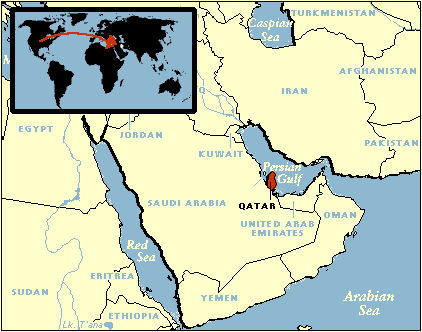
Qatar - people want better enforcement and stricter tobacco control measures..


May 4, 2010 - Even as the Supreme Council of Health (SCH) has intensified its campaign against smoking in public places, a large number of nationals and residents feel that the measures taken by the authorities to combat this menace are far from satisfactory.

Background:
While the prevalence of smoking in the Arab countries of the Persian Gulf is 30-50%, national health data in Qatar, the second smallest country in the Persian Gulf with a total population of more than 724,125, reported that the prevalence of smoking is 37% among males and 0.6 % among females according to the Gulf Family Health Survey (GFHS) in 1999.

The first comprehensive law concerning the control of tobacco and its derivates in Qatar has been put into force in 2002. The Law number 20 of 2002 encompasses a range of legislative measures starting from smoking bans in enclosed public places, banning advertising for tobacco products, prohibition of selling tobacco products to minors, and other measures (as shown in Table-1).
Table-1 Tobacco control law in Qatar- The law number 20 of 2002

1. Smoking ban in all enclosed public places including public transportation, public workplace, educational institutes, health care premises, and recreation places such as cinemas and theaters.
2. Ban of tobacco advertisement in mass media and billboards.
3. No sell for tobacco products to minors (any person under 18-year old).
4. No sell for tobacco product within 500-meters around the school.
5. No vending machines for cigarettes to be allowed in the country.
6. No tobacco to be cultivated in the country.
7. One fourth of pack size to be dedicated for health warning labels on diseased caused by smoking.
8. Two percent of revenue of taxation on tobacco products to be used in tobacco control and health education programs.

Read more: Tobacco Control in Qatar, Mohamed Ghaith AL-Kuwari, MBBS, ABCM, FPHM (drmgalkuwari@hotmail.com) Senior Specialist in Public Health Medicine (Health Promotion) Secretary General to Qatar Medical Society, Middle East Journal of Family Medicine Volume 6, Issue 6 August 2008, FULL TEXT..
In an online survey conducted by Al Sharq, the majority of respondents (58 percent) said they were not satisfied with the ongoing SCH campaign and called for stricter measures against those violating the anti-tobacco law in the country.

Some pointed out that the ban on smoking had been openly violated in many offices of ministries, companies and institutions. The ban has also become a convenient excuse for some employees to leave their office quite frequently under the pretext of going out to smoke. Some respondents called for imposing stricter penalties for violations of the law. Inspection teams should be formed with members from all communities, and given judicial powers to book the violators, they said.

“People who are authorised to execute the ban fail to do follow-up in this regard due to the lack of a contact mechanism with the regulatory bodies,” said Mubarak Saleh Salim a member of the Central Municipal Council (CMC), while reacting to the survey results. The CMC had proposed establishing special offices in shopping malls to deal with complaints from consumers as well as those related with smoking in public places. It had also proposed putting up signboards in shopping malls warning people against smoking and displaying the telephone numbers of the offices in charge of the smoking ban.

The respondents also called for unified efforts by the SCH, the Ministry of Municipality and Urban Planning and the managements of shopping malls to effectively implement the ban. Managements of eateries have been urged to support such efforts by advising their customers and notifying the authorities about violations.

Reference: Anti-smoking measures insufficient: Survey, Web posted at: 5/2/2010 3:29:9, Source: THE PENINSULA - Qatar's leading English Daily.

Qatar related briefs:
BAT Middle East - conference on the illicit tobacco trade..;
Sheesha (Shisha, Hookah, Narghile, Waterpipe) As Harmful as Cigarettes, says Expert..

Qatar has (signature date June 17, 2003) ratified (date July 24, 2004) the
WHO Framework Convention on Tobacco Control (FCTC) Treaty.


Read more...

Brazil - plaintiff always loses in court cases brought against tobacco companies..


May 3, 2010 - The 4th Panel of the Superior Justice Court (STJ), the highest Brazilian appeal court, by unanimous vote (3x0), denied the claim for indemnification [relief, compensation] for moral damages brought against the cigarette manufacturer Souza Cruz, the Brazilian branch of British American Tobacco Group - BAT.

The suit had been brought by family members of ex-smoker Vitorino Mattiazzi, in the estimated amount of 490,000 reais (US$ 280,000).

This was the first time the Brazilian Superior Court of Justice reviewed the merits of a lawsuit for indemnification for damages attributed to the consumption of cigarettes, and their decision confirmed the majority of the rulings adopted by Brazilian courts in first and second instances in decisions already handed down in similar cases. In all 290 lawsuits with final rulings in Brazil, such indemnification claims were denied.

The case that was reviewed by the Superior Court of Justice began in 2005 in the city of Cerro Largo (state of Rio Grande do Sul, 490 km from capital Porto Alegre), when the widow of Vitorino Mattiazzi filed a lawsuit alleging that her husband was unaware of the risks associated with smoking, had been induced by misleading advertising and had died from respiratory illnesses which the widow attributed, exclusively, to the consumption of cigarettes manufactured by Souza Cruz. As redress, she claimed indemnification for moral damages in an amount greater than 2,000 minimum wages.

At first instance, Judge Guilherme Eugenio Mafassioli Correa did not accept the argument of "lack of awareness" of the risks associated with smoking, pointing out that the sale of cigarettes is legal and that it is not possible to prove that the person exclusively smoked products manufactured by Souza Cruz, since these are not the only cigarettes available on the market.

Further, he emphasized that "there is no way to hold third parties liable for a decision that is eminently one's own, individual, as is the case here. Even if it were questions of status when Vitorino began smoking, he could have opted not to smoke. Certainly there are people who did so."

In one of the lower court decisions the reporting Justice mentioned that the cigarette advertising does not interfere in the free will of the consumers, who may choose to smoke or not. These, among other factors, according to the Justices, exclude the manufacturers from liability for alleged damages associated with smoking.

Reference: Brazil's Appeals Court Denies Moral Damages Against Cigarette Maker, BrazziMag, 4/29/2010.
Read more...

FDA CTP next meeting Subcommittee of the Scientific Advisory Committee..


May 3, 2010 - Center for Tobacco Products (CTP): June 8-9, 2010 Meeting of the Tobacco Constituents Subcommittee of the Tobacco Products Scientific Advisory Committee.

Read more...

Ireland - Illicit tobacco trade booms..


May 3, 2010 - The trade in illicit (illegal, contraband, smuggling) tobacco has reached new heights in the Republic of Ireland, creating more problems for the nation's recession-hit independent retailers.

Finance Minister Brian Lenihan said he did not increase excise on cigarettes in the December budget fearing the already high price - around 8.45 euro (12.88 USD) for a pack of 20 - could contribute further to the smuggling problem. (Ireland - no increase in excise duty on tobacco products worry about smuggling..)

One store owner from Temple Bar in Dublin told C-Store that his turnover had plummeted from £25,000 (38,117.26 USD) a week to £15,000 (22,870.29 USD) in the past 12 months as illicit traders adopted crafty new ways of selling cheap counterfeit cigarettes.

Handwritten notes offering counterfeit versions of top-selling brands for little more than half the legitimate price are being widely dropped through letter boxes. C-Store saw scribbled notes offering 200 JPS Blue cigarettes for just 45 Euros (59.40 USD) more than 40 Euros (52.79 USD) cheaper than the legitimate price.

There are also widespread reports of illicit traders targeting people who leave their contact numbers in the classified sections of local papers.

A Centra retailer from Cork said he was aware of cartons of 200 cigarettes being sold for 20 Euros (26.39 USD) through his local pub.

Maired Warren, manager of O Reilly's Garage in Cork, said the problem had worsened noticeably since a ban on the display of legitimate tobacco was enforced in shops last summer. "Before it was mainly cigarette sales that were being affected, but roll your own is now a problem, too," she said.

"While the legitimate channel is being forced to comply with a mountain of regulation, very little is being done to combat the illicit trade, making it an attractive option for criminals," she added. (Ireland - increase fine for cigarettes imported illegally..)

Anti-smoking group ASH Ireland also said that more needed to be done to control the problem. "Customs and Excise needs additional services to tackle this epidemic or it will expand rapidly," a spokesman warned. "Additional personnel, technology, canine support and legislative changes are needed urgently."

Reference: Illicit tobacco trade booms in Ireland Gaelle Walker, Convenience Store, the Grocer, 4/29/2010.

Some Ireland related news briefs:
Ireland - no increase in excise duty on tobacco products worry about smuggling..;
reland - ASH will never give up - get smoking out of cars (and homes) when kids are present..;
Ireland - harder to quit when switching to low tar cigarettes..;
Ireland - after 2004 smoking ban decline in maternal smoking rates as well as lower risk for preterm births..;
Ireland - cancer society urges government to increase cigarette tax..;
Ireland - increase fine for cigarettes imported illegally..;
Ireland - roll your own cigarettes making a comeback..;
Ireland - lots of smokers - lots of sickness - resulting in premature death - THIS HAS TO STOP..;
Ireland - people responding well to the ban on cigarette displays..;
Ireland - Prof Clancy not enough spent on prevention..;
Ireland - tobacco vendors must register by October 1, 2009..;
Children - exposed to cigarette smoke in cars have greater chance of respiratory distress..;
Ireland - tobacco companies not helping small retailers - display ban..;
Tobacco control initiatives starting Wednesday, July 1, 2009..;
Ireland - Office of Tobacco Control 2008 annual report - Positive..;
Ireland - modest penalty for cigarette smuggling..;
Ireland - to amend tobacco legislation to to include pictoral warnings..;
Ireland - as of July 1, 2009 no advertising or display of tobacco products will be permitted in retail outlets..;
Ireland - cigarette tax abandoned over smuggling fears..;
Ireland - may raise tax on cigarettes as part of emergency budget..;
Ireland - ban smoking in cars when kids are present..;
Ireland - further provisions of the Public Health (Tobacco) Acts 2002 and 2004 are to be commenced on 1 July 2009.;
Ireland - 80% of smokers want a ban on tobacco advertising in shops to stop youngsters starting the habit..;
Ireland to ban tobacco displays..;
Ireland - reduction in admissions for acute coronary syndrome...

Read more...

Switzerland - May 1st start of nationwide law stamping out smoking in public places..


May 3, 2010 - A nationwide law aimed at stamping out passive smoking in public spaces in Switzerland came into force on Saturday, May 1, 2010.

The legislation gives cantons (Switzerland consists of 26 cantons; each is member state of the federal state of Switzerland), which have differing approaches to the issue, minimum standards to apply. But some say that it does not go far enough.

Nicole Disler of the Federal Health Office told swissinfo.ch that second-hand smoke (shs, environmental tobacco smoke, ets, passive, involuntary, sidestream) was a serious health risk and that the new law would provide protection to non-smokers.
“There is no lower limit where second-hand smoke would not be harmful, and it can cause among other things, lung cancer, cardiovascular diseases, asthma and infections of the respiratory system,” she said in an email.

Some countries, including Swiss neighbours Italy and France, already have a nationwide ban in place. But Switzerland’s federal system, which had left the cantons in charge of the issue, resulted in a more piecemeal approach.

The Italian-speaking southern canton of Ticino was the first to ban smoking three years ago. Other cantons followed suit, with some allowing staffed smoking areas and others permitting small “fumoirs” (smoking rooms) without service. Some, such as Appenzell Inner Rhodes, did not implement any measures.

Minimum standards
From May 1 smoking will no longer be allowed in public spaces, including bars and restaurants, schools, hospitals and shopping malls, across the country. But there are exceptions. Catering outlets can set up staffed smoking rooms with ventilation and small locales of up to 80 square metres may remain open for smokers. “The new law is providing a minimum regulation for the whole country,” Disler said. Cantons are free to decree additional regulations and those that already have stricter measures can keep them in place. However, some argue that Switzerland should have one rule for everyone.

People’s initiative
The Swiss Lung League has already gathered 120,000 signatures in favour of a people’s initiative to ban smoking in all indoor public spaces. It also wants to outlaw staffed fumoirs. Looking at cantonal vote results, the initiative appears to have a good chance. Almost 80 percent voted in favour of a smoking ban in Ticino when the issue came to the polls in 2006. Last year more than 80 per cent in canton Geneva signalled their approval.

But there is also some opposition. A group of restaurateurs has launched an initiative to allow establishment owners free choice over smoking. But it does not have the support of the umbrella group of the catering industry, Gastrosuisse.

For Angelo Tomada, scientific collaborator at the Health Promotion and Assessment Office in canton Ticino, there is another problem with the law. “It is not at all satisfactory because it does not make the aim of the smoking ban completely concrete, namely to protect staff,” he said.

Ticino’s experience
Ticino has seen positive effects since its ban was enforced, Tomada said. A survey found that before the ban 15 percent of employees often complained of headaches and 12.9 percent said they had to cough frequently. A year later this had fallen to 10.5 percent and 7.6 percent respectively. “It also found that the smoking ban was generally well accepted by customers, employees and owners,” said Tomada.

One of the main arguments against the ban is that it could affect turnover, which was a consideration in the federal law’s exemption clause for small locales.

In Ticino one in five establishments, especially the small and medium-sized ones, has reported lower revenue. But some had already seen a drop before the ban, Tomada pointed out.

Economic impact?
In fact, it is hard to tell how much of an economic impact outlawing smoking has had, especially since there are other factors, such as the economic downturn, he added.

“There have probably been small problems,” Tomada said, adding that landlords who were against the ban tended to give more negative answers than those in favour. Research in other countries has concluded that there was no great economic impact.

But what about smoking habits? “A secondary aspect of the law could be to try to reduce the number of smokers. This has not happened and furthermore research has shown that there are only at most small changes in the short term,” said the expert.

The move has to be considered in a wider context of prevention measures and in the mid-term. “Overall in the last decade we have in fact seen the number of smokers drop from 32 percent to 27 percent,” Tomada said.

Reference: Swiss stub out their cigarettes – almost, Daniele Mariani and Isobel Leybold-Johnson, swissinfo.ch, 5/1/2010.

Related news briefs:
Switzerland - three holes let smoker have cigarette outside..;
Graubünden, Switzerland - smoker ban leads to drop in heart attacks..;
Switzerland - Davidoff sponsored Swiss Indoor Tennis Tournament begins..;
Switzerland - Imperial Tobacco sponsorship major televised European tennis event..;
Geneva, Switzerland - ban on smoking in public places returns..;
Switzerland - unified program to ban smoking in buildings open to the public..;
Switzerland could join EU requiring sale of only self-extinguishing cigarettes...
Read more...