Montana will require fire-safe cigarettes..


April 16, 2008 - Montana will become on May 1, 2008 the 28th U.S. state with legislation requiring the sale of only cigarettes with lowered ignition propensity – so-called ‘fire-safe’ cigarettes. In 2003, New York was the first state to pass such legislation, while Virginia, Indiana, Idaho, Washington and Wisconsin are the latest, having done so this year. As of April 2008, Kentucky will require that all cigarettes sold be fire-safe. Coalition for Fire-Safe Cigarettes, about 60 per cent of the U.S. population now lives in a state that requires the sale of only fire-safe cigarettes or that will do so in the immediate future. Let's have fire-safe cigarettes for all 50 states - NOW. In March 2008, the Liggett Group announced that all of its U.S. cigarette brands would comply with fire safety standards by the end of January 2009, even those sold in states that did not impose such standards. Other related news briefs: March 27, 2008, August 28, 2007, August 27, 2007 and. July 20, 2007. Click on image to enlarge..(TobaccoWatch.org)
Read more...

Tobacco displays are on their way out in an increasing number of countries..


April 15, 2008 - Tobacco displays are on their way out in an increasing number of countries.. New Zealand's Cancer Society's Tobacco Control Advisor Belinda Hughes, “In addition to bans on tobacco displays in Iceland and Thailand we are seeing them introduced in a growing number of Provinces in Canada and beginning to be introduced in Australian states led by Tasmania. Cancer Society’s Tobacco Control Adviser Belinda Hughes. The UK government is also looking into getting tobacco out of sight." The Australian state of Tasmania is the latest jurisdiction to announce that it is phasing out retail displays of tobacco products. It will be the first Australian state to ban the display of tobacco products but others are racing to catch up. The Australian Capital Territory has introduced legislation to ban tobacco displays and other states are under pressure to follow suit.

In Canada the Province of British Columbia is the most recent Province to introduce a ban on tobacco displays (March 2008) since Saskatchewan banned tobacco displays in 2002. Complete bans on the retail display of tobacco products are in place in the Canadian Provinces of Nunavut (2004), Prince Edward Island (2006), Nova Scotia (2007), Ontario (2008) and Québec (2008). Canada is now considering national legislation regulating tobacco displays. "A ban on retail tobacco displays will stop children being confronted with promotional tobacco imagery occupying the most prominent display space in retail outlets. By doing so it will help prevent the children of this generation becoming the smokers of tomorrow," said Ms. Hughes. Ontario - come May 31,2008 tobacco displays that feature cigarette packs and other tobacco products will no longer be allowed in Ontario retail stores. According to the Smoke-Free Ontario Act, tobacco must be stored in such a way that prohibits consumers from seeing it before it is purchased. "The goal of this particular legislation is to save lives," said Ontario Minister of Health Promotion Margarett Best. ( Province bans cigarette packs from view,Karen Ashford, The Windsor Star, 4/15/2008) Some related news briefs: March 8, 2008. 80% of smokers want a ban on tobacco advertising in shops to stop youngsters starting the habit.. Let's get it done throughout the world. Meanwhile in the U.S.A. - Philip Morris is hard at work competing for prime tobacco display space in c-stores. Click on image to enlarge..
Read more...

Altria's growth depends on the Marlboro name..


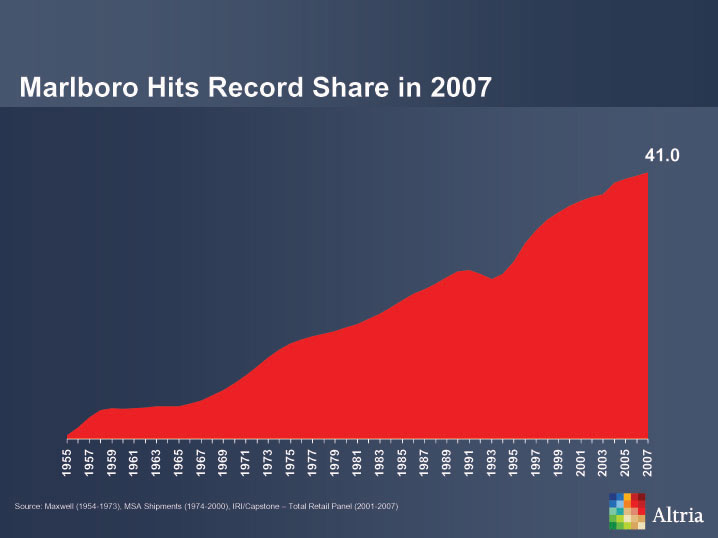
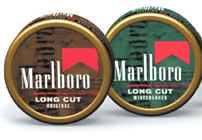
April 13, 2008 - Can the new Altria - PM USA make it in the smokeless tobacco category just riding the Marlboro name?? PMI has forecast annual growth in earnings per share of 10 - 12%. Altria expects its own earning growth to be 8 - 10% annually. Altria will deal with fewer cigarettes sales by capitalizing on its Marlboro brand and selling more smokeless products. In August 2007 Citi group analyst Bonnie Herzog told investors that PM USA will fully cement its place in the smokeless segment using the power of its Marlboro brand. "We anticipate that PM USA will be able to attract the majority of smokers that will cross over into the smokeless market as well as attracting existing moist users." PM considers Marlboro more than a cigarette - a brand that stands for superior tobacco flavor. PM USA is using Marlboro's superior tobacco flavor and resources that support the Marlboro cigarette to create value in new businesses such as SNUS and Moist Smokeless Tobacco. (Altria Group, Inc., Investor Presentation, New York, March 11, 2008) But market tests find that even the name Marlboro doesn't seem to sell the Marlboro smokeless products. Nik Modi, a UBS tobacco analyst has stated, "The Marlboro brand name is not as transferable as many originally believed." Modi points out that test of Marlboro moist smokeless tobacco in Atlanta is slowly slipping down hill. Their original entry Taboka failed and has been removed and Marlboro SNUS hasn't done much better. The Word From Dallas - Test Market for Marlboro SNUS.. We're reminded by the Chief Operating Officer of UST, Murray Kessler that "Nine out of 10 smokers that try smokeless still reject the product." Kesler continues, "Clearly Marlboro is a great cigarette brand. That said, history clearly shows that it is difficult to extend brands from one one category to another. We feel in order for PM USA to be a significant player in the smokeless tobacco category they'll need to expand through acquisitions e.g., PM-UST, PM-Swedish Match). Many related news briefs - browse the library - here's one example Philip Morris USA (PM) continues to stumble in the smokeless tobacco arena.. (TobaccaWatch.org) - Incomplete..
Read more...

Massachusetts (MA) Likely to Increase Tobacco tax..


April 12, 2008 - Massachusetts (MA) Likely to Increase Tobacco tax.. On Thursday, April 10th The MA House voted 131 - 23 to impose an additional one dollar per pack on cigarettes. The House stipulated in the new tax bill that the cigarette tax, supported by Gov. Deval L. Patrick and Senate President Therese Murray, would go into effect starting July 1, 2008. Under the House bill, an estimated $175 million in new revenues from smokers would go to the Commonwealth Care insurance program. State Rep. Harold P. Naughton Jr., D-Clinton, said he voted for the cigarette tax hike because his mother who smoked, died a painful death at age 76 from lung cancer. Tax hike proponent Frank M. Hynes, D-Marshfield, said the higher prices would prevent 46,000 children from taking up smoking and pressure 26,000 adults to quit. MA tax on a pack of cigarettes would be raised from $1.51 to $2.51. Click on image to enlarge..

Read more...

Further evidence SNUS is NOT a component of smoking cessation..


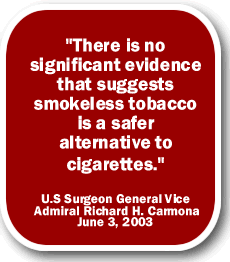
April 12, 2008 - A retrospective random telephone survey of Swedish smokers (985) and ex-smokers (1000) to assess to what extent SNUS has been used as an aid to stop smoking among Swedish smokers. To assess to what extent SNUS has been used as an aid to stop smoking among Swedish smokers. The study suggested that by using snus, Swedish male smokers may increase their overall chances of abstinence. However, 71% of the men in this sample who quit smoking did so without using SNUS and the duration of abstinence was not affected by SNUS use. This suggests that SNUS is NOT necessary component of smoking cessation at the population level. SNUS use was very rare among women. Role of SNUS (oral moist snuff) in smoking cessation and smoking reduction in Sweden, Gilljam et al., Addiction 98(9): 1182-9, 2003) Dr. Lars E. Rutqvist, the Vice President for Scientific Affairs at Swedish Match (the world's second largest maker of snuff and chewing tobacco and market leader in Sweden - volume share of 90% at the end of 2006) has stated the drive in SNUS sales in Sweden has been in response to the smoking ban rather than the perceived advantage to user’s health. The trend for Swedish women's smoking habits also refutes the myth that SNUS use is a necessary component to reduce smoking. Between 1977 and 2000, the proportion of daily smokers among young Swedish women - among whom SNUS is uncommon - declined 47 to 19 percent. There are no controlled studies which demonstrate the effectiveness of SNUS as a smoking cessation aid. (Who benefits from increased use of snus?) Overall smoking prevalence in Norway, as well as in young Norwegians, has decreased at the same rates in men and women during the last decade, whereas a marked increase in SNUS use during this time period has only occurred in young men. EU Scientific Committee Concludes: Insufficient Evidence to Lift Ban on SNUS.
Read more...