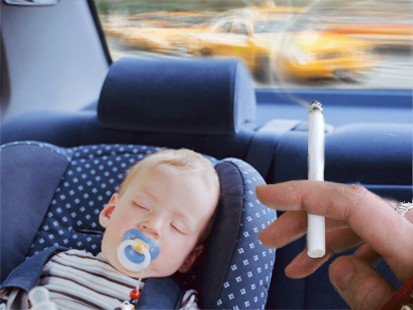
The first Anniversary (July 1,2008) of England's smokefree law shows the public ready to accept even stronger tobacco control measures. A government survey revealed that in England: 77% of adults support a ban on smoking in cars carrying children under the age of 18.
In developing the British Department of Health's new National Tobacco Control Strategy the second main area entitled: Protecting children and young adults from smoking includes the statement protecting children from secondhand smoke to prevent future generations suffering poor health caused by tobacco. (On May 31, 2008 the British Government's Department of Health (DH) released the paper on the the future of tobacco control.)
Vehicles Have Been Found to be the Most Dangerous Space for Second-Hand Smoke Levels.. Secondhand (environmental,involuntary, passive) Smoke: Blood Vessel Damage Within Minutes...
Banning smoking when children are in the car is a no-brainer - even Philip Morris agrees. David Sutton, a spokesman for Philip Morris USA said the company believes the public "should be guided by the conclusions of public health officials regarding the health effects of secondhand smoke" and "particular care should be exercised where children are concerned."
Related news briefs: Nicotine Dependence in Kids Exposed to Second-Hand Smoke.. and Maine - illegal to smoke in cars while children present...
Reference: CALL TO BAN SMOKING IN YOUR CAR by Martyn Brown, Daily Express, 10/8/2008.
Click on image to enlarge..
TobaccoWatch.org
Read more...
ASH calls for a debate in England on banning smoking in all cars with kids present..
Grocery Store Chain - Cigarettes $1.00 per pack..

Fundamental to tobacco control is convincing governments to sharply raise tobacco taxes and as a result the cost of a pack of cigarettes increases. Numerous economic studies in peer-reviewed journals have documented that cigarette tax or price increases reduce both adult and underage smoking. The general consensus is that every 10 percent increase in the real price of cigarettes reduces overall cigarette consumption by approximately three to five percent, reduces the number of young-adult smokers by 3.5 percent, and reduces the number of kids who smoke by six or seven percent.
This effort is defeated if the store turns around and sells cigarettes for a cheaper price. Cigarettes and most moist snuff products do not carry an expiration date (do have some coded value) and the tobacco can not be returned to the manufacturer. UST's Skoal and Copenhagen have an expiration date and can be returned for credit. At least one c-store owner we have talked to thinks UST Inc. (with no regulations in place) reconstitutes the expired tobacco and again returns it to the marketplace for sale - more on this aspect later. UST salesman..
Reference: RAISING CIGARETTE TAXES REDUCES SMOKING, ESPECIALLY AMONG KIDS (AND THE CIGARETTE COMPANIES KNOW IT)
Click on image to enlarge..
Read more...
Michael Rubens Bloomberg - ELF Award winner 2008


Michael Bloomberg has donated $375 million over six years to five key partner organizations (The Campaign for Tobacco-Free Kids, Centers for Disease Control and Prevention Foundation, The Johns Hopkins Bloomberg School of Public Health, The World Health Organisation and The World Lung Foundation). This campaign aims to help people quit smoking and reduce the number of deaths caused by smoking, by improving anti-smoking education, increasing the price of tobacco and making more places smoke free.
As an example of Bloomberg’s work, New York City now has 200,000 fewer smokers than it did four years ago. Bloomberg has more than doubled tobacco control funding in low and middle income countries to try and extend this success across the world.
The funding provided by Bloomberg has already enabled the formation of MPOWER**, a package of the six most important and effective tobacco control policies that are proven to reduce tobacco use. Once these policies are enforced together, they will prevent young people from starting to smoke, will help current smokers to quit, will protect non-smokers against the dangers of second hand tobacco smoke and will free citizens worldwide from the harm of tobacco.
If smoking rates continue to stay at current levels without intervention, a predicted one billion people are expected to die from tobacco use this century. Bloomberg’s generous contribution has the potential to save thousands of lives by benefitting the world’s smokers and non-smokers.
**MPOWER:
Monitor tobacco use and the policies to prevent it .
Protect people from tobacco smoke
Offer people help to quit tobacco use
Warn about the dangers of tobacco
Enforce bans on tobacco advertising, promotion and sponsorship
Raise taxes on tobacco
Reference: Michael Rubens Bloomberg - ELF Award winner 2008, European Lung Foundation, 10/5/2008.
ELF is the public voice of the European Respiratory Society.
Read more...
Chinese cigarettes go global - Golden Deer Cigarettes..

(Chinese cigarettes to go global)
In 2006, Shanghai Tobacco has taken steps to implement a strategy of turning Golden Deer into a major international cigarette brand. The 8mg “Golden Deer”(yellow) cigarettes and 5mg “Golden Deer”(white) cigarettes were launched in succession in the Taiwan market, and received good response. After about six months’ efforts, the 10mg “Golden Deer”(blue) cigarettes entered Taiwan market successfully.
After succeeding in Taiwan taxable markets were developed South America, the Middle East, Australia and other countries and regions. Shanghai Tobacco Group managed to step up development of the taxable market in the Philippines by strengthening coordination with local dealers, and had the 10mg Golden Deer go on the taxable market in the country. According to information on its sales on the local taxable market over the past more than two weeks, Golden Deer, as a high- and medium-grade cigarette products on the local market, and has won favor from young consumers in terms of both packaging and flavor. Golden Deer, which was launched in the Philippines on September 5, is described as a 10 mg cigarette. (Golden Deer grazing on Philippines market)
A related news brief: Made-in-China Marlboros - a major mistake by Philip Morris International..
References: 10mg “Golden Deer”(Blue) Cigarettes Enter Taiwan Market Successfully, ChinaRealNews, 8/31/2008; Golden Deer Cigarettes go on Taxable Market in the PhilippinesTobaccoChina, 10/6/2008 and Three Chinese Cigarette Brands to March into International markets, ChinaRealNews, 1/31/2008.
Read more...


U.S. Supreme Court: Good v. Altria Group,.

The question before the Supreme Court is whether state-law challenges to advertising claims about tar and nicotine yields are pre-empted by federal law.
The plaintiffs contend, Altria - formerly known as the Philip Morris Companies - misled smokers into thinking that light cigarettes, with less tar and nicotine, were less hazardous to health. If the Supreme Court rules in favor of the three smokers, who enjoy the support of the U.S. government and Federal Trade Commission, the result could be a tsunami of lawsuits that could cost the tobacco industry billions of dollars.
Read more...


To Provide Public Awareness
Purpose
About Us
Contact Us
2008 HIGHLIGHTS
TOPIX PAPERS - 2008 & 2009..