

Despite rapid growth in disposable income and massive migration of people from rural to urban areas, cigarettes are the choice of only a slim segment of Indian tobacco users. Many prefer chewing tobacco. Among those who smoke, hand-rolled leaf tobacco is favored; a mere 15% smoke cigarettes.
And profit margins are tight, in part because of competition from contraband cigarettes smuggled across the borders and illegally made local smokes. Though there are no specific estimates of how many such smokes circulate in the market, ITC says they are its biggest challenge.
On top of that, New Delhi, particularly the Health Ministry, is increasingly vocal about curbing smoking. Even before the formal investment ban, the government had rejected proposals by foreign players to increase their presence in India. Existing rules use licenses to cap the number of cigarettes a company can produce in a year, and there are loud calls for higher tax rates to reduce tobacco use. The country's tobacco tax already represents 69% of the retail price of a cigarette -- among the highest percentages in the region, according to the Tobacco Institute of India, a trade group.
And cigarette makers bear a disproportionate share of the tobacco tax. Though cigarettes represent only about 40% of India's $12 billion tobacco market, they generated 80% of the revenue collected from the tobacco industry in 2007-08. The non-cigarette industry is fragmented, consisting of many small-scale players.
Certainly, global companies may have hoped a market like India -- where cigarette consumption is growing around 5% a year, according to Datamonitor -- could offer growth potential they lack at home. Japan Tobacco is hunting for new markets as its domestic market shrinks due to a declining population and fewer people lighting up.
But when the smoke clears, foreign firms may see India's protected market has its own shortcomings.
Reference: Cigarette Makers' India Pipe Dreams by HARSH JOSHI, WSJ.com, 4/13/2010; Govt bans FDI in cigarette manufacturing, Business Standard Reporter, New Delhi/kolkata, 4/9/2010.
India - some related news briefs:
*India - increasing taxes on cigarettes and bidis to save lives..;
*India - cabinet decided to bar foreign direct investment in cigarette manufacturing..;
*India - captions with pictorial warnings should use local languages..;
*ndia - pictorial warning will appear on every tobacco pack sold from June 1 , 2010..;
*India - government set to ban foreign direct investment in tobacco..;
*India - despite tobacco control measure in place - tobacco sales increase..;
*India - still confusion pictorial warnings on cigarette packs..;
*Mumbai, India - NGO activists want closure of hookah bars..;
*India - gutkha and bidi companies NOT pictorial warnings..;
*India - cigarette packs with pictorial warnings are here..; *ndia - NO graphic pictorial warnings yet..;
*India - Still no pictorial warnings on cigarette packs..;
*India - pictorial warning on cigarettes and tobacco products effective May 31, 2009..;
*India - pictorial warning on cigarettes and tobacco products will be implemented from May 31 - no doubts about it..;
*India - will pictorial or graphic health warnings be implemented from May 30, 2009..;
*India - placing pictorial warnings on tobacco products delayed again..
Read more...
India - more on ban on foreign direct investment - more insight on tobacco market ..
Japan - people more aware of dangers of smoking cigarettes - dangers to smokers and those around them..

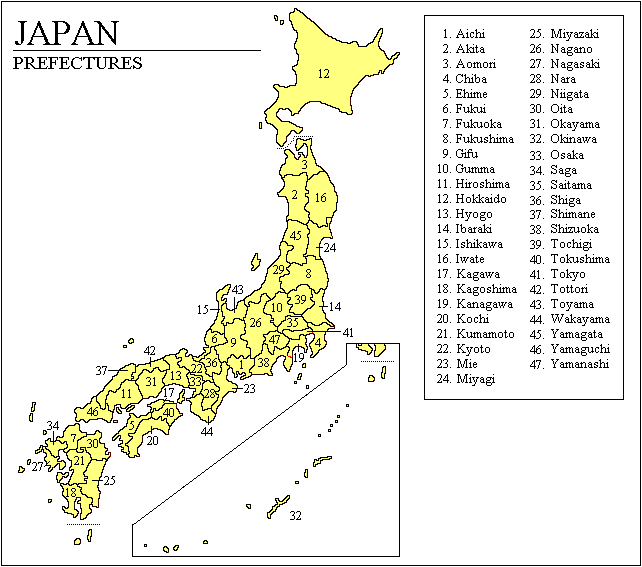
Step inside Lunchan Café and you can see and smell change in the air; literally. Everything's non smoking. The restaurant is in Kanagawa, the first prefecture to go non-smoking in all of Japan. A new ordinance now mandates if you want to light up indoors you need a separate, walled off space.
Kanagawa's tobacco control unit says the only place you can smoke in this government building is outside, with the pigeons; amid the rooftop vents of the building.
More than 80 percent of men smoked right after the war, says Horie Nobuo. Less than 40 percent smoke nowadays. This is a big change.
But Japan is far behind other developed nations, says non-smoking advocate Koreyoshi Takahashi. Takahashi pays the price for Japan's decades long smoking culture. He can walk up a few stairs, but beyond that, what remains of his lungs cannot take much more. Doctors removed two thirds of his right lung, lost to lung cancer, caused by two decades of a two to three pack a day smoking habit. Everyone smoked he says, no one thought the government would sell anything bad for your health. But it was, and still is, Japan tobacco is majority-owned by the government.
Takahashi is suing Japan tobacco, he lost in the district courts and the case is on appeal. He doesn't expect to win, but hopes it will continue to force the country to change its laws. (Japan - plaintiffs have slim chance of winning against big tobacco..)
Tobacco is still on the market, he says, containing tons of cancerous material. And it's sold by the government. “It's unbelievable.”
Kazuhito Yamashita is the vice president of scientific and regulatory affairs at Japan tobacco, also known as JT. It's a groundless opinion that the government's ownership of JT shares is delaying anti-smoking public policy, he says, adding that JT has been pushing for 100 percent privatization. He points out the non-smoking trend in Japan is happening and the company is adjusting to the new culture.
Smokers are finding fewer and fewer places to light up. Outside one train station, smokers are confined to "smoking" pens, paid in part by Japan tobacco. I don't like this, says Shinji Motegi, who says this is what animals at the zoo must feel like. “It makes me feel like a criminal.”
Responding to that customer complaint that there are fewer and fewer places to smoke, Japan tobacco has developed a smokeless cigarette, called "zero-style."
Instead of lighting up, you inhale a plastic pipe, the tobacco is inside in replaceable cartridges. It's not a way to hook consumers on another type of tobacco, stresses Yamashita.
This is a tobacco product, therefore there's a risk with it. It's our job to provide options for the customers who understand that risk and still would like to smoke.
Takahashi is fighting against the use of any tobacco products, calling it all poison. For his generation, smoking was a rite of passage into adulthood. Takahashi sees the non smoking laws as an awakening for Japan. That he hopes will mean a longer life for the next generation.
VIDEO:
Reference: Lighting up in Japan a way of life, Kyung Lah, CNN - Fox10tv.com, 4/14/2010.
Japan - some related news briefs:
Japan - 7 governors consider measures against passive smoking..;
Japan, Kanagawa Prefecture to ban smoking on beaches..;
Japan - Health Ministry set to urge all local governments to go smoke-free..;
Japan - TASPO (tobacco passport) cards to confirm legal age of cigarette purchaser..;
Tokyo, Japan - smokers find haven on smoke-free streets..;
Japan Tobacco - reacts angrily to governments decision to raise cigarette tax..;
Japan - tax increase, a pack of 20 cigarettes will increase by an average of 33%..;
Japan - cigarette taxes increase may be less than expected..;
Japan - prime minister calls for tobacco tax increase..;
Japan Tobacco growing popularity of its British cigarette brands..;
Japan - new government administration considering raising cigarette taxes..;
Japan - plaintiffs have slim chance of winning against big tobacco..;
Japan - convenience store sales fell in June 2009..;
Japan - tobacco control people upset with smoker-only cafes..;
Japan - Tokyo smoking cafes, people with children, those under 20 NOT allowed..;
Japan - Kanagawa - bans smoking in public places starting April 2010..;
Japan shelves tobacco tax hike for 2009..;
Japan - Ruling party plans tobacco tax hike in 2009..;
Japan Tobacco Starts Petition To Fight Tax Increase..;
How to get most smokers to quit?? - Keep On Raising The Price..;
Japanese lawmakers want to triple cigarette prices..;
Japanese tobacco giants focus on point-of-sales cigarette purchases..;
Japan - photos can be used to fool the age-verification cameras on some vending machines..;
Vending Machines - Japanese protecting their children from becoming life-long nicotine addicts...
Read more...
South Carolina - senators try to write bill on cigarette tax increase to override Governor Sanford's veto..
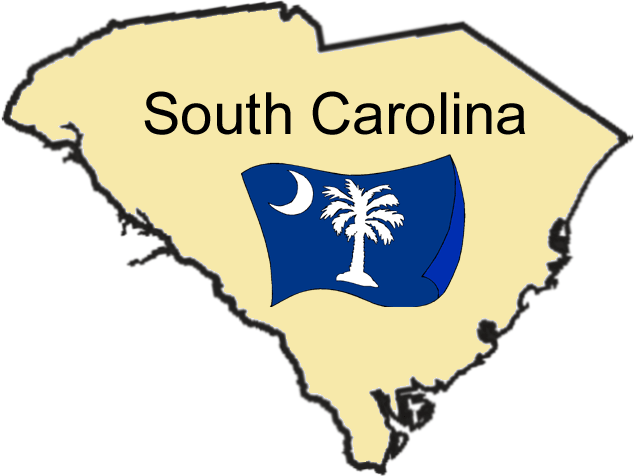


April 15, 2010 - On Tuesday, April 13th the South Carolina senators didn't get around to debating final approval on raising South Carolina's lowest-in-the-nation cigarette tax by 50 cents a pack. Lawmakers instead spent Tuesday's session in a procedural argument about abortion legislation.
On Wednesday, April 14th South Carolina senators on approved raising the nation's lowest cigarette tax by 50 cents a pack. South Carolina's current cigarette tax of 7 cents a pack hasn't increased since 1977, when a pack cost 49 cents.
By a 32-12 vote, the Senate on Wednesday gave final approval to raising the tax to generate about $130 million for Medicaid programs. They'll set aside $5 million each for cancer research at the Medical University of South Carolina and programs to reduce smoking.
The Senate legislation would put the Medicaid share of the money into a trust fund and will be used in the 2012 budget year to head off deep spending cuts in health care programs for the state's elderly, disabled and poor after temporary federal help for those programs disappears.
When the cigarette tax cash is matched by federal money, it will generate about $500 million, said Senate Finance Committee Chairman Hugh Leatherman, R-Florence. That "will plug holes - not to start new programs; not to expand programs - simply try to provide what we're doing now," Leatherman said.
State Sen. Kevin Bryant, a Republican pharmacist from Anderson, argued the money should be used on a tax decrease elsewhere and not on money-losing government health care programs. "If we don't reform the system, we're going to continue to pour money down this drain and we're never fully going to have a good Medicaid system in this state until we reform the system," Bright said.
The bill now is bound for the House, which can go along with the Senate's plan or amend the bill and send it back to the Senate. House budget writers approved a cigarette tax increase of 30 cents a pack last month. But Senate rules won't allow that tax increase to be included in the spending plan they'll take up in a couple of weeks.
Legislators expect the bill will end up in a conference committee for differences to be worked out.
Republican Gov. Mark Sanford has promised to veto a cigarette tax increase if the money isn't used to reduce taxes in other areas.
Senators Wednesday scrambling to make it more likely the tax increase would survive a veto threat. They stripped out plans to use part of the tax increase to pay for agriculture product marketing and rural projects. Instead those initiatives would be paid for with money from the state's settlement with tobacco companies.
"The whole thing is an effort to get the votes needed to override a veto," said Senate Minority Leader John Land. The Manning Democrat two weeks ago rallied votes for those initiatives when the bill won second reading with a 26-16 vote. If Senate support holds, the margin the bill passed with Wednesday is sufficient to override Sanford.
References: SC Senate doesn't get to debate on cigarette tax,
The Associated Press, 4/13/2010; 50-cent cigarette tax passes in Senate, theState.com, 4/14/2010.
Related news briefs:
South Carolina - increase in cigarette tax still NOT likely..;
South Carolina - cigarette tax, State Superintendent of Education Jim Rex speaks up..;
South Carolina - among the worst states in the nation in smoking prevention efforts..;
South Carolina - among the worst states in the nation in smoking prevention efforts..;
South Carolina - most residents support raising the tobacco tax..;
South Carolina - with Gov. Sanford still in office most likely no tobacco tax increase in 2010..;
South Carolina - low cigarette pricing, smuggling, higher insurance premiums, etc..;
Lexington County, South Carolina has a workplace smoking ban..;
South Carolina - governor disappears, maybe its time to slip through a cigarette tax..;
South Carolina - next legislative session starts June 16th..;
South Carolina - lawmakers may disappoint again on cigarette tax increase..;
SC tobacco tax increase - doubt exists maybe NOT this year..;
South Carolina - can we expect a tobacco tax increase this year??;
South Carolina a magnet for cigarette black market..;
South Carolina - legislators eager to pass cigarette tax increase - the odds are against them??;
South Carolina to spend NO money on tobacco prevention..;
South Carolina (SC) will NOT devote any resources to anti-smoking programs..;
In 2008 will the politicians do what's right for the State of South Carolina??;
South Carolina - Tobacco Tax Increase Killed - State House Fails to Override Governor's Veto..
Tobacco Tax Increase – What’s Wrong with South Carolina??
Read more...
Ireland - no increase in excise duty on tobacco products worry about smuggling..


Retailers also wrote off 692 million euro (939.4 million USD) in lost sales due to the lucrative illegal trade, although nine shops are being investigated by customs officers for selling counterfeit brands.
A review by cigarette giant Japan Tobacco International (JTI) found customs seized 218.5 million cigarettes last year, valued at just over 92 million euro (124.9 million USD). (Japan Tobacco acquired British based Gallaher Group in April, 2007..)
Finance Minister Brian Lenihan said he did not increase excise on cigarettes in the December budget fearing the already high price - around 8.45 euro for a pack of 20 - could contribute further to the smuggling problem. "The tobacco industry itself has a crucial contribution to make in dealing with the threats posed by smuggling. I did not increase the excise duty on tobacco products in my December Budget as I believe the high price is contributing to increased cigarette smuggling."
"Tobacco smuggling is a serious problem for Ireland. It deprives the state of the revenues from the sale of legitimate products, and is damaging to both the tobacco industry and the retail trade," the minister said.
JTI said the most common platforms for selling illegal cigarettes were unlicensed street markets and door-to-door sales, with even bread vans and a postman reported to be engaged in the trade in 2009. But the study reveals an upsurge in the number of legitimate shops trading in counterfeit goods, with nine retailers being investigated by customs last year.
JTI said it is taking a zero tolerance approach to such behaviour and took the "unprecedented" decision to cease trading with a shop in the midlands believed to be selling counterfeit Benson & Hedges Gold Kingsize. Cease and desist letters were also sent to three other shops thought to be dabbling in the trade.
JTI warned inadequate penalties, low fines, and unregulated street markets continued to make the illicit trade of tobacco a common choice for criminals in Ireland. It said there was a growing link between the trade and hard-core criminality. (Ireland - modest penalty for cigarette smuggling..)
We all await the World Health Organization's (WHO) solution to the problem of tobacco product smuggling faced by countries throughout the world..
VIDEO: Story of a guy who smuggles cigarettes from somewhere in eastern Europe to sell in Ireland.. - 2 min 28 sec.
Reference: Tobacco smuggling costing 556m euro, Belfast Telegraph, 4/14/2010.
Some Ireland related news briefs:
reland - ASH will never give up - get smoking out of cars (and homes) when kids are present..;
Ireland - harder to quit when switching to low tar cigarettes..;
Ireland - after 2004 smoking ban decline in maternal smoking rates as well as lower risk for preterm births..;
Ireland - cancer society urges government to increase cigarette tax..;
Ireland - increase fine for cigarettes imported illegally..;
Ireland - roll your own cigarettes making a comeback..;
Ireland - lots of smokers - lots of sickness - resulting in premature death - THIS HAS TO STOP..;
Ireland - people responding well to the ban on cigarette displays..;
Ireland - Prof Clancy not enough spent on prevention..;
Ireland - tobacco vendors must register by October 1, 2009..;
Children - exposed to cigarette smoke in cars have greater chance of respiratory distress..;
Ireland - tobacco companies not helping small retailers - display ban..;
Tobacco control initiatives starting Wednesday, July 1, 2009..;
Ireland - Office of Tobacco Control 2008 annual report - Positive..;
Ireland - modest penalty for cigarette smuggling..;
Ireland - to amend tobacco legislation to to include pictoral warnings..;
Ireland - as of July 1, 2009 no advertising or display of tobacco products will be permitted in retail outlets..;
Ireland - cigarette tax abandoned over smuggling fears..;
Ireland - may raise tax on cigarettes as part of emergency budget..;
Ireland - ban smoking in cars when kids are present..;
Ireland - further provisions of the Public Health (Tobacco) Acts 2002 and 2004 are to be commenced on 1 July 2009.;
Ireland - 80% of smokers want a ban on tobacco advertising in shops to stop youngsters starting the habit..;
Ireland to ban tobacco displays..;
Ireland - reduction in admissions for acute coronary syndrome...
Read more...
U.S. Congress discusses elimination of tobacco use by Major Leagne Baseball players..
Rick Bender former baseball player with part of mouth removed - Philip Morris/R.J. Reynolds safer than cigarettes but where's the tongue??
April 15, 2010 - Executives from Major League Baseball and the players' association joined U.S. public-health officials to testify before the House Committee on Energy and Commerce on Wednesday, April 14th on the prevalence of smokeless tobacco and whether its use by professional athletes influences children.
Rep. Henry Waxman, D-Calif., chairman of the House Committee on Energy and Commerce, said Major League Baseball and the players' union should "take action to end the use of smokeless tobacco by big-league players."
"Like many generations of Major League Baseball players, I started using spit tobacco because I saw other players doing it, and I thought it was part of being a major-league player," said Joe Garagiola, a television announcer and former player. "This is a dangerous, deadly habit." (The National Spit Tobacco Education Program..)
Tobacco of all kinds is banned in minor-league baseball, a policy Garagiola urged major-league players to adopt. While major-league players aren't allowed to smoke cigarettes in uniform in view of spectators, chewing tobacco is different, said David Prouty, chief labor counsel for the Major League Baseball Players Association.
Prouty said. "Baseball players should not be prohibited from using substances that are perfectly legal and available to the general public." Tobacco companies led by Philip Morris and RJ Reynolds argue they should be allowed to market smokeless products as a safer alternative to cigarettes. "Some adults who would otherwise continue smoking may be willing to move to a smokeless-tobacco alternative to cigarettes," said James Dillard, a senior vice president at Altria Group, which owns Philip Morris. "Smokeless-tobacco products are substantially lower on the risk continuum than cigarettes."
Health officials say they worry chewing tobacco will have the opposite effect: that it may act as a gateway to cigarettes, and that children could become addicted to tobacco by emulating its use by baseball players.
Nine of every 10 people who die from mouth and throat cancers used tobacco, according to the American Dental Association (ADA). Tobacco products also are linked to higher rates of gum disease, one of the leading causes of adult tooth loss, the ADA said in an October letter to the FDA.
Terry Pechacek of the Centers for Disease Control and Prevention, and Deborah Winn of the National Cancer Institute testified about the links between smokeless tobacco and cancer, and the addictiveness of smokeless tobacco. Pechacek said smokeless tobacco can cause oral cancer and pancreatic cancer, and has been linked to fatal heart attacks.
Banning use would require negotiations with the players union, said Robert Manfred, an executive vice president for Major League Baseball.
VIDEO - Don't Dip Snuff / The Dangers of Smokeless Tobacco....
Reference: MLB asked to chew on tobacco ban by Meg Tirrell, Bloomberg News - The Seattle Times (Material from The Associated Press is included in this report.), 4/14/2010.
Read more...


To Provide Public Awareness
Purpose
About Us
Contact Us
2008 HIGHLIGHTS
TOPIX PAPERS - 2008 & 2009..