
R.J. Reynolds Tobacco Co. (a unit of Reynolds American Inc.) maker of Camel cigarettes, and Lorillard Inc., which sells Newport menthol brand, filed the federal lawsuit with several other tobacco companies. Joining in the suit filed in U.S. District Court in Bowling Green, Kentucky, are: National Tobacco Co., Discount Tobacco City & Lottery Inc., and Kentucky-based Commonwealth Brands, which is owned by Britain's Imperial Tobacco Group PLC. The makers name the FDA, the government and individual leaders as defendants in the lawsuit.
Part of the bill, passed in June, covers cigarette marketing.
COMPLAINT FOR DECLARATORY JUDGMENT AND INJUNCTIVE RELIEF - UNITED STATES DISTRICT COURT FOR THE WESTERN DISTRICT OF KENTUCKY BOWLING GREEN DIVISION...
The lawsuit doesn't challenge the decision to give the FDA authority over tobacco products.In the lawsuit, the companies say they aren't challenging the provisions of the law that directly address tobacco sales to minors. "The case will be about whether Congress has gone too far about preventing tobacco companies from communicating with adults, and keeping adults from receiving the information that tobacco companies want to send to them," said Floyd Abrams, a First Amendment lawyer representing Lorillard, the maker of Newport cigarettes.
Mr. Abrams, of Cahill Gordon & Reindel LLP in New York, said so-called tombstone provisions requiring tobacco packages to show large images reflecting the long-term health risks associated with cigarette smoking violate First Amendment rights because cigarette makers would only be able to promote their products on the bottom half of each side of a package. That part of cigarette packs, he noted, is often obstructed from the view of a customer at a retailer.
Another major complaint by tobacco companies is that they are barred from making truthful statements about the relative health risks of tobacco products if the FDA determines that such statements wouldn't benefit the health of the U.S. population as a whole. The issue could be of importance to companies such as Reynolds that make smokeless tobacco products, like Camel Snus, a type of spit-free smokeless tobacco. Some research has shown that such products are less harmful than cigarettes because they generally contain fewer carcinogens and don't enter the lungs.
Advertisers are also rankled by a provision that requires sponsors of sports, cultural or musical events such as rock concerts to mention only the company's corporate name in their promotions, not its tobacco products.
"The law contains provisions that severely restrict the few remaining channels we have to communicate with adult tobacco consumers," Martin L. Holton III, general counsel for Reynolds, maker of Camel cigarettes, said in prepared remarks.
FDA spokeswoman Kathleen Quinn said the agency does not comment on pending litigation.
The Family Smoking Prevention and Tobacco Control Act allows the FDA to reduce nicotine in tobacco products, ban candy flavorings and block labels such "low tar" and "light." Tobacco companies also will be required to cover any carton images with large graphic warnings.
The law doesn't let the FDA ban nicotine or tobacco outright, but the agency will be able to regulate what goes into tobacco products, make public those ingredients and prohibit certain marketing campaigns, especially those geared toward children.
Richmond-based Altria Group Inc., parent company of the nation's largest tobacco company, Philip Morris USA, supported the bill, saying it backs tough but fair regulation.
Altria's chief rivals -- No. 2 Reynolds American Inc., parent company of R.J. Reynolds, and No. 3 Lorillard, both based in North Carolina -- opposed the bill, saying FDA restrictions on new products would lock in Altria's share of the market.
Sweda, a lawyer for the Tobacco Products Liability Project in Boston: "My expectation is that this lawsuit will be ultimately unsuccessful," pointing to previous laws limiting cigarette advertising and marketing that have been in place for more than 40 years.
Altria Group Inc., the maker of Marlboro cigarettes, is absent from the lawsuit.
Reference: RJ Reynolds, other tobacco companies file suit challenging FDA oversight provisions, Associated Press, 8/31/2009; 2 tobacco giants file suit to block marketing rules, NewJersey.com - Associated Press, 9/1/2009; Tobacco Giants Challenge Law by DAVID KESMODEL, LAUREN ETTER and ALICIA MUNDY, The Wall Street Journal, 9/1/2009.
Read more...
R.J. Reynolds, Lorillard, others file suit claiming law restricts communication...
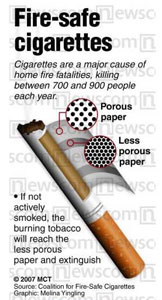
Missouri - fire-safe cigarettes delayed until January 2011..

Under the new law, the state's Revenue Department could impose a fine of $100 per pack on retailers who sell the non-fire safe cigarettes. The law applies to all brands of cigarettes, not just those manufactured in the U.S.
A fire-safe cigarette is designed to self-extinguish, because of bands layered into the tube, said David Sutton, spokesperson for Phillip Morris. These bands, or "speed bumps" as Sutton called them, slow the burn rate of a cigarette when the lit end crosses over them. Cigarettes containing these "speed bumps" tend to go out quicker than those with traditional tubes.
Although no changes to the tobacco have been made, some smokers have complained about a change in taste or the nuisance of having to relight their cigarettes, said David Howard, spokesperson for R.J. Reynolds Tobacco Co. Most smokers become accustomed to changes and complaint calls subside, Sutton said.
R.J. Reynolds will begin producing only fire-safe cigarettes at the end of 2009, Howard said, and Phillip Morris hopes to make all of its cigarettes fire-safe by the first half of 2010, Sutton said. Phillip Morris began shipping only fire-safe cigarettes to Missouri in July, 2009.
All states except Wyoming have adopted fire-safe cigarette laws, though 16 states, including Missouri, have delayed implementation until 2010 or 2011, according to the national Coalition for Fire-Safe Cigarettes.
Reference: Switch to fire-safe cigarettes delayed until 2011 by Jeremy Essig, Missourian, 8/27/2009.
Read more...
Wisconsin - tobacco taxes to go up tomorrow, Tuesday, September 1, 2009....

Securing the higher tax was part of a one-two punch secured by anti-smoking advocates this year. The other was convincing the Legislature to pass a statewide anti-smoking ban that takes effect on July 5, 2010.
Those who fought for the ban and the tax increase say it provides those looking to quit, like Maurice "Moe" Bird of Waterloo, with more motivation. Bird, a 41-year-old auto mechanic, used to spend about $30 a week on cigarettes before he quit about two years ago. But a few months later he started smoking cigars, which now cost him about $15 a week. Bird said he's going to use the new tax increase as a reason to stop smoking cigars cold turkey. "I basically can't afford it," he said of his habit.
Taxes on other tobacco products are also going up Tuesday in Wisconsin. The chewing tobacco tax goes up to 100 percent of the manufacturer's wholesale price and the tax on other tobacco products, including cigars and pipe tobacco, goes from 50 percent to 71 percent of the wholesale price. The amount of the tax will vary depending on the price of each product: the cheaper the tobacco or cigar, the less the tax. However, the tax on cigars is capped at no more than 50 cents per cigar.
"There's a lot of folks who attempted to quit when the dollar increase went up and they might not have been successful," said Maureen Busalacchi, executive director of SmokeFree Wisconsin. "This gives them another impetus to try. We know the more you attempt to quit, the more successful you will be."
Don Marx, a 65-year-old retired elementary school gym teacher, said he quit smoking in 2006 after developing throat cancer. Once he quit, Marx decided to put the $120 a month he had been spending on cigarettes into a separate savings account. He's tapped the fund four times since to take golf trips to Myrtle Beach. Marx said he supports the tax increase and hopes it motivates others to follow his example.
"If anything it's going to hurt the kids who are starting to smoke," he said.
Nationwide, the average price for a pack of cigarettes is $5.12, according to the Campaign for Tobacco-Free Kids. Wisconsin's cigarette taxes will go from 16th to fifth highest on Tuesday.
While health advocates are heralding the increase, it presents a problem for retailers in businesses along the borders where cigarette taxes are much lower in neighboring states. The per-pack tax is just 98 cents in Illinois, $1.36 in Iowa, $1.50 in Minnesota and $2 in Michigan.
Groups representing Wisconsin grocery and convenience stores, along with gas stations, estimate that the tax increase will cut 25 percent to 40 percent of their non-fuel sales. Ironically, many of the stores are replacing the revenue lost from tobacco sales with healthier alternatives like salads and fresh foods.
"There's not 25 to 40 percent of the people quitting smoking, obviously," said Steve Loehr, vice president of operations for Kwik Trip, a convenience store chain with about 355 stores in Wisconsin, Minnesota and Iowa. "They're finding other places to buy cigarettes."
Stores along Wisconsin's borders are even more vulnerable to a loss in sales, officials with the groups representing roughly 3,000 stores said. The price difference on a carton of cigarettes in Iowa or Minnesota can be as much as $10 or $15, Loehr said.
The only smokers left are the die-hards who will continue buying no matter how high the taxes, said Julie Yahnke, owner of a Quik Stop in Holmen which is near the Minnesota border. She said she only sells about a carton a day; most buyers in her shop get a pack or two at a time.
Grocery stores are swimming upstream in the competition over cheaper cigarettes across state lines, tribal smoke shops and over the Internet, said Brandon Scholz, president of the Wisconsin Grocers Association. His group represents about 1,000 grocery and convenience stores in the state.
Those who pushed for the higher taxes say it's all about saving lives. Cigarette smoking results in an estimated 443,000 premature deaths each year, and costs the national economy $193 billion in health care expenses and lost time from work, according to the Centers for Disease Control and Prevention. Smoking is a major contributor to heart disease, cancer and lung disease.
The American Cancer Society estimates Wisconsin's new tax increase will stop 33,000 kids from starting to smoke and motivate 17,000 adults to quit.
After the $1 increase in January 2008, calls to the state's Tobacco Quit Line more than tripled. Busalacchi said her anti-smoking group was trying to publicize resources that are available to help smokers quit. "If you're a tobacco user, take advantage of it. Use it as an impetus to quit," she said of the tax increase. "Get a jump on New Year's. You're going to improve your health dramatically."
And while health advocates hope the higher tax motivates more people to quit lighting up, Gov. Jim Doyle and the Democratic Legislature are counting on the extra $335 million over the next two years to help with the state's bottom line. For the current two-year budget, cigarette and tobacco product taxes are nearly 6 percent of all taxes collected at $1.5 billion. That is fourth highest behind income, sales and corporate taxes. All money raised from cigarette and tobacco taxes goes into the state's general fund, which is then tapped to pay the majority of expenses related to running state government.
Reference: Wisconsin cigarette tax goes up Tuesday by SCOTT BAUER - Associated Press Writer, bnd.com, 8/30/2009.
Wisconsin related news briefs: U.S. - Midwest States smoking bans do not hurt business..; Wisconsin Governor Doyle signs smoking ban..; Wisconsin - legislature passes smoking ban in restaurants, bars and other businesses..; Count Wisconsin as the 26th state to ban smoking..; Wisconsin may be the 26th state to ban smoking in all bars and restaurants..; Wisconsin - Increased Sales Tax Decrease in Smoking..; Wisconsin's achieves the lowest adult smoking prevalence ever..; The primary reason to increase the tax on tobacco is to get smokers to quit and dissuade kids from starting..; Wisconsin cigarette tax and tax on other tobacco products to increase January 1, 2008..;Wisconsin to Increase Tax on All Tobacco Products..; Wisconsin voters overwhelmingly (2-to-1) favor upping cigarette taxes by $1.25 a pack..
Image - Maureen Busalacchi, executive director of SmokeFree Wisconsin with Governor Doyle..
Read more...

Turkey - smoking ban, cafes (teahouses) losing business, owners threaten to strike..

If it was not enough that the worst economic crisis in the past 60 years has ravaged the country's employment and consumption figures and driven down kahvehanes' customer base by up to 50 percent, the smoking ban, which came into full effect last month, has caused an estimated loss of an additional 20 percent of customers. Even Ramadan, a period when the kahvehanes have historically experienced an explosion in business, does not seem to be providing any respite to the plummeting business.
The situation of kahvehane owners has deteriorated so badly in the aftermath of the smoking ban that they have threatened political action ranging from sit-ins to strikes or even hunger strikes if the government does not address their concerns.
Kahvehane owners are worried that if the government does not take action and loosen the rigidity of its present smoking ban, half of the over 100,000 kahvehanes across the country will be squeezed out of business, causing the ranks of the unemployed to swell by hundreds of thousands.
Kahvehanes have, since time immemorial, been the sanctuary of retired and unemployed Turkish men wishing to escape the stresses of everyday life. It's therefore somewhat ironic that during this time of unprecedented unemployment -- which now stands at 13.6 percent -- these teahouses are not brimming with unemployed men whose numbers are expanding on an hourly basis. Instead, business is worse than ever.
İsa Güven, president of the Ankara Chamber of Coffeehouse Proprietors (AKO), told Sunday's Zaman that business was down by upwards of 50 percent as a result of the crisis. The smoking ban, he said, has taken an additional 20 percent bite out of the industry. He said that it was hard to untangle the effects of the smoking ban from the effects of the crisis.
Estimates vary, but according to some, about 70 percent of Turkey's adult male population smokes. In kahvehanes, those that Sunday's Zaman spoke with said that almost 100 percent of the customer base smokes. “Our potential customers are smokers,” said Murat Ağaoğlu, president of the 100,000-strong Turkish Teahouses and Canteens Federation (TKKBF).
“Given these circumstances, no one can come to a kahvehane where there is a smoking ban,” he said. He did not feel that the option of putting a few tables outside for men to smoke at, as has been the suggestion of many, was a particularly viable option. “If you put tables outside, the neighbors complain. Who wants to see a couple of tables crowded with a bunch of men playing cards and smoking below their apartment?”
But if the government does not take immediate action to improve the situation, Güven said, upwards of 50 percent of kahvehanes face the risk of closing their doors permanently, which would lead to a startling jump in unemployment. Ağaoğlu said that in addition to the 100,000 kahvehanes registered with the TKKBF, an additional 100,000 kahvehanes are not registered with the TKKBF, and when these are factored into the equation, the number of people “earning their bread” from the kahvehane business could amount to well over a million. Business never been worse..
“Very, very, very, very bad,” is how Muharem Öz, an employee at Altınyol teahouse in Osmanbey described the situation when asked by Sunday's Zaman how his business was holding up in the wake of the crisis and smoking ban. Standing in the doorway of a completely empty kahvehane with a lit cigarette in his hand (the cigarette was outside the door), he said that in all of his many years in the business, things had never been worse. Next to him were two older men squatting on the sidewalk of the mainly residential street, puffing on cigarettes and nodding their heads in agreement.
Business was so bad, Öz claimed, that he was not even able to determine whether or not the smoking ban had contributed to a further drop in business. “It doesn't matter,” he said when asked about the effects of the smoking ban. “There are no customers to drive away.”
According to him, Ramadan, a time when kahvehanes are traditionally smoke-filled dens overflowing with tea-drinking card players who stay there till the wee hours of the morning, has provided no relief: Business is down to alarming levels. “People just don't have any money to come,” he said. This year, he said, Ramadan was less busy than even the worst of normal times of past years.
A petition has been presented to the government asking for immediate action. Proposed has been the creation of smoking and non-smoking sections, separated by a partition with an air filter, or smoking and non-smoking kahvehanes. If no actions are taken, kahvehane owners and workers have threatened to launch a one-week strike. Some have gone so far as to threaten hunger strikes.
Reference: Cafe owners shun smoking ban, say many kahvehanes may close down, Today's ZAMAN, 8/31/2009.
Turkey - related news briefs:
Turkey - hundreds of cafe owners demonstrate against smoking ban..;
Turkey - small--scale retailers to demonstrate against smoking ban..;
Turkey - anti-smoking advocates happy with early results of smoking ban..; Turkey - smoker wounds manager and kills his friend when asked to stop smoking..
Turkey - cafe owners complain about smoking ban..;
Turkey - dangers of secondhand smoke media campaign..;
Turkish Government - makes major move to improve the health of its citizens..;
Turkey - smoking ban starting July 19th will be enforced - these guys are serious..;
Turkey - poll indicates employers, their employees and customers support smoking ban in cafes, bars and restaurants..;
Turkey - July 19th total smoking ban, will employees lose jobs..;
Turkey - on July 19, 2009 will mark the beginning of “100 percent smoke-free air” in this country..;
Turkey - national smoking ban starts July 19, 2009..;
Turkey - quit smoking photo displayed in İstanbul's Taksim Square..;
Turkey - data on tobacco usage - Turkish Statistics Institution..;
Turkey - smoking ban in all bars, restaurants and coffeehouses starting July 19, 2009..;
Smoking ban in Turkey lowers cigarette consumption..;
Turkey's ban on pubic smoking goes into effect on Monday, May 19, 2008..;
British American Tobacco (BAT) reported group volume sales up for first quarter 2008..;
More on the quick fix for outdoor smokers..;
BAT to Acquire Most of Denmark's ST..;
More on Philip Morris International of the Future..;
WHO Report on the Global Tobacco Epidemic 2008...
Read more...

College intramural or club sport students more likely less likely to smoke from hookah than cigarettes..
"This study demonstrates that many athletes clearly perceive hookah smoking as less of a concern than cigarette smoking," said Brian Primack, M.D., Ed.M., M.S., assistant professor of medicine and pediatrics at Pitt's School of Medicine and lead author of the study. "What they don't realize, however, is that they are exposing themselves to many of the same toxic chemicals contained in cigarettes."
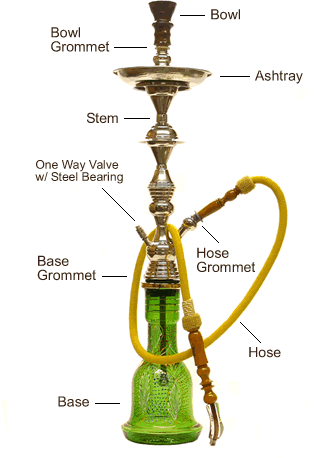
A hookah, or waterpipe, is used to inhale tobacco that usually is flavored or sweetened. The opening of hundreds of hookah cafes in the U.S. over the past decade demonstrates the increasing popularity of hookah smoking. Although the aesthetic appeal of the practice suggests that it is not harmful, studies show that hookah tobacco smoke is just as toxic as cigarette smoke and is associated with substantial harm and addictiveness. For example, one average hookah smoking session exposes the user to 40 times the tar of a single cigarette.
England - smoking a shisha pipe just as bad as smoking tobacco..
Researchers at Pitt examined survey data from 8,745 college-age individuals who participated in the National College Health Assessment administered by the American College Health Association in 2008, and found that 33 percent of the respondents reported participating in varsity, club and intramural sport in the preceding 12 months. Overall, 29.5 percent of the total sample reported having smoked from a hookah. Consistent with what has been reported in the past, all types of athletes were less likely than non-athletes to smoke cigarettes. Similarly, varsity athletes were 22 percent less likely than non-athletes to have smoked tobacco from a hookah. However, club and intramural participants were each 15 percent more likely than non-athletes to have smoked tobacco from a hookah.
"Varsity athletes may be particularly cautious with any type of substance use because of the demands of their sport and the seriousness of their athletic commitment," said Dr. Primack. "But club and intramural athletes clearly perceive this as a safer form of tobacco use. We in public health need to impress upon them that it is not."
PAPER: Waterpipe and Cigarette Smoking Among College Athletes in the United States, Brian A. Primack, M.D., Ed.M., M.S.abcCorresponding Author Informationemail address, Carl I. Fertman, Ph.D., M.B.A., C.H.E.S.d, Kristen R. Rice, M.P.H.b, Anna M. Adachi-Mejia, Ph.D.e, Michael J. Fine, M.D., M.Sc., Journal of Adolescent Health, ABSTRACT...
Reference: Many College Athletes Reject Cigarettes But Smoke Hookah, Pitt Study Finds, Medical News Today, 8/27/2009.
A few related news briefs: England - smoking a shisha pipe just as bad as smoking tobacco..; Mumbai, India - NGO activists want closure of hookah bars..; England - Shisha bars still open if comply with the smokefree legislation..; Hookah is worse than smoking cigarettes..; Sheesha (Shisha, Hookah, Narghile, Waterpipe) As Harmful as Cigarettes, says Expert..; Dangers of hookah (waterpipe) smoking - Harvard Mental Health Letter..; Hookah smoking popular among college crowd..; Hookahs on college campuses becoming growing public health issue...
Read more...


To Provide Public Awareness
Purpose
About Us
Contact Us
2008 HIGHLIGHTS
TOPIX PAPERS - 2008 & 2009..