Bulgaria - female tennis player Tsvetana Pironkova upsets Venus Williams at Wimbledon..


June 29, 2010 - Bulgarian tennis player Tsvetana Pironkova beats Venus Willams (the #2 seed) 6-2, 6-3 at Wimbledon - one of the four Grand Slam Tennis tournaments..

Ms. Pironkova is the first Bulgarian tennis player to ever reach the semi-finals at Wimbledon.


Reference: Boston Globe on Pironkova: 'Star' Now Has Bright Future, Novinite.com, 6/30/2010.


Read more...

U.S. PACT Act takes effect Tuesday, June 29, 2010..


June 28, 2010 - The new PACT (Prevent All Cigarette Trafficking) law begins on June 29, 2010. After this date, all cigarettes, including roll-your-own tobacco and smokeless tobacco, cannot be mailed y the United States Postal Service (USPS), except in certain instances. Cigars can still be sent through the mail.

The new law requires that all shipments of cigarettes and smokeless tobacco (except for shipments within Alaska and Hawaii – see below) must be sent with a service that provides tracking and confirmation of delivery. Therefore, USPS® will require Express Mail® service to be used to send any package containing cigarettes and smokeless tobacco through the U.S. Mail, using one of the exceptions provided in the law.

The main goal for passage of the PACT Act: to Protect Our Children - Make it illegal to use the U.S. Postal Service to deliver any form of tobacco product..

USPS PACT - Frequently Asked Questions..

Some PACT related news briefs:
U.S. PACT Law takes effect June 29, 2010..;
President Obama Signs PACT Act Into Law..;
U.S. House passed PACT Act again now awaits presidential signature and it's law..;
U.S. Senate - unanimously passes the PACT Act..;
Disappointment - U.S. legislators from New York State are delaying passage of PACT Act..;
NATO - urging retailers to call their U.S.Senators to get the PACT Act passed..;
U.S. let's get the PACT bill passed by congress and then signed into law..;
NY State - Seneca Indians - lobbying against the PACT act.;
U.S. - Senate Judiciary Committee Approves PACT ACT..;
U.S. - Senate Committee scheduled to vote on PACT..;
Web-Based Companies must stop selling flavored cigarettes..;
Internet, Flavors everywhere - snuff being marketed to kids as hip, cool and healthy..;
U.S. customs officials bar imports bearing the Philip Morris USA trademark..;
Let's Get It Passed - Prevent All Tobacco Trafficking Act of 2009..;
U.S - PACT legislation passed by House..;
U.S. - PACT Legislation to be considered by House this month..;
We must get the United States Postal Service (USPS) out of the tobacco delivery business..;
PACT Legislation now in the U.S. Senate Judiciary Committee..;
U.S. House Passes Bill to Prevent Tobacco Delivery By Mail..;
We must get the United States Postal Service (USPS) out of the tobacco delivery business..
Protect Our Children - Make it illegal to use the U.S. Postal Service to deliver any form of tobacco product...
Read more...

Oregon Supreme Court rejects smoker's $100 million damage award..


June 28, 2010 The Oregon Supreme Court on Thursday, June 24th upheld a lower court’s ruling that set aside a $100 million punitive damages award brought by a smoker of Philip Morris cigarettes. The court ruled that Philip Morris USA was entitled to a new trial because of constitutional violations during the original trial in Multnomah County Circuit Court, which began in 2000. Specifically, the Supreme Court said the trial court erred in its instructions to the jury on punitive damages.

It remanded [sends an appealed case back to the trial court for further action] the case to the circuit court for a new trial limited to the question of punitive damages.

Background:
In this case, which was originally (see paragraph below) brought 10 years ago in 2000, a Multnomah County jury awarded approximately $168,000 in compensatory damages and $150 million in punitive damages against PM USA, and the trial court later reduced the punitive award to $100 million. In 2006, an intermediate appellate court affirmed the compensatory award, but reversed the punitive damages award and ordered a retrial on punitive damages.

The original lawsuit was filed by Paul Scott Schwarz on behalf of his late wife, Michelle Schwarz. The suit accused Philip Morris of negligence, strict product liability and fraud in the manufacture, marketing, and research of the company’s low-tar cigarettes. According to court documents, Michelle Schwarz switched to the Philip Morris low-tar Merit cigarette brand in 1976. She continued to smoke one pack of cigarettes a day after she switched brands, believing that low tar and nicotine filters weren’t as unhealthy as “full-flavored” cigarettes. She died in 1999 at age 53 from a brain tumor that was the result of metastatic lung cancer.

In 2006, the Oregon Court of Appeals affirmed the compensatory damages but ordered a retrial on punitive damages. The case then made its way to the Oregon Supreme Court. It was argued and submitted last November 2009.
The Oregon Supreme Court held that the trial court violated the U.S. Constitution by allowing the jury to impose punitive damages to punish for harm to non-parties,. The U.S. Supreme Court has ruled that constitutional restrictions forbid imposing punitive damages on such a basis.

References: PM USA Entitled to New Trial Oregon Supreme Court rejects punitive damage award, CSP Daily News, 6/28/2010; Oregon High Court Voids $100 Million Punitive Awards, Grants New Trial On Amount, Posted by Gerald C. Matics, (gerald.matics@lexisnexis.com.), Litigation Resource Community, 6/28/2010.
Read more...

U.S. Supreme Court - rejects appeal from U.S. Justice Department, also rejects appeal from tobacco companies..


July 28, 29010 - The U.S. Supreme Court today, June 28th rejected the Justice Department’s bid for as much as $280 billion in tobacco company profits, refusing to hear an Obama administration appeal.

The court also rejected, without comment, an appeal by the tobacco companies of a ruling by a lower court that the companies had violated racketeering law by conspiring to lie for years to sell tobacco products they knew were dangerous. But the elimination of any potential for a large payout was seen as a victory for cigarette makers.

Background..
The U.S. government and three cigarette makers separately asked the U.S. Supreme Court on Friday, February 19th to review a racketeering verdict against major tobacco companies that was upheld by an appeals court last year.

For more background information click on the following: U.S. federal govt and 3-cigarette makers asked the Supreme Court to review racketeering verdict..
It is now critical that the trial court move forward with strongly enforcing the remedies that it did order. These include requiring the tobacco companies to make corrective statements about the health risks of smoking and secondhand smoke and their deceptive practices through newspaper and television advertising, on their web sites and on cigarette packaging. The trial court also ordered the tobacco companies to report marketing data annually to the government, extended and expanded current requirements that the cigarette manufacturers make public their internal documents produced in litigation, and prohibited the companies from committing acts of racketeering or making false, misleading or deceptive statements about cigarettes and their health risks in the future. The court also banned deceptive cigarette labels such as "light" and "low-tar," a ban that has already taken effect as a result of a new federal law granting the U.S. Food and Drug Administration (FDA) authority over tobacco products.

References: UPDATE 3-Supreme Court rejects appeal for tobacco damages by James Vicini and Emily Stephenson (editing by John Wallace and Matthew Lewis), Reuters, 6/28/2010; U.S. Supreme Court Upholds Verdict that Tobacco Companies Conspired To Deceive American Public and Addict Children, Matthew L. Myers, President, Campaign for Tobacco-Free Kids, 6/28/2010.
Read more...

Wisconsin - with smoking ban coming tavern league selling discounted e-cigarettes - is this legal??

June 28, 2010 - In advance of the state's smoking ban on July 5, the Brown County Tavern League is selling electronic cigarettes, battery-powered devices that use liquid nicotine to imitate a cigarette's taste and effects is selling electronic cigarettes, battery-powered devices that use liquid nicotine to imitate a cigarette's taste and effects. (Green Bay, WI is in Brown County)
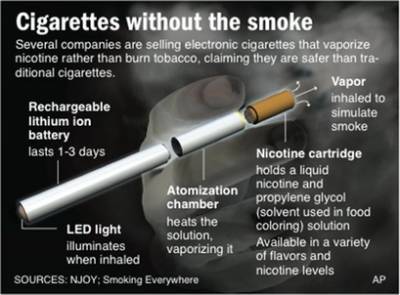
The league began selling the devices in March, and the demand from bars and taverns around the state has been "crazy," said Brown County Tavern League President Sue


The Tavern League of Wisconsin is a non-profit trade association dedicated to serving the needs of the retail beverage alcohol segment of the hospitality industry in the State of Wisconsin. (Tavern League of Wisconsin)


Brown County Tavern League President Sue Robinson, "We're hoping that it'll keep our smoking customers comfortable and coming to our business," said Robinson, who sells the devices through her tavern.

Electronic cigarettes - study finds not an effective nicotine delivery system..

Units can cost more than $100, but the league charges $60 each because Robinson said the organization buys directly from a distributor called AirE8. The league also sells 10 refills of nicotine for $15. One refill of nicotine can equal one-and-a-half packs of normal cigarettes, which is less expensive than a pack of cigarettes, the cheapest being $5.59, without tax.

We do not understand why these e-cigarette devices are being sold in the US. The importation of e-cigarettes was banned indefinitely as the result of a unanimous ruling by the U.S. Court of Appeals. (U.S. - federal appeals court, import of e-cigarettes on hold again..)

Just recently, on June 14th by the American Medical Association (AMA) recommended that electronic cigarettes (e-cigarettes) be classified as drug delivery devices, subject to the same FDA regulations as all other drug delivery devices. The AMA supports prohibiting the sale of e-cigarettes that are not FDA approved. (US AMA policy - e-cigarettes FDA should treat as a drug delivery device..)

In order for any drug or drug delivery device to be marketed in the U.S., it must first be approved by the FDA. To gain FDA approval, the company intending to market a specific drug must conduct clinical tests to demonstrate that the drug is both safe for use and that it works for the purpose for which it is intended. Once clinical testing is complete, the results are presented to an FDA panel of experts for evaluation. If the panel believes the clinical test results demonstrate both safety and efficacy, the drug is recommended for approval. (e-cigarettes - FDA approval needed prior to marketing..)

The devices have been banned inCanada and Australia.

Reference: Brown County Tavern League sells e-cigarettes as alternative after ban by Ilissa Gilmore (igilmore@greenbaypressgazette.com), GreenBaypressGazette.com, 6/27/2010.

Click on image to enlarge..

Read more...