 February 16, 2008 - Head-to-Head Discussion.. Dr. John Britton Professor of Epidemiology at the City Hospital Nottingham. Smoking currently kills over 100,000 UK citizens each year. Currently 77% of UK smokers want to quit and 78% have tried and failed, mainly because of nicotine addiction. Britton believes that, as a measure of last resort in smokers who have tried all other cessation and substitution options, doctors would be justified in suggesting an individual trial of snus. Whether this approach will prove effective remains to be seen and desperately needs to be tested in clinical trials, he concludes. Dr. Alexander Macara, President of the National Heart Forum, Bristol argues that this Britton's approach could result in increased use of tobacco. He points to evidence that smokeless tobacco is carcinogenic to humans. Studies have also shown increases in the risk of oral and pancreatic cancers and heart attacks related to the use of various smokeless tobacco products. Macara fears that, if legalised, snus might be taken up by people, especially the young, who might never have smoked tobacco but who may then progress to doing so. ERROR: the sentence: He (Macara) acknowledges that smokeless tobacco is less addictive than smoked tobacco, but warns that at least 60% of people who use snus to quit smoking become chronic snus users. Smokeless Tobacco is NOT less addictive than tobacco smoking in fact nicotine blood levels last longer and may even be higher when using smokeless tobacco (the pH of the smokeless tobacco is usually adjusted upward to increase absorption of nicotine in the oral cavity.(Maximum levels of nicotine were similar but, because of prolonged absorption, overall nicotine exposure was twice as large after single exposures to smokeless tobacco compared with cigarette smoking (Benowitz et al., Clin Pharmacol Ther. Jul;44(1):23-8, 1988) (Should doctors advocate alternative sources of nicotine? Head to Head: Should doctors advocate snus and other nicotine replacements?), BMJ - Press releases Saturday 16 February 2008) "There is no evidence smokeless tobacco can help people quit smoking. There are no studies we would consider sufficient." Dr. Terry Pechacek, Associate Director of Science at the Centers for Disease Control Office on Smoking and Health. (SNUS the BUMP, Nordic Reach (The Scandinavian Lifestyle Quarterly}, No.17 Volume XIX, 2007, p53). The vast majority of inveterate smokers will not learn the art of snusing. Murray Kessler, Chief Executive Officer of UST, Inc - the world's leading producer of moist smokeless tobacco products - tells us that 9 out of 10 smokers that try smokeless reject the product. Dr. Britton was soundly defeated in a debate on the topic of the use of snus by Dr. Lewis Keir at the first National Conference for the British Association for Stop Smoking Practitioners in Manchester on September 26, 2007. As pointed out by Dr. Britton himself "It's their (tobacco companies) job to sell as much tobacco as possible, so they will be targeting non-smokers rather than current ones, that's the worry." The initial test marketing of snus in the states by traditional cigarette companies has failed and these companies are either removing the product or calling for more education and public awareness. The EU ban on SNUS must be upheld or all of Europe will end up with another generation of nicotine addicts never able to reach their full potential. (TobaccoWatch.org)
Read more...
SNUS use in Inveterate (long established, deep-rooted, in-grained) Tobacco Smokers..

Vehicles Most Dangerous Space for Second-Hand Smoke Levels..
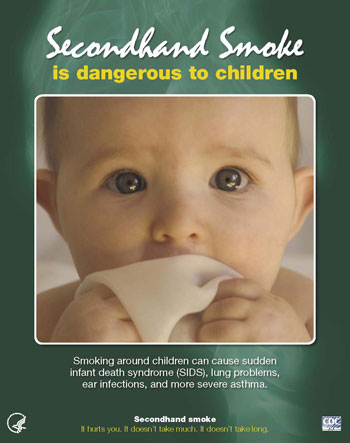 February 16, 2008 - Vehicles Most Dangerous Space for Second-Hand Smoke Levels.. New research shows that the concentration of second-hand smoke (SHS, passive smoking, involuntary smoking, environmental tobacco smoke, ETS) particles in a car can be up to 60 times higher than concentrations indoors, more than double previous findings. ( A Harvard School of Public Health report indicated that secondhand smoke in cars can be up to 10 times more of a health risk than secondhand smoke in a home. - TM) Ontario doctors believe this research and other recent findings on in-car smoke concentrations will aid the government in moving quickly to implement a provincial ban on smoking in vehicles when children are present. "We now have new evidence showing the harmful levels of second-hand smoke in a car are even more potent than we once believed," said Dr. Janice Willett, President of the Ontario Medical Association (OMA). "These important findings should be heard by both caregivers who smoke and our lawmakers so that children can be protected." For children, the risks associated with SHS include respiratory illnesses (asthma, bronchitis and pneumonia), middle ear disease, lower respiratory tract infections, as well as sudden infant death syndrome (SIDS) and increased incidences of cancer and heart disease in adulthood. In December 2007, Nova Scotia became the first province in Canada to pass legislation banning smoking in cars with children. Most recently, British Columbia announced that it will be introducing similar legislation. This follows on the heals of a growing list of U.S. jurisdictions that have already implemented bans including California; Arkansas; Louisiana; Bangor, Maine; Keyport, New Jersey; and Rockland County, New York. South Australia has also taken action to protect children from the dangers of SHS in vehicles. Some related news briefs: Ban on smoking in cars when children are present.., California bans smoking in cars with kids.., Smokers have already been banned from New York bars and restaurants, and soon they could be prohibited from lighting up in cars carrying minors.. and When a parent brings a child into this world... Quit Victoria (Australia) surveys of smokers have found that 90% would support a ban on smoking in cars when children are present - So Let's Get It Done - it's a no-brainer. Click on image to enlarge..(TobaccoWatch.org)
Read more...
High incidence of passive smoking found..
 February 14, 2008 - Serving staff in bars and restaurants could well be passively (ETS, secondhand, involuntary) smoking the equivalent of up to 38 cigarettes a day, a study has found. The report, released by the Valais Anti-Smoking Centre, is said to be one of the first of its kind to quantify the effects of inhaling second-hand smoke. Researchers gave out to the public 1,500 special nicotine-measuring devices in badge form at the beginning of 2007; 630 were given back six months later. It was found that almost all the badge wearers, aged from three months to 82 years old, were subject to second-hand smoke. The most badly affected were serving staff - inhaling the equivalent of 15 to 38 cigarettes per day, depending on their place of work. 5.7 per cent were barely affected and the rest were subjected to the equivalent of one to more than ten cigarettes a day. The results of the study have been published in the Swiss Medical Review. ( High incidence of passive smoking found.., swissinfo.ch, 2/13/2008) Some related news briefs: Acute asthma death associated with work-related ETS.., WHO Report on the Global Tobacco Epidemic 2008.. and Congratulations to Richard H. Carmona, M.D., MPH,. Click on image to enlarge..
Read more...
The Word From Dallas - Test Market for Marlboro SNUS..
 February 13, 2008 - When Marlboro SNUS first arrived, it seemed very expensive, but now there are deep discounts and price promotions. A lot of the promotion has been in conjunction with Marlboro cigarettes – promotional signs on cigarette displays, samples of snus and coupons in cigarette packs, etc. Sales reportedly are not going well. The product is not appealing to traditional dippers. Smokers tend to not like it, but some say they are ordering true Swedish SNUS on the Internet. Some say they are using it to quit cigarettes. Others who have tried snus say they prefer Camel and the refrigeration for that product gives it a better flavor. A few stores in the Dallas area are now selling Camel Snus. In East Texas Camel Snus is showing up in the Nacogdoches area. A teenager indicated that his peers love it because they can use it “under the radar” without anyone knowing – which all tobacco control professionals have suspected since this stuff was first introduced. Some store clerks didn’t even know it is a tobacco product and were unaware that they could not sell it to minors – they thought they were breath mints or something. - Many thanks to Darah Waldrip and Betty Boenisch, Tobacco Prevention and Control, Texas Department of State Health Services. Some related news briefs: With organic (internal) development in the smokeless tobacco arena failing look for Philip Morris USA to expand through acquisitions.. and Marlboro MST / Marlboro SNUS - Philip Morris USA (PM) Trying to Paint a Rosie Picture.. Click on image to enlarge..
Read more...
February 13, 2008 - When Marlboro SNUS first arrived, it seemed very expensive, but now there are deep discounts and price promotions. A lot of the promotion has been in conjunction with Marlboro cigarettes – promotional signs on cigarette displays, samples of snus and coupons in cigarette packs, etc. Sales reportedly are not going well. The product is not appealing to traditional dippers. Smokers tend to not like it, but some say they are ordering true Swedish SNUS on the Internet. Some say they are using it to quit cigarettes. Others who have tried snus say they prefer Camel and the refrigeration for that product gives it a better flavor. A few stores in the Dallas area are now selling Camel Snus. In East Texas Camel Snus is showing up in the Nacogdoches area. A teenager indicated that his peers love it because they can use it “under the radar” without anyone knowing – which all tobacco control professionals have suspected since this stuff was first introduced. Some store clerks didn’t even know it is a tobacco product and were unaware that they could not sell it to minors – they thought they were breath mints or something. - Many thanks to Darah Waldrip and Betty Boenisch, Tobacco Prevention and Control, Texas Department of State Health Services. Some related news briefs: With organic (internal) development in the smokeless tobacco arena failing look for Philip Morris USA to expand through acquisitions.. and Marlboro MST / Marlboro SNUS - Philip Morris USA (PM) Trying to Paint a Rosie Picture.. Click on image to enlarge..
Read more...
Acute asthma death associated with work-related ETS..
 February 12, 2008 - A young asthmatic woman who collapsed and died shortly after arriving for her shift as a waitress at a bar may be the first reported death to be reported nationally from acute asthma associated with environmental tobacco smoke (ETS, second hand smoke, passive smoking, involuntary smoking). The case report (Am J Ind Med 51:111-116,2008) states the woman arrived at the bar in Michigan and, according to co-workers, seemed happy and healthy. About 15 or 20 minutes later she collapsed and within a few minutes died. "This is the first reported acute asthma death associated with work-related ETS," said Kenneth Rosenman, a Michigan State University professor of medicine and chief of the Division of Occupational and Environmental Medicine. "Recent studies of air quality and asthma among bar and restaurant workers before and after smoking bans support this association."This death dramatizes the need to enact legal protections for workers in the hospitality industry from secondhand smoke." We have federal laws that say employers have to provide a safe and healthy workplace. This was clearly not a safe and healthy workplace for this employee. "This death dramatizes the need to enact legal protections for workers in the hospitality industry from secondhand smoke." In the United States, 23 states have already banned smoking in restaurants and bars. A number of other states, including Michigan are considering it. "Consider that 75 percent of the population doesn't smoke," he said. "Banning smoking could actually serve to increase business. Studies of restaurants and bars in Boston, New York City, San Francisco and Washington D.C. all show business up since they banned smoking. Chicago went smoke free the beginning of this year." (First reported acute asthma death associated with work-related environmental tobacco smoke, News-Medical.Net, 2/11/2008) Some related news briefs: When a parent brings a child into this world they want the child be healthy and to live a happy and enjoyable life.., Banning tobacco smoking in public places is a public health issue and not a property rights or business rights issue.. and For your pet's sake, keep your home and car tobacco-free...
Read more...
Italy - smoking ban results in sharp fall in heart attacks..
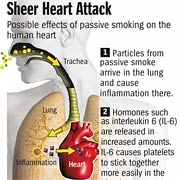 February 12, 2008 - Italy's 2005 smoking ban has led to a sharp fall in heart attacks, researchers reported in a finding they said shows that such laws really do improve public health. Following the ban the number of heart attacks in men and women aged 35-64 -- people most likely to be exposed to smoke in cafes, bars and restaurants -- fell 11 percent, the researchers said.
The findings showed the health benefits of European smoking bans in public places, said Francesco Forastiere, an epidemiologist at the Rome Health Authority who led the study. "Most of this change is due to the decreased impact of passive smoke," he said in a telephone interview. "This is ... important because it shows the impact of a health intervention that can be achieved in other countries."
The ban in Italy, where the researchers said about 30 percent of men and 20 percent of women smoke, prohibited smoking cigarettes in all indoor public places such as offices, retail shops, restaurants, pubs and discos.
The researchers compared the rate of heart attacks from 2000 to 2004 to those occurring in the year after the ban was enforced. The team analyzed hospital records and adjusted for heat waves, flu epidemics, air pollution and other factors that could have contributed to heart attacks. The researchers also took daily measurements on air quality in 40 public places.
After the ban, cigarette sales also fell 5.5 percent but the researchers attributed the health benefits seen in the study to reduced exposure to passive smoke. They said young men and women living in poorer areas appeared to have the greatest health benefit after the ban.
Reference: Heart attacks drop after Italy's smoking ban: study, Reporting by Michael Kahn, Editing by Maggie Fox, Reuters, 2/11/2008.
Click on image to enlarge..
Read more...
More on Philip Morris International of the Future..
 February 12, 2008 - More on Philip Morris International of the Future.. When Altria's international cigarette unit (PMI) gets its independence on March 28, 2008, it will move quickly to pursue sales more aggressively without ties to its American counterpart. Lausanne, Switzerland-based Philip Morris International has said that it would rank as the biggest non-governmental cigarette maker in the world, behind the state-owned China National Tobacco. The separation could shield PMI from U.S. legal and public relations issues, such as pressure by antismoking groups to curb sales in developing countries and a U.S. court decision in the so-called Kessler case that says PMI cannot use the "light" and "low-tar" labels to market cigarettes. Philip Morris International, which has operations in 160 countries, has a slew of tobacco products ready to take advantage of growth in emerging markets. It is selling the shorter Marlboro Intense in Turkey; a clove-based cigarette called Marlboro Mix 9 in Indonesia; Marlboro Filter Plus in South Korea, Russia, Kazakhstan, Romania and Ukraine; and the thicker Marlboro Wides in Switzerland, Germany, Sweden, France, Japan and Mexico. In Hong Kong, it is selling Marlboro Fresh Mint and Marlboro Crisp Mint. Philip Morris International reported 2007 gross revenue of $55.1 billion, compared PMUSA's $18.49 billion. Some related news briefs: January 24, 2008, December 10, 2007 and September 28, 2007.
Read more...
Want To QUIT Smoking - Ask Philip Morris For Help..
 February 11, 2008 - Just ask Philip Morris(PM) executives and they'll tell you that the company strives to be socially responsible. The Chairman and CEO of PM USA Michael E. Szymanczyk will tell you that his company is involved in a number of tobacco prevention activities. They even have introduced programs to help smokers who decide to quit be more successful. Mr. Szymanczyk, "While this may seem counterintuitive to some, we are focused on ensuring that consumers who interact with our company have a great experience, including when they decide to quit smoking. The evidence indicates that many of our consumers will, at some point, decide to stop using our products. We want to be there to help them succeed when they make that decision with the launch of the QuitAssist initiative."
According to the Centers for Disease Control and Prevention (CDC), more than 70 percent of smokers want to quit. So why isn't PM helping these people free themselves of a life of tobacco and nicotine dependence?? Instead PM is rewarding adult smokers for their loyalty to Marlboro cigarettes by providing unique experiences for these smokers. The experiences range from trips to experience Marlboro Country, a trip to Crazy Mountain Ranch in Montana, to getting behind the wheel at the Marlboro Racing School, or having an opportunity to ride shotgun with a pro-driver or to be invited with tens of thousands of other smokers to go out to your local race track as guests to see Marlboro Team Penske compete in the Indy Racing League. All, of these efforts have helped contribute to the retaining of market share by Marlboro - the world's most popular cigarette. For every 100 cigarette customers in the U.S. approximately 41 (for hispanic smokers this figure is close to 50) of these smokers will ask for Marlboro cigarettes. Philip Morris Looks to the Future, March/April 2007 Image - For its 50th anniversary, Marlboro introduced a new version of its Reds and Light cigarettes – the “72’s”. These shortened cigarettes come in smaller more metallic looking packs and are currently promoted as the anniversary packs of Marlboro’s 50th celebration. Philip Morris began shipping the 72’s in January 2005. Marlboro Turns 50 (TobaccoWatch.org)
Read more...


Congratulations.. Thailand Joins Developed World With Total Ban On Smoking..
 February 11, 2008 - Congratulations.. Thailand Joins Developed World With Total Ban On Smoking.. Thailand will extend its ban on smoking to air-conditioned bars and offices and outdoor markets next month, joining major developed countries in a war on tobacco, a leading Thai anti-smoking agency said on Friday. Smokers faced a 2,000 baht ($60) fine and owners who fail to enforce the law could be fined 20,000 baht ($600) after the ban takes effect on February 17, said the Thailand Health Promotion Institute, which helped push for the law. The smokefree law passed in November 2002 banned smoking in covered indoor public places, including air-conditioned restaurants but exempted nightclubs and bars. The Health Ministry ban could face opposition from some bar owners, group president Hatai Chitanondh said in a statement. "They may be thinking the Health Ministry is ruining their business, kicking away their customers, but our research papers show a smoking ban will bring more customers to them," Hatai said. The ban’s extension is being hailed by health advocates who say it is another milestone for tobacco control. Related News Brief: Thailand Discouraging Tobacco Use - Horrific Images on the Packaging.. Click on image to enlarge..
Read more...


To Provide Public Awareness
Purpose
About Us
Contact Us
2008 HIGHLIGHTS
TOPIX PAPERS - 2008 & 2009..