 February 28, 2009 - Twenty-six of the United States' leading tobacco control researchers and policy experts have called for regulatory control of all tobacco products. They also called for policies that encourage current tobacco users to reduce their health risks by switching from the most to the least harmful nicotine-containing products.
This group met in a two-year process they called The Strategic Dialogue on Tobacco Harm Reduction - members met four times between December 2005 and August 2007.
Their vision: a world in which virtually no one uses cigarettes. But the group acknowledged that smokeless-tobacco products are an option for reducing health risks for tobacco users. They also called for policies that encourage current tobacco users to reduce their health risks by switching from the most to the least harmful nicotine-containing products.
PAPER: Mitch Zeller et al., The strategic dialogue on tobacco harm reduction: A vision and blueprint for action in the United States, Tob Control 2009 0: 200802731, ABSTRACT..
We’re all for this safer alternative if distribution could be limited to inveterate tobacco smokers (smokers who are either unable or unwilling to quit). The harm reduction component envisioned by the American Association of Public Health Physicians would be part of a larger program, with "marketing" limited to satisfying the nicotine addiction of inveterate smokers at substantially less health risk than smoking.
Let's be realistic it would be impossible to limit distribution of smokeless tobacco products to inveterate tobacco smokers. As Professor John Britton, Chairman of the Royal College of Physicians Tobacco Advisory Group, a proponent of harm reduction solution has concluded, “It’s their (tobacco companies) job to sell as much tobacco as possible, so they will be targeting non-smokers rather than current ones, that’s the worry.”
Dr. Britton is correct in that tobacco companies have an entirely different goal in mind – they are already targeting a much younger crowd of young adults and any kids they can entice along the way - witness the tagline for Camel SNUS: "Pleasure for wherever." Or how about the ads that have be run in local papers where Camel SNUS was being test marketed. Smokeless tobacco manufacturers are very disappointed with the progress of the SNUS segment in total. The entire segment itself has gained very little traction, and we had plans to be more aggressive.
"There is no evidence smokeless tobacco can help people quit smoking. There are no studies we would consider sufficient." Dr. Terry Pechacek, Associate Director of Science at the Centers for Disease Control Office on Smoking and Health. (SNUS the BUMP, Nordic Reach (The Scandinavian Lifestyle Quarterly}, No.17 Volume XIX, 2007, p53). The vast majority of inveterate smokers will not learn the art of snusing. Murray Kessler, former Chief Executive Officer of UST, Inc - the world's leading producer of moist smokeless tobacco products - tells us that 9 out of 10 smokers that try smokeless reject the product. Smokers faced with the increased in the federal tax on cigarettes (effective April 1, 2009) have been telling clerks at c-stores they're thinking of quitting but hardly anyone has indicated they are thinking of switching to smokeless tobacco.
We surely don't want our children - our future leaders to end up being nicotine addicts never able to achieve their full potential. Take a look at the first of R.J. Reynolds new dissolvable smokeless tobacco products called Camel Orbs (candy-like product) next to a container of Tic-Tacs candies - quite similar.
Here's a statement from Dr. Brad Rodu’s web site TobaccoHarmReduction.org: “Of course, you can also try pharmaceutical nicotine products but unfortunately the available nicotine patches and gums are not designed to be good long-term alternatives to tobacco.” It seems to indicate they want the users to continue with their addiction possibly forever.
One of many related news briefs (do a random search of the archive): NO - don't even consider legalizing SNUS in Australia..
References: Experts in Government, Public Health, Public Policy and Science Outline Blueprint for Reducing Death and Disease From Tobacco in the United States, redOrbit, 2/24/2009; A World Without Cigarettes
Group acknowledges smokeless products are option for reducing health risks, CSP Daily News, 2/27/2009.
Read more...
U.S. group acknowledged that smokeless-tobacco products are an option for reducing health risks for tobacco users..

U.S. House Committee on Energy and Commerce - legislation to regulate tobacco,..
 February 27, 2009 - Legislation to put tobacco under control of the Food and Drug Administration will surface in the U.S. Congress next Wednesday, March 4, 2009 and may be passed along to the president early this year. The House Committee on Energy and Commerce chaired by Henry Waxman is expected to vote on the legislation on Wednesday, a spokeswoman, Karen Lightfoot, said Friday, 2/27/2009.
The legislation would set up a new office in the F.D.A., financed by industry fees, to focus on tobacco. It would allow further restraints on sales and marketing to young people, including stronger warning labels with graphic depictions of smoking-related illnesses.
The present bill should be carefully reviewed and revised where necessary to produce the best piece of legislation. Regulation of the tobacco industry is absolutely necessary but let's do it RIGHT this time. The Campaign for Tobacco-Free Kids (TFK) worked very closely with Philip Morris USA (PM), to produce this legislation. You can say the Campaign TFK got in bed with the enemy. Senator Michael B. Enzi (R-WY) said it best, "Poison peddlers shouldn’t get to decide how we as responsible legislators fight the war against their deadly products."
Matthew L. Myers of TFK has even said, “The election of Barack Obama changes everything.” We worry that the legislation will be flawed because the biggest player in the tobacco industry - Altria - Philip Morris USA (PM) has been directly involved in writing the bill. Mike Szymanczyk now the CEO of Altria, Inc. has told investors they were directly involved in the process of preparing the bill. (Remarks, Investor Presentation, 3/11/2008)
Prior to approval of this legislation PM is already working to circumvent the law. Citi bank tells shareholders that if the FDA begins to regulate the tobacco industry, it would make little difference. Many concessions have been granted to get tobacco companies to buy into this legislation weakening the bill even further. UST Inc. (now owned by Altria Group, Inc, the parent of PM), the biggest U.S. maker of smokeless tobacco products and the North American unit of Swedish Match AB which also sells smokeless tobacco announced they would support the bill. The bill was amended to give smokeless companies the ability to give away free samples to adults under limited circumstances which hadn't been allowed in earlier versions of the bill.
Dr. Joel L. Nitzkin, chairman of the tobacco control task force of the American Association of Public Health Physicians, criticized the compromise. “This bill will be worse than no bill at all,” he said in a phone interview. (FDA tobacco regulation - bill distorted in current form...
Archive of Supporting Documentation: Campaign for Tobacco-Free Kids - Need for FDA Regulation of Tobacco..; February 2009 - legislation FDA to regulate tobacco..; FDA Regulation Likely for Tobacco - Let's Do It RIGHT..; President--Elect Barack Obama and Tobacco..; Revise Senate's Version FDA Tobacco Regulation Bill..; FDA tobacco regulation - bill distorted in current form..; AWMA urges grassroots effort to defeat FDA tobacco regulation and SCHIP.."; More - Lorillard-Newport - FDA proposed tobacco regulation..; FDA Tobacco Regulation Bill Overwhelmingly Passed U.S. House..; House to Vote on FDA Regulation of Tobacco..; Bush administration opposes legislation to give FDA authority to regulate tobacco products...; With U.S. FDA tobacco regulations on the horizon Altria already preparing to circumvent the law..; Public health experts are questioning why menthol flavoring in cigarettes, received special protection as Congress tries to regulate tobacco..; Lorillard Tobacco opposes US FDA bill to regulate tobacco..; FDA regulation moves a step closer..; On Tuesday April 1, 1970 President Richard Nixon signed a measure banning cigarette advertising on radio and television, to take effect in January 1,..; FDA regulatory control tobacco bill is voted forward..; Reject Proposed Legislation That Would Add Responsibility For Tobacco Regulation to the FDA..; FDA Head: 'No' to Tobacco Cigarettes too "inherently dangerous" to regulate; would "undermine mission."; Federal tobacco regulation backed...; On July 18, 2007, the U.S. Senate Health, Education, Labor and Pensions Committee postponed a vote on the bill - which would for the first time allow...
Reference: House Bill Expected on F.D.A. Control of Tobaccoby DUFF WILSON, New York Times, 2/27/2009.
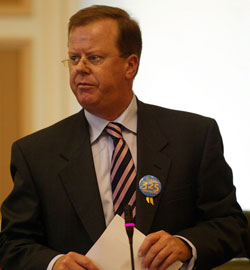
Image, Senator Edward M. Kennedy the sponsor of bill and Senator Senator Michael B. Enzi who has been against PM involved with writing this bill.
Read more...
U.S.: The Family Smoking Prevention & Tobacco Control Act (H.R. 1108)
 February 27, 2009 - With the passage of the State Children's Health Insurance Program (SCHIP) legislation the next item for consideration may be The Family Smoking Prevention & Tobacco Control Act (H.R. 1108). The legislation which would give the U.S. Food & Drug Administration (FDA) control over tobacco, could be back before Congress within a matter of weeks. Citigroup analyst Adam Spielman said last week, according to the Associated Press. "Given the Democratic control of Congress and the White House, we expect the bill to pass," he wrote in a research note.
Campaign for Tobacco-Free Kids - Need for FDA Regulation of Tobacco..
Reference: Tobacco Control on 'To-Do' List
Legislation to give FDA authority over tobacco products on front burner by Steve Holtz, Convenience Store / Petroleum CSP Daily News, 2/27/2009.
Read more...
Hong Kong - Tax on cigarettes pushed up by 50 percent..
 February 27, 2009 - The tax on cigarettes in Hong Kong was pushed up 50 percent Wednesday, February 25, 2009 to try to curb a worrying increase in smokers in the former British colony. Financial Secretary John Tsang Chun-wah, JP announced in his annual budget speech that the duty on each cigarette sold would be increased from 80 Hong Kong cents to 1.20 Hong Kong dollars (10 to 15 US cents).
The increase pushes the price of a packet of 20 cigarettes to almost 5 US dollars, still around half the price of cigarettes in Singapore or Australia.
"We will continue to step up our efforts on smoking cessation as well as on publicity and enforcement in tobacco control," Tsang told legislators.
A study last year found that smoking rates in Hong Kong have actually increased by around 14 percent since a ban on smoking in restaurants and bars came into effect in 2006. Anti-smoking campaigners have called for far heavier taxes on cigarettes and for the smoking ban to be enforced more rigorously.
Cigars have also been affected by the increase, but due to their more complex pricing structure, new price lists have yet to be released.
Anthony Hedley, of the University of Hong Kong's school of public health: "We are pleased that the tobacco companies are helping our cause by increasing the price further." Li Cheong-lung, from the Committee on Youth Smoking Prevention, said: "Price influence is one of the most important reasons of youth smoking.
New prices: Marlboro HK$39; Kent HK$39; Salem HK$39; Next HK$34; L&M HK$36; Dunhill HK$39; Davidoff HK$35; Winfield HK$34; Capri HK$41; Winston HK$35. (1HKD=0.1289USD=0.1017EURO=0.0903GBP)
As we would expect Philip Morris also expressed worries that the higher tax would provide business for illegal traders.
Related news briefs: Honk Kong - smoking increase raise tobacco duties??; Hong Kong - temporary smoking ban exemption ends July 1, 2009..; Hong Kong - after smoking ban cigarette consumption up 14 percent..; Hong Kong - public smoking ban - smoking rooms??; Shanghai Tobacco's Golden Deer Cigarettes - Hong Kong..; More on Philip Morris International of the Future...
Reference: Tax on cigarettes pushed up by 50 percent in Hong Kong by DPA, EarthTimes.com, 2/25/2009; Smokers left gasping at HK$10 rise in price of a packet of cigarettes by Bryony Taylor, South China Morning Post, 2/27/2009.
Read more...


Scotland to ban cigarette displays and outlaw cigarette vending machines..
 February 26, 2009 - Cigarette sales in Scotland will be further restricted after ministers announced plans today to outlaw cigarette vending machines and ban shops from openly displaying tobacco. The sweeping measures will include a new registration scheme for shops selling tobacco products, on-the-spot fines for retailers who sell to under-18s and sales bans against retailers who continually sell to underage smokers.
Ministers have dropped plans to ban the sale of cigarettes in packs of 10 – a measure opposed by retailers – after admitting there were doubts the devolved government was legally empowered to do so. They will, however, press for a UK-wide ban.
Ministers and the chief medical officer for Scotland, Harry Burns, said stricter and more rigorously enforced controls were needed to protect public health, and particularly to stop children smoking. Scottish public health minister, Shona Robison, said radical steps were needed to prevent children being lured into smoking; research had shown that someone who started smoking at 15 was three times more likely to die of cancer than a smoker who began in their mid-20s. "Point of sale marketing is a powerful tool and I believe it's totally inappropriate for cigarettes to be promoted in this way," she said. "Similarly, I believe there is no place in a modern Scotland for cigarette vending machines – we wouldn't allow any other dangerous product to be sold in this way." It was found that underage smokers made more than a third of vending machine purchases: one in 10 smokers aged 13 and 15 had used them.
The ban on displaying cigarettes mirrors similar measures in England where, like Scotland, the new rules will come into force for larger shops in 2011 and smaller retailers in 2013.
In March 2006, Scotland became the first part of the UK to ban smoking in public places. In October 2008, the minimum age for buying tobacco was raised to 18 along with the rest of the UK.
Related news briefs: Bar workers who smoke also benefit from smoking ban..; 17 countries in the world ban indoor smoking - ENFORCEMENT..; England, Wales to ban tobacco displays in shops..; Definite Health Benefits of Smoking Bans..; Northern Ireland raising age for sale of tobacco from 16 to 18 joining the other three United Kingdom (UK) countries..; Scotland proposes to implement more measures to discourage tobacco use including the banning of tobacco displays..; Raise Age to 21 to Purchase Tobacco Products...
Reference: Scotland to ban cigarette displays in stores Crackdown includes outlawing vending machines after research found underage smokers are among their main users, Severin Carrell - Scotland correspondent, Guardian.co.uk, 2/26/2009.
Read more...

Teen smokers may be at a greater risk of Multiple Sclerosis MS)..
 February 26, 2009 -People who start smoking before age 17 may increase their risk for developing MS, says study author Dr. Joseph Finkelstein of Johns Hopkins University School of Medicine. The study involved 87 people with MS who were among more than 30,000 people in a larger study. The people with MS were divided into three groups: non-smokers, early smokers who began before age 17 and late smokers, who started smoking at age 17 or older. They were matched by age, gender and race to 435 people without MS. Early smokers were 2.7 times more likely to develop MS than non-smokers, however, late smokers did not have an increased risk for the disease. More than 32 percent of the MS patients were early smokers, compared to 19 percent of the people without MS.
Studies show that environmental factors play a prominent role in multiple sclerosis, Finkelstein said in a statement. Early smoking is an environmental factor that can be avoided. The findings are scheduled to be presented at the American Academy of Neurology's 61st annual meeting in Seattle April 25-May 2.
With a Little Bit of Effort Every Youngster Can Succeed..
Reference: Teen smokers at greater MS risk, redOrbit, 2/23/2009.
Read more...
Ireland - ban smoking in cars when kids are present..

February 26, 2009 - In March 2004 Ireland became the first country in the world to impose an outright ban on smoking in workplaces. Now almost five years later TDs and senators have been urged to support a campaign by  to ban smoking in cars carrying children. The anti-tobacco group said the workplace smoking ban protected adults but there was no protection for children traveling in cars with smokers. It is holding a briefing for all members of the Oireachtas (The National Parliament (Oireachtas) consists of the President and two Houses: Dáil Éireann (the House of Representatives) and Seanad Éireann (the Senate), whose powers and functions derive from the Constitution of Ireland) in Dublin, Tuesday February 24, 2009 today to seek support for its campaign to ban smoking in cars where under-16-year-olds are present.
Ash Ireland's chairwoman Dr. Angie Brown said many countries had introduced such bans. "The ban is in place in several Australian regions, in parts of Canada and the United States, in Cyprus, and is under consideration in the Netherlands, South Africa and elsewhere. There is irrefutable evidence to show that a car can be 23 times more toxic than a home environment in the context of passive smoke," she said. She said children had much higher respiratory rates and metabolism than adults which made exposure to passive smoke in vehicles a serious health risk. "Children are unlikely to ask adults not to smoke when they are being transported - so we must take this important health initiative out of their hands by introducing legislation to address this issue," she said. Dr. Brown said the ban could be introduced within months if politicians supported it.
Environmentalist and television presenter Duncan Stewart said he would always urge parents not to smoke when driving with children. "However, the Government can make this easier for all of us by just banning the practice of smoking in cars transporting children - and people will comply with this," he said.
Banning smoking when children are in the home or car is a no-brainer - even Philip Morris agrees. - see 1st news brief below.
Reference: Smoking ban sought in cars carrying children by ALISON HEALY, IrishTimes.com, 2/24/2009.
Some related news briefs: Further evidence - STOP smoking in the presence of your children..;ASH Calls for a Debate in England on Banning Smoking in Cars with Kids; Among children with asthma, exposure to ETS is related to increased child behavior problems among boys..; U.S. - Children Remain Especially Vulnerable to Secondhand Smoke..; Maine - illegal to smoke in cars while children present.. and Vehicles Most Dangerous Space for Second-Hand Smoke Levels... For others - do a random search.
Read more...
Mississippi - with federal stimulus package passed cigarette tax loses momentum..
February 25, 2009 - Increasing the cigarette tax - once the dominant issue of the legislative session - has taken a back seat to the federal stimulus package..
When the legislative session began in early January, both House and Senate leaders spoke of the urgency to increase Mississippi's cigarette tax - the third lowest in the nation - to help with the budget woes caused by the economic slowdown.
But it appears that urgency was replaced with lukewarm interest when President Barack Obama signed the stimulus package into law.
State legislators - both Republican and Democrat - appear to be licking their chops to get the stimulus funds to help with everything from Medicaid to education to highway construction.
Even Republican Gov. Haley Barbour, who has made news nationally by saying he did not want to accept a portion of the funds, has made it clear that he intends to use a vast majority of the stimulus money dedicated for Mississippi.
Related news briefs: Mississippi - tobacco tax increase may pass this time..; U.S. States Considering Tobacco Tax Increase...
Reference: BOBBY HARRISON:Cigarette tax loses momentum as stimulus expectations rise, Northeast Mississippi Daily Journal, 2/24/2009.
Read more...
New Zealand - government may NOT support tobacco display bans..
 February 25, 2009 - Back on September 30,2008 we reported that the National Member of Parliament (MP) Jo Goodhew said its four MPs on the health select committee had voted against the ban because they believed "more robust international evidence" was needed.
The Government has until the end of February to respond to a health select committee recommendation that the display on these deadly products be banned at retail outlets such as dairies, convenience stores, supermarkets and service stations.
Research supports tobacco display ban in convenience stores and retail outlets. Paper: Evidence and arguments on tobacco retail displays: marketing an addictive drug to children? George Thomson, Janet Hoek, Richard Edwards, Heather Gifford, Journal of the New Zealand Medical Association, 20-June-2008, Vol 121 No 1276 ABSTRACT...
Smokefree Coalition Director Mark Peckhe: A survey of nearly 30,000 14 and 15-year-olds showed a significant association between tobacco displays and smoking susceptibility. "For the sake of our children's future health, we (Smoke Free Coalition) urge the Government to make the right decision and ban tobacco displays."
A call to ban tobacco displays from shops has not got the support of the National Government at this stage, New Zealand Prime Minister John Key says. Retailers Thank National Government Stay Displays Coalition based on comments from the Prime Minister - there would be no changes to the law on displays, Scoop Business News, 2/24/2009.
Action on Smoking and Health (Ash) NZ and other lobbyists have been pushing for tobacco displays to go, but a retail coalition has argued it would be expensive and ineffective.
High profile sports team doctor John Mayhew last week said the displays were essentially mini-billboards. "We can't afford to continue to send mixed messages to young people. There are plenty of anti-smoking messages around, yet to see tobacco sitting alongside bread and milk in shops like it is a normal everyday product contradicts those messages," Dr Mayhew said.
But Mr Key said evidence suggested such moves were not an effective way to tackle smoking as a health issue and he wouldn't support it. Mr Key said heavy tax and advertising restrictions were in place and the government sponsored plenty of quit smoking programs, but the costs to the likes of dairies of changing displays couldn't be justified.
OPEN LETTER to the people of New Zealand.. - NZ Drug Foundation.
Reference: No evidence tobacco ad ban works: NZ PM, theage.com.au, 2/24/2009; Time to ban cigarette ads in shops - Smokefree Coalition, stuff.com.nz, 2/16/2009.
Related news briefs: New Zealand More Evidence Needed to Ban Tobacco and Cigarette Displays..; More evidence - tobacco displays increase the risk of teens smoking..; Horror photos go on New Zealand cigarette packs..; Country to Eliminate Smoking - The South Pacific nation of Niue; Ireland to ban tobacco displays..; Smokefree NZ within 10 years..; By law, oral snuff cannot (but nasal snuff is allowed) be sold in New Zealand and can be imported only for personal use..
Read more...

NO - don't even consider legalizing SNUS in Australia..
 February 25, 2009 - Dr. Gunilla Bolinder, Chief Physician, Director of Studies and Education, Karolinska University Hospital, Stockholm points out, "To sing the praises of SNUS is a deathblow to over 20 years of hard tobacco preventive work. SNUS only saves the life of the tobacco industry" (SNUS gets the thumbs-down NEWS-24 1/31/2007).
Except for Sweden, snus is outlawed by the European Union (EU) (in May, 1992) mainly because it was believed it would be used above all by young people, and that oral tobacco contained particularly large quantities of carcinogenic substances even snus. (The use of snus is part of the Swedish heritage - its use dates back over 200 years.)
Bans have been placed on smokeless tobacco products in a number of countries, including Australia (in 1991), Israel, Hong Kong, New Zealand, Taiwan, Singapore, Japan, Saudi Arabia, Bahrain, Kuwait, Oman, Qatar and the United Arab Emirates.
In a recent communication with Queensland Health Minister Stephen Robertson MP tells us that Australia's toughest and most comprehensive tobacco control laws can be found in his state.
Then why in the world would they have an academic from the University of Queensland Dr. Coral Gartner wanting to bring another tobacco product into the country.
(Call to legalise 'snus' in Australia, by Danny Rose, Medical Writer, The Sydney Morning Herald, 2/23/2009) Professor Wayne Hall colleague of Dr. Gartner - Encourage Smokeless Tobacco Use Though Banned in Australia Since 1991..
They must realize that all tobacco products with no exceptions are highly addictive and dangerous to health; as the World Health Organization tells us "Tobacco is Deadly in Any Form or Disguise."
Not enough is known about smokeless tobacco. As pointed out by Marita Broadstock in her systematic review (Systematic Review of the health effects of modified smokeless tobacco products, NZHTA Report, February 2007, Volume 10 Number 1), the number of studies on smokeless tobacco is relatively slight compared to the wealth of literature published relating to smoking.) More and more studies are surfacing about the dangers of smokeless tobacco.
Selection of supporting news briefs from the archive..
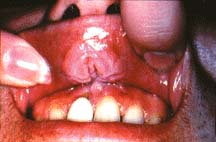
1st image placement of a snus packet and the 2nd an oral lesion induced by sucking on snus bags.
Dr. Goran Boethius, pulmonary specialist and in Sweden Chairman of Doctors Against Tobacco: only five percent of all adults men in Sweden have quit smoking with the use of snus. (Sweden Tobacco Control 2006 Progress & Challenge - both are greater than ever) Michael Thun, MD, American Cancer Society, Vice President of Epidemiology and Surveillance Research - "There is no evidence that smokers will switch to smokeless tobacco products and give up smoking. Encouraging smokeless tobacco use is not only a dangerous tactic in the drive to reduce smoking rates, but scientifically unproven as well.."
The levels of one of the carcinogens in snus, namely nitrosamines, may be lower than in most U.S. brands but the levels are at least 100 times greater than the nitrosamine levels permitted by the United States Department of Agriculture in any non-tobacco product on the U.S. market. (Communication with Dr. Stephen S. Hecht, an internationally recognized expert on cancer-causing agents in tobacco.)
Sir Alexander Macara: if legalized, snus might be taken up by people, especially the young, who might never have smoked tobacco but who may then progress to doing so.(BMJ 2008;336:359 (16 February)) (SNUS use in Inveterate [long established, deep-rooted, in-grained] Tobacco Smokers..) The result of legalizing snus would be a generation of youngsters addicted to nicotine never able to reach their full potential. (Are adults snoozing while kids are "snusing?"..)
Snus causes premature death..; Karolinska Institution finds twice risk of pancreatic cancer when using moist snuff (snus)..
From the article in The Local (Sweden's news in English) - the availability of snus in Norway, a non-EU country, had NOT led to any measurable drop in the prevalence of smoking. Those that use snus in Norway are young adults and kids that tobacco companies have convinced to give it a try. According to Dr. Karl E. Lund, research director at the Norwegian Institute for Alcohol and Drug Research over the past decade, daily use of snus has tripled among teens and young adults. Swedish Match, makes what Dr. Lund calls "starter kits." "This is snus sold in glamorous metal boxes in which the snus is seasoned with different kinds of fruit flavors," he explains. "[They are] easy to use for snus novices." (NCI Cancer Bulletin, Feb 20, 2007 vol 4 number 8)
Royal College of Physicians still pushing the use of SNUS..
Tobacco companies like Swedish Match/Philip Morris International since they lack credibility are always looking for researchers to champion their cause. Both the Gold Coast and the Sunshine Coast of Queensland offer some of the best beaches in the world. If you thought Cigarette Butts Everywhere Were Bad Wait Until Discarded SNUS Bags..
Many more news briefs can be found (perform a random search) on the dangers of all tobacco products.
Read more...


Canada - little cigar/cigarillos smoking declined from 2007 - 2008..
 February 24, 2009 - Data from the Canadian Tobacco Use Monitoring Survey (CTUMS) indicates that the smoking of little cigars / cigarillos declined from 2007 to 2008.
Let's not forget - Health Canada data released at the end of May 2008 showed that sales of cigarillos have grown by over 300% per year between 2001 and 2006, from fewer than 50,000 units to over 80 million. (TobaccoWatch.org)
Among minors (under the age of 18), the prevalence rate declined from 8.4% in 2007 to 7.4% in 2008 - resulting in 12,100 fewer little cigar / cigarillo smokers. Among 18-19 year olds, the prevalence rate declined from 14.2% in 2007 to 13.6% in 2008 - resulting in 5,500 fewer little cigar / cigarillo smokers in this age group.
Comparatively speaking, cigarette use actually increased during this same period. Among minors (under the age of 18), there were 1,135 additional cigarette smokers in 2008 (compared to 2007); Among 18-19 year olds, CTUMS recorded an additional 7,596 cigarette smokers in 2008 (compared to 2007).
Related news briefs: Canadian Cancer Society calls for federal ban on flavored cigars..; Ontario to outlaw candy flavored cigars..; Ontario poised to ban flavored cigarillos..; Canada: a bill introduced to snuff out drive to recruit young smokers..; Still sucking our youngsters in.. and Quebec - Teens Switch from Cigarettes to Cigarillos...
Reference:
Health Canada Research Confirms: Orchestrated Attack on Flavored Cigarillos Baseless, CNW Group. 2/18/2009.
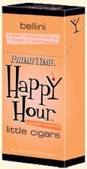
Image - box of peach flavored little cigars with a splash of champagne..
Read more...
Canada - funding for First Nation tobacco cessation program..
 February 23, 2009 - Assembly of First Nations National (AFN) Chief Phil Fontaine said today that he hopes the Government of Canada's recent announcement to commit more than $472,000 in federal funds over two years to tobacco cessation programs for Inuit youth will lead to a renewed commitment to restore similar projects for First Nations youth.
The Assembly of First Nations is the national organization representing First Nations citizens in Canada. First Nations (term has replaced the term "Indian", except for historical reference) peoples' refers to the Indian people in Canada.
Aboriginal Peoples - the descendants of the original inhabitants of North America. The Canadian Constitution recognizes three groups of Aboriginal people -- Indians, Métis and Inuit. These are three separate people with unique heritages, languages, cultural practices and spiritual beliefs. The term "First Nation" has now replaced the term "Indian", except for historical reference. The Inuit reside in Northern Canada - above the tree line in the Northwest Territories, Nunavat, and in Northern Quebec and Labrador. (First Nation, University of Manitoba, Manitoba Centre for Health Policy)
Since the First Nations and Inuit Tobacco Control Strategy (FNITCS) was cancelled in October 2006, there has been no tobacco control strategy for First Nations peoples, who have some of the highest rates of smoking in the country. Chief Fontaine: "There is an urgent need to reduce the use of tobacco for non-traditional purposes among First Nations youth. More than 50 percent of First Nations adults engage in smoking. With half of our people under the age of 25, if this trend continues unchecked, tobacco-related diseases will become an even more significant cause of death amongst First Nations and represent a tremendous future burden on Canada's health care system."
The AFN is working on a new strategy that will include: increasing awareness of the harmful impacts of the non-traditional use of tobacco, especially among youth, and increasing the capacity of individuals to address second-hand smoke exposure by reducing the non-traditional use of tobacco among families and communities as well as building the capacity for monitoring of data concerning tobacco consumption.
Reference: AFN National Chief calls on government for commitment to First Nations Tobacco Reduction Strategy,
CanadianBusiness.com, 2/23/2009.
Read more...
International Pipe Day - Smoking Pipes on U.S. College Campuses..
 February 22, 2009 - Last Friday, February 20, 2009 was International Pipe Day....
No one tracks how many young men and women are pipe smokers. But sales of pipe tobacco are rising again after years of decline, and many think young smokers are the reason. U.S. sales of pipe tobacco plummeted to 4.9 million pounds in 2006, from 52 million pounds in 1970, says Norman Sharp, president of the Cigar Association of America. Sales climbed to 5.3 million pounds in 2008.
Health advocates warn of oral cancer, mouth lesions and rotting teeth may result from pipe smoking. Researchers from the American Cancer Society have found that pipe smoking may be just as harmful as cigar smoking.
Reference: The Latest Thing They're Smoking in Pipes on College Campuses: Tobacco by MARY PILON, The Wall Street Journal, 2/20/2009.
Read more...
Cigarette tax increase cut smoking less payment to states, harm bond repayment..
February 22, 2009 - Ten years later, tobacco deal going up in smoke by Bob Sullivan, Red Tape Chronicles: Consider this the next time you see a teenager take a drag on a cigarette: Your state government likely has a financial stake in that kid continuing to smoke. And quite possibly, so does your retirement portfolio.
That was hardly the intention 10 years ago, when a collection of state attorneys general delivered a crushing blow to Big Tobacco. On Nov. 23, 1998, the nation's four largest cigarette sellers agreed to pay $200 billion over 30 years in what seemed like a victory for David over Goliath. The money was supposed to help the states pay for health care and anti-smoking campaigns. Instead, much of it -- even payments that aren't due for 20 years -- has already been spent on politically popular tax breaks through complicated borrowing schemes initiated by Wall Street investment banks.
Because these states have essentially borrowed against future payments from the tobacco industry, they are now dependent on the continued vitality of cigarette sales. If Big Tobacco stumbles, states will be on the hook for these massive, billion-dollar loans. In other words, David and Goliath are now allies. Higher federal and state taxes on cigarettes this year may bring the biggest drop in smoking ever, reducing the tobacco industry’s annual payments to states by as much as $500 million and threatening the repayment of $37 billion in municipal bonds backed by that money. As a result, many states have a perverse incentive to support the tobacco industry, on whom they are now dependent for future payments against this debt.
Bloomberg article: An expansion of the State Children’s Health Insurance Program this month (February 2009) will raise the federal tax by 62 cents to $1.01 a pack, bringing the average price of a pack of cigarettes nationally to around $5. The tax increase alone will save 900,000 lives, according to the American Cancer Society’s Cancer Action Network.
The higher prices could cut U.S. cigarette consumption by as much as 10 percent, said Richard Larkin, research director at Herbert J. Sims & Co., a municipal-bond firm in Iselin, New Jersey. He noted that most state tobacco bonds were sold based on the assumption that cigarette use would drop by around 2 percent a year. A reduction of 10 percent, which is about 2.5 times the yearly average over the past decade, would decrease payments to states under the 1998 MSAto $6.5 billion in 2010 from an estimated $7 billion this year, Larkin said. Most tobacco bond structures have debt service requirements with built-in increases for future years,” he said. A $500 million decline -- coming amid the industry’s attempts to recoup parts of some previous payments -- could force some issuers to dip into reserves for debt service, said Larkin.
Reference: Cigarette Tax Increases Cut Smoking While Harming Bonds’ Healthby Joe Mysak, Bloomberg.com, 2/19/2009.
Related news brief: Ten Yrs Later the 1998 State Tobacco Master Settlement Agreement (MST)..
Related article: Thomson Financial News Light cigarette ruling to further sideline tobacco bonds by Karen Pierog, Reuters, 12/15/2008.
Read more...
Indonesia - Rock band involved in TV cigarette ads..
 February 22, 2009 - The National Commission for Child Protection/ Komisi Nasional Perlindungan Anak (NCCP) has sent Nidji an open letter complaining about the rock band's involvement in a cigarette ad on TV.
“Nidji’s involvement in the cigarette ad has indirectly called Indonesian children to smoking,” the commission wrote. The commission warned that Indonesia ranks third highest in the world for aggregate levels of tobacco consumption, with the number of children smokers growing each year.
The commission’s letter quoted findings by the Central Statistics Agency that the number of teenagers who smoke (aged 15 to 19) had increased by 144 percent from 1995 to 2004. It also quoted a 2004 study that found smoking had led to the deaths of 427,948 people in 2001 alone - or 1,172 people every day. . . .
“For the sake of children and for the protection of their rights to life, grow and develop, we call on Nidji to reconsider their involvement as the model in the advert,” read the letter, which was signed by the commission chairman Seto Mulyadi and secretary-general Arist Merdeka Sirait.
While stopping short of an outright ban, the Ulema Council, or MUI (a quasi-government council of Muslim scholar - give guidance on many issues including smoking for Moslems), issued a fatwa prohibiting smoking in public places or by pregnant women and children.
The commission urged Indonesia to ratify the World Health Organization's Framework Convention on Tobacco Control (FCTC), the world's first public health treaty.
Reference: Nidji comes under fire for cigarette ads, The Jakarta Post, 02/20/2009.
Related news briefs: Indonesia - farmers hold rally protest tobacco controls..; Indonesia - tobacco farmers reject Islamic council's edict..; Indonesia - Ulema Council - debate results is split on smoking..; Indonesia - Withdraw Sponsorhip of Another Rock Concert..; Indonesia to increase tax on tobacco products..; Semarang, Indonesia - Cigarette Smoking Areas to be Prepared..; Jakarta, Indonesia - Malls help enforce non-smoking ban..; Indonesia - federal anti-smoking laws in one year - MAYBE..; Indonesia - NGO's (non-government organizations) Demand the Government Ratify WHO's FCTC.; Indonesia to raise cigarette tax by 6 to 7% in 2009..; Surabaya, Indonesia - anti-smoking bylaw 10/2009 - FOR REAL??; Indonesians smoking more than ever before..; Indonesia further rise in the excise tax would hurt the cigarette industry..; Alicia Keys - Jakarta Concert (July 31st) tobacco companies forced to withdraw sponsorship.. and Most Indonesians support moves to ban tobacco advertisements...
Read more...

Altria more layoffs in February 2009..
 February 22, 2009 - Altria Group Inc., the parent company of cigarette maker Philip Morris USA, announced planning job cuts (in its Client Services unit)in its Richmond-area operations by the end of February 2009.
On Friday, February 20th Altria Group Inc. said that it expects a wave of layoffs this month at its Richmond-area operations but declined to specify the number of employees affected. Brendan McCormick, company spokesman said, Job reductions have been ongoing for some time, but a "larger wave" of employees are departing this month. The cuts are expected to come from the Henrico County-based company's Altria Client Services unit, which provides administrative services for its subsidiaries, such as Philip Morris USA.
Altria has been cutting costs to save about $1.5 billion by 2011. It also has been reorganizing its operations after acquiring UST Inc., the nation's largest moist-snuff company, for $10.4 billion in January. UST's headquarters operations will move here from Greenwich, Conn., this year.
Altria also is adjusting headcount not because of the recession but in response to ongoing declines in cigarette consumption in the United States, company Chairman and Chief Executive Officer Michael E. Szymanczyk said last month during a conference call with industry analysts and reporters. (Altria's 2008 Full Year & 4th Quarter Results) Goldman Sachs tobacco analyst Judy Hong said in a research note said the likely increase in the federal excise tax in cigarettes could lead to a 7 percent decline in industry-wide volume in 2009.
Reference: Altria: More job cuts this month by JOHN REID BLACKWELL, Richmond Times-Dispatch, 2/21/2009.
Related news brief: Philip Morris (PM) to close N.C. cigarette plant..
Click on image to enlarge.., image by Steve Helber - The Associated Press
Read more...


To Provide Public Awareness
Purpose
About Us
Contact Us
2008 HIGHLIGHTS
TOPIX PAPERS - 2008 & 2009..