 February 19, 2011 - An ongoing dispute between the King Mountain Tobacco Co. and state and federal authorities over jurisdiction and treaty rights flared up this week in the form of a lawsuit Tuesday and a federal raid Wednesday, February 16th. Details about the raid were scant. King Mountain is owned and operated by Delbert Wheeler Sr., a Yakama tribal member who started the company in 2005 on reservation land off Fort Simcoe Road.
In 2006, cigarette giant Philip Morris sued over allegations King Mountain labels looked too similar to Marlboro. (PHILIP MORRIS USA INC v. KING MOUNTAIN TOBACCO COMPANY INC, United States Court of Appeals,Ninth Circuit, Findlaw.com) And in December, the city of New York accused the company of illegally selling and distributing untaxed smokes in New York state. (December 16, 2010 - New York City - suing tobacco company in Washington State..).
A lawyer for King Mountain declined comment except to say FBI and Bureau of Alcohol, Tobacco, Firearms and Explosives agents were "swarming" the Yakama cigarette maker's facilities in White Swan. Neither the FBI nor the ATF returned phone calls seeking comment.
A copy of the search warrant, signed by federal Magistrate James Hutton and anonymously faxed to the Yakima Herald-Republic, was also short on details. Hutton gave agents permission to seize company records and computer equipment, but an affidavit explaining the purpose of the raid was not included.
Coincidental or not, the raid came a day after lawyers for King Mountain sued the state of Washington and Attorney General Rob McKenna, alleging violations of the Yakama Nation's 1855 treaty rights.
The company says its cigarettes are made from tobacco grown on the reservation and that roughly 65 percent of the company's employees -- currently about 100 people -- are tribal members. According to the lawsuit, filed in U.S. District Court in Yakima, lawyers for the company accused the state of illegally collecting a penalty stemming from the 46-state Big Tobacco settlements in 1998. Per the terms of the settlement agreements, smaller tobacco companies that were not part of the deal must pay penalties into "qualified escrow accounts" that are collected by individual states and held for 25 years as a hedge against cigarette-related litigation. Lawyers for King Mountain argue the company is protected by the Yakama Treaty of 1855, which guaranteed Yakamas could get their goods to market "free of any fees, tolls, or other impediments."Under a settlement states reached with major tobacco companies over health care expenses in the 1990s, states adopted statutes requiring companies that didn't participate in the settlement to pay into holding accounts. The accounts would cover the states' claims if they sued the companies within 25 years. (Tobacco manufacturers not part of the 1998 master settlement are still required to pay into escrow accounts held for the benefit of the states that they market their tobacco products in. The escrow money may be used to satisfy future judgments against tobacco firms that weren’t part of the original agreement.)
The company said the Yakama National Tribal Council last year formally passed a resolution supporting King Mountain and saying, "No state government can impose its revenue-generating laws ... on King Mountain for it engaging in an historic right of trade and travel with respect to tobacco products."
A damage figure was not cited, however the company is seeking court orders declaring King Mountain is not subject to the Big Tobacco penalty and directing the state to refund all penalties paid to date. The company also wants a court order directing the state to "list King Mountain as an approved manufacturer of tobacco products in the State of Washington."
In a statement late Wednesday, Dan Sytman, a spokesman for the Attorney General's Office, accused King Mountain of reneging on a previous agreement to pay the Big Tobacco penalty. "We do not agree that the treaty (of 1855) grants the exemptions King Mountain claims," he said.
The company has previously been in the news as a defendant in a lawsuit rather than a plaintiff.
Reference: Feds raid tobacco company on reservation by Chris Bristol, Yakima Herald-Republic, 2/16/2011.
Read more...
Washington State - govt raids King Mountain Tobacco Co. located on the Yakama Indian reservation..
Washington, D.C. - protestors stood in front of CVS stores protesting the sale of tobacco..


February 11, 2011 - Over the course of seven months, a small group of protesters stood in front of various CVS stores in Washington, D.C., holding up signs with a simple yet powerful statement: "CVS sells poison."
Let CVS and Rite Aid know that selling tobacco while claiming to promote health is a conflict of interest and should be stopped.
Directly related news briefs:
Boston - NO Tobacco Products Sold - Pharmacies/College Campuses..;
San Francisco - fight about selling tobacco products in drugstores has flared up...
The "poison" is something most of us are accustomed to seeing at check-out: cigarettes, chew, cigars. CVS, like other major pharmacies, promotes and sells tobacco products, while simultaneously dispensing medication designed to treat tobacco-related diseases. This conflict of interest is one that activists are hoping to point out to the stores, customers and lawmakers.
The "CVS Sells Poison" campaign was started by the folks at the Toxic-Tobacco Law Coalition. In addition to their protest, they've also made a "CVS Sells Poison" music video on YouTube, sung by the talented 13-year-old Sofia Roma. The chorus includes: "CVS sells poison/Just like the other drug chains/Distributing cigarettes far and wide/Causing heart disease, cancer and pain."
Inside the stores, they turned the camera to the CVS Pharmacy counter, where a staged customer asks for advice about how to safely use two products sold in the stores: a popular over-the-counter heart burn medicine and cigarettes.
The pharmacists, not surprisingly, tell the customer that there's no safe level of tobacco. But the decision to carry cigarettes and chewing tobacco isn't up to them; in fact, 98 percent of pharmacists prefer that their stores are tobacco-free. Last year, the American Pharmacists Association supported the discontinuation of tobacco products in pharmacies and facilities that include pharmacies.
Most small pharmacies are tobacco-free, but the large chains are in the pocket of Big Tobacco, which pays large sums to have their product displayed right at the cash register, a highly-sought after piece of product real estate. And according to industry files from UCSF's tobacco documents library, tobacco companies have "actively recruited pharmacies to sell tobacco products, oppose tobacco control legislation and emphasize profits over health concerns."
It's a not-so-slight attempt at keeping their products accessible and accepted, as common as chewing gum and shampoo. But although pharmacies now sell a host of products not-related to health, they are still trusted sources of health information for many consumers. They sell products and medications designed to prevent and treat illness, offer health screenings and some even have health clinics.
It wouldn't make sense for an oncologist to have a cigarette machine in the waiting room and it doesn't make sense to sell and promote cigarettes in a place of health care.
Reference: Activists Target Tobacco in Pharmacies With 'CVS Sells Poison' Campaign by Brie Cadman, change.org, 2/17/2011. Read more...
Zimbabwe's tobacco output increase - Chinese heavily involved..


 February 19, 2011 - ZIMBABWE'S tobacco output will increase at least 40 percent this year after a boost in funding to farmers from banks and firms, many of which are Chinese, and due to good weather, an industry official said on Wednesday.
Chinese companies have become the major financiers and buyers of Zimbabwe's tobacco crop and industry officials say these firms will buy at least half of this year's tobacco.
Tobacco's earnings potential has fallen behind that of mining in recent years. Before the collapse of commercial agriculture in 2000, as President Robert Mugabe oversaw the seizures of white-owned farms, it was the country's single largest foreign currency earner, generating $400 million.
Tobacco Industry and Marketing Board (TIMB) chief executive Andrew Matibiri told Reuters during the opening of the 2011 selling season on Wednesday that he expected sales of at least 170 million kg this year, up from the 120 million kg which earned the country US$384 million last year.
Zimbabwe's tobacco-selling season opened on Wednesday, February 16th with beneficiaries of President Robert Mugabe's land reform programme forming the majority of those who brought their bundles to the market. Agriculture Minister Joseph Made said the farmers who cultivate small plots were expected to deliver the bulk of the crop, saying it was vindication of a programme which saw thousands of white-owned farms expropriated. (Land battle sets black against white by Africa Correspondent Jane Standley, BBC News, 12/1/1998) It is expected that during the marketing season more than half of the tobacco will come from small-scale farmers, that is communal and A1 (small-scale) farmers who now constitute 82 percent of the total registered farmers," he added.
References: China oversees tobacco crop leap by Reuters/AFP, newzimbabwe.com, 2/16/2011; New farmers dominate Zimbabwes tobacco sales, AFP, 2/16/2011; New farmers dominate Zimbabwe tobacco sales, thecitizen.co.tz, 2/19/2011.
Read more...
Federal appeals court revives challenge to the PACT Act..


February 19, 2011 - The plaintiff, Robert Gordon, a member of the Seneca tribe in upstate New York who sold tobacco across the country via an Internet site, filed suit last year in Washington’s federal trial court against the enforcement of the “Preventing All Cigarette Trafficking Act.” PACT Act). U.S. PACT Act takes effect Tuesday, June 29, 2010..
Directly related news brief:
August 12, 2010 -U.S. Federal District Court Judge refuses to further delay enforcement of PACT Act..;
August 11, 2010 - U.S. Federal Court - appeal of judges split decision regarding PACT Act...
Gordon’s suit, seeking an injunction, was filed a day before the new law was set to take effect. U.S. District Judge Henry Kennedy Jr. in Washington dismissed the suit, noting, among other things, the “lateness of the hour” in which Gordon was seeking relief from the courts. Kennedy said in his ruling that it wasn’t in the public’s interest to stop the legislation in its tracks.
A federal appeals court in Washington, February 18th revived this suit challenging regulations that restrict the online sale of tobacco products. A three-judge panel of the U.S. Court of Appeals for the D.C. Circuit today vacated the dismissal of the suit and sent it back to the trial court for further proceedings.
Judge Janice Rogers Brown, writing for the appeals court panel, said Kennedy should not have relied on the timing of Gordon’s suit in dismissing it. “A motion seeking to enjoin a statute’s enforcement before the statute may legally be enforced is timely—or at least not late—by definition,” said Brown, who heard the case with Judges Judith Rogers and Thomas Griffith.
Reference: D.C. Circuit Revives Challenge to Online Tobacco Sale Restrictions, Posted by Mike Scarcella, The Blog of LegalTimes, 2/18/2010.
Read more...
Dublin, CA strengthens smoking rules for apartment complexes with 16 or more units - San Francisco Bay Area..


February 18, 2011 - The Dublin City Council has asked its staff to strengthen the city's smoking rules for apartment complexes with 16 or more units. After hearing an encouraging report Tuesday, February 15th on the results of a 2008 city ordinance requiring those complexes to designate 50 percent of their units smoke-free by January 1 of this year, the council told its staff to amend the ordinance to require a 75 percent ban by 2013.Background Surrounding area..
In the report, the city surveyed all 17 apartment complexes that fit the requirement and found that of the 4,146 units, 2,879, or 69 percent, are now designated smoke-free. After examining reports from each complex, it was also determined that five of the complexes had gone smoke-free and that only one had done the minimum of 50 percent.
Richmond, California officials will require multiunit housing to go smoke-free by January 1, 2011. Belmont made national headlines in 2007 when it became the first in the country to ban smoking in multiunit housing; that went into effect in January, 2009. Dublin followed suit in 2008 with a less-restrictive requirement that half the units in buildings with more than 16 rentals be smoke-free by 2010.
In Richmond, people can continue to smoke at home if it is a single-family house and on sidewalks and streets, but not within 25 feet of a door, window or vent that leads to a place where smoking is prohibited. Tobacco retailers are required to get a permit.
Richmond, CA strictest secondhand smoking laws in the San Francisco Bay Area..
"Ninety percent of the residents in Alameda County don't smoke," said Councilwoman Kasie Hildenbrand, the council's biggest advocate for a smoke-free city. "There is a great number of the population that is looking to live and breathe clean air."
A handful of Bay Area cities, led by Belmont in 2007, have banned smoking in apartment complexes. Others include Union City, Richmond and Sebastopol. Hildenbrand said Dublin is moving in that direction, but at a slower pace.
"The rest of the council has been very supportive," she said of Dublin's anti-smoking laws. "They have just been a little more conservative on how to approach it."
Before enacting its current smoking ordinance in apartments, the city set up a task force composed of apartment managers and owners, tenants and city staff to develop the law. Part of the task force's recommendation was to raise the number of units to 70 percent.
Reference: Dublin moves to toughen its smoking ordinance; brings back farmers market by Robert Jordan, Contra Costa Times, 2/17/2011.
Read more...
Washington State - legislature bills - cigar lounges/retail tobacconists..

 February 18, 2011 - Two separate bills recently introduced by Washington state lawmakers would, if passed, grant cigar enthusiasts the right to once again smoke inside tobacco shops and cigar lounges.
Washington State Legislature
SB 5542 - 2011-12
Establishing special license endorsements for cigar lounges and retail tobacconist shops.
HB 1683 - 2011-12
Establishing special license endorsements for cigar lounges and retail tobacconist shops.
Washington passed a very strict smoking ban in 2005, outlawing indoor smoking in all public buildings, including restaurants, bars and even retail tobacconists. (Washington State's New Smoking Ban, Garvey Schubert Barer Legal Update, February 16, 2005)
Both of the introduced measures, Senate Bill 5542 and House Bill 1683, call for the establishment of a special state licensing program whereby businesses would apply to the State Liquor Control Board for endorsement as either a cigar lounge or retail tobacconist. These businesses would receive a license, which could be renewed each year, and in return, patrons could light up within these establishments.
No more than 100 lounges would be licensed as a cigar lounge at $15,000 per year. Up to 500 businesses, each paying a fee of $5,000 per year, could receive a retail tobacco license.
According to the language contained within the bills, 5 percent of fees would be used for administrative costs, while 95 percent of the fees collected by the state would go to government programs. The House version directs that the funds accrued from the program are to go to a scholarship program for foster youth, while the Senate version dictates that the funds are to go towards health care.
Reference: Washington Eyes Creating Smoking Licenses, Andrew Nagy, cigaraficionado.com, 2/16/2011.
Read more...
Campbell County, Kentucky - smoking ban is overturned..

 February 18, 2011 - The Enquirer this weekend reported that new county commissioners Pete Garrett and Brian Painter plan to overturn the ban on smoking in bars, restaurants and other indoor businesses that was approved in December by outgoing commissioners Dave Otto and Mark Hayden during their final meeting as county officials. (Northern Kentucky county passes compromise indoor smoking ban, wkyt.com. 12/22/2010)
In an effort to change the minds of Campbell County officials, the Northern Kentucky Medical Society and St. Elizabeth Healthcare on Monday, February 14th issued a joint statement urging county leaders not to strike down the countywide smoking ban that is to take effect in April 2011. “Given the overwhelming scientific evidence that secondhand smoke is a known cause of disease and premature death in healthy nonsmokers, and given that there are no safe levels of exposure to tobacco smoke according to the United States Surgeon General, the Northern Kentucky Medical Society and St. Elizabeth Healthcare support smoke-free indoor air ordinances to prohibit smoking in public places, including the one passed by the Campbell County Fiscal Court in 2010.
Campbell County officials voted 3-1 to kill the measure, which had been adopted in December and was supposed to go into effect in April. Opponents packed the public hearing, with one of the loudest bursts of applause coming from a man who likened the ban to, wait for it, the policies of Hitler, notes the Cincinnati Enquirer. Proponents had their say, too, including one woman who asked commissioners: “At least 88 people … could die, or will die, in 2011. How does that make you feel?”
References: Doctors: Don’t repeal smoking ban, From Enquirer reporter Mike Rutledge, nky.com, 2/14/2011; County Bucks Trend, Repeals Smoking Ban Did we mention it's in Kentucky? by John Johnson, Newser Staff, 2/17/2011.
Read more...
Smoking linked to increased severity of new-onset asthma..
 February 17, 2011 - Little is known about the association between cigarette smoking and asthma severity. We assessed smoking as a determinant of disease severity and control in a cohort of clinic-referred allergic subjects who developed new onset asthma.
For the current study, the researchers examined the influence of smoking on the severity of new-onset asthma among 371 adults with allergic rhinitis who were followed up for 10 years.
PAPER: Greater severity of new onset asthma in allergic subjects who smoke: a 10-year longitudinal study, Riccardo Polosa (polosa@unict.it), Cristina Russo, Pasquale Caponnetto, Gaetano Bertino1, Maria Sarvà, Tjana Antic, Stefania Mancuso and Wael K Al-Delaimy, Respiratory Research 2011, 12:16, ABSTRACT/FULL TEXT..
The researchers also found that smokers with asthma had a greater risk for uncontrolled disease than non-smokers who developed the respiratory condition. For example, patients with 1-10 and more than 10 pack-years of smoking were a respective 5.51 and 13.38 times more likely to have uncontrolled asthma than those who had never smoked.
Polosa et al conclude: "Smoking status and smoking duration were markedly related in a dose-dependent fashion to the level of asthma severity and to poor asthma control. They add: "The demonstration of strong association and clear-cut dose-response relationship of smoking with asthma severity and control is in support of causality."
Reference: Smoking linked to increased severity of new-onset asthma by Mark Cowen, 2/14/2011.
Read more...
Northern Ireland - smoking ban challenger court case fails..
Smoking now banned in public
places in Northern Ireland, April 30, 2007..
February 17, 2011 - A smoking ban challenger has failed in a new legal challenge against Northern Ireland's ban on lighting up in public. Senior judges threw out a bid by north Down man Chris Carter to quash his conviction for smoking at the front of Bangor Town Hall. Mr Carter claimed his rights to privacy and freedom from torture and discrimination were breached by the prohibition. He alleged that the ban was comparable to restrictions imposed by the Third Reich in Hitler's Germany.
But his case was dismissed because he was not held to have the status of a victim and as no breach of his human rights was established.
Lord Justice Coghlin said: "Furthermore, if such a breach had been established, we are satisfied that the ban on smoking restricted to public places falls within the margin of appreciation of the State being lawful and necessary in a democratic society."
Mr Carter, 56, who represented himself as a personal litigant, was seeking leave to apply for a judicial review of the legislation which led to him being fined and ordered to pay costs of £1,250 in total. He was prosecuted under the terms of the Smoking (NI) Order 2006 for lighting a cigarette in a no-smoking area in October 2007. Even though his application was dismissed by the High Court last June, Mr Carter was allowed to re-run his challenge in front of a three-judge panel. A Divisonal Court was convened on the basis that there was no jurisdiction for the original hearing because it was a criminal cause or matter.
Mr Carter, who describes himself as campaign manager for The Smokers Rights Appeal Fund UK Ireland, argued that the sovereignty of the United Kingdom has been infringed by anti-smoking laws coming from the European Union. Mr Carter claimed to have found parts in them similar to legislation brought in by Hitler between 1938-1942.
But Lord Justice Coghlin also held that he appeared to have based much of his argument on a misconception about the concept of sovereignty in UK constitutional law. "We have not been persuaded by the applicant's submissions that he has raised a case of bad faith, improper motive or manifest absurdity amounting to a flagrant and unconstitutional abuse of power," he said. "In such circumstances we do not consider that this court has any power to reopen the policy debates that led to the passage of the Order."
Let's not forget that Northern Ireland - 9 of 10 households would welcome a ban on smoking in cars with children present.. - let's get it done..
Reference: A pro-smoking campaigner has failed in a new legal challenge against Northern Ireland's ban on lighting up in public, UTV News, 2/14/2011.
(United Kingdom)
Read more...
Teton, Wyoming - judge rejects county smoking ban..
Click to enlarge..
 February 17, 2011 - A judge’s decision to strike down Teton County’s public smoking ban will not affect the effort to adopt workplace smoking restrictions in the Casper area, the group organizing the effort said Thursday, February 10th.
District Judge Timothy Day ruled Wednesday, February 9th Teton County’s health board exceeded its authority when it enacted the public smoking ban. Day also concluded the board’s actions violated the separation of powers provision of the Wyoming Constitution.
Opponents of the ban sued the health board after it enacted the Smokefree Air Rule in March 2009. They included the Wyoming State Liquor Association and The Virginian Saloon, a Jackson bar that allowed smoking. (Teton, Wyoming District Board of Health unanimously approved a countywide smoking ban in March 2009)
The Casper-Natrona County Board of Health cited the lawsuit when it voted against pursuing its own workplace smoking ban in November. Some board members worried enacting such an ordinance could prompt a similar lawsuit challenging their authority.
After the November meeting, Smokefree Natrona County — the group that asked the health board to pursue a workplace restriction — said it would focus on city-level regulations. Day’s ruling won’t alter the group’s approach, said campaign manager Rachael Bailey.
“We always knew this was a possibility, and it’s really not going to change our campaign moving forward,” she said. “We are still moving toward asking the city councils in Casper, Mills and Evansville to consider passing a regulation.”
In his ruling, Day wrote that the correlation between second-hand smoke and disease was a “matter beyond reasonable controversy.” But, he added, the case turned on the authority of the board to adopt a smoking ban, rather than the health effects of smoking.
“In the case of the Smokefree Air Rule, a local, unelected board is, in effect, legislating a new criminal offense in the absence of an explicit standard from either the state Department of Health or the Wyoming Legislature, and it does so with no oversight from any elected official or body,” the ruling states. “This impermissibly circumvents the legislative process, and it precludes public participation and the checks and balances in the legislative process.”
A bill that would have given county commissions and local health boards the power to enact public smoking bans died in the Legislature last month. Lawmakers have also rejected past attempts to adopt a statewide public smoking ban.
Reference: Judge rejects Teton County smoking ban by JOSHUA WOLFSON (josh.wolfson@trib.com), Star-Tribune staff writer, TRIB.com, 2/11/2011.
Read more...
More hotels go completely smoke-free..
 February 17, 2011 - Hotels, motels and other lodgings are following the trend of airlines and passenger-train operators by banning smoking throughout their premises. Some are doing it voluntarily, as public awareness about the health dangers of secondhand smoke grows. Others are being forced by a growing number of state and local laws.
Dollar and Thrifty rental car fleets - NO Smoking Allowed..
More than 12,900 lodgings serving the public in the USA are now smoke-free throughout, a USA TODAY analysis of data from AAA, the American Automobile Association, finds. That's nearly 4,600 more than in November 2008, when USA TODAY first analyzed AAA data.
Though the number of smoke-free hotels is growing, the percentage of adults who smoke cigarettes has not declined since 2005, the Centers for Disease Control and Prevention says. About one of every five adults — 46.6 million — smokes cigarettes.
Four of every 10 non-smokers — 88 million people — were exposed to cigarette smoke during 2007-2008, the CDC says. Among other health problems, smoking causes cancer, heart attacks and stroke, and exposure to secondhand smoke causes cancer and heart disease in non-smoking adults and respiratory infections and more severe asthma in children, the agency says.
The St. Louis Post-Dispatch says that the Ritz-Carlton St. Louis hotel in Clayton will pay a $300 fine, plus $27 in court costs, as punishment for violating the city's smoking ban. The 300-room hotel also agreed to comply with the city's ordinance going forward.
The MGM Grand Hotel in Las Vegas should immediately rescind the new $20 per day fee it is charging customers to "guarantee" a non-smoking room.
Some smokers readily agree something stinks about having a room that's been smoked in. Doug Gillikin of Lafayette, La., who works in the millwork industry and stayed at hotels more than 150 nights last year, says he smokes outside hotels and prefers they be smoke-free. He chooses non-smoking rooms over smoking ones in hotels that offer a choice. Why? "The smell is terrible," Gillikin says.
Reference: More hotels go completely smoke-free by Gary Stoller, USA TODAY, 2/18/2011.
A few related news briefs:
Wisconsin - July 2010 smoking ban included banning smoking in every hotel guestroom..;
Los Angeles City - smoking to be banned just about everywhere..;
Michigan - governor signs state smoking ban..;
Hefty Fines - Hotels are serious about rooms being smoke free..;
Extended Stay Hotels, which operates 682 North American properties, recently announced that it plans to continue to welcome smokers, according to a r;
Read more...
Smoking and Risk of Amyotrophic Lateral Sclerosis (ALS, Lou Gehrig's disease)..

February 17, 2011 - Cigarette smoking appears to be associated with amyotrophic lateral sclerosis (ALS), although several aspects of the relationship remain unclear, results of a prospective five-cohort study indicate.
ALS, also known as Lou Gerhig's Disease, is a neurodegenerative disorder that affects more than 5,500 patients in the U.S. each year. There is no known cause or treatment, according to background information in the study, which was published in the Archives of Neurology Feb. 2011 issue.
Although previous studies have suggested a link between cigarette smoking and ALS risk, the researchers noted that results were conflicting, possibly due to small sample sizes and selection or survival bias.
PAPER: Smoking and Risk of Amyotrophic Lateral Sclerosis A Pooled Analysis of 5 Prospective Cohorts, Hao Wang, MD, PhD; Éilis J. O’Reilly, ScD; Marc G. Weisskopf, PhD; Giancarlo Logroscino, MD, DrPH; Marji L. McCullough, ScD; Michael J. Thun, PhD; Arthur Schatzkin, PhD; Laurence N. Kolonel, MD, PhD; Alberto Ascherio, MD, DrPH, Arch Neurol. 2011;68(2):207-213, ABSTRACT..
Other data indicated that ALS risk increases 9% for every 10 years a person smoked (P<.006), and a 10% increase with each 10 cigarette increment smoked in a day (P<.001). Risk also increased incrementally based on the age of the person at the time they started smoking — each five year younger increment was associated with a pooled 1.11 relative risk (95% CI 1.01 to 1.22; P=0.03). The researchers wrote that the lack of consistent risk increases with pack years smoked, suggests a more complex relationship between ALS and cigarettes. They proposed several hypotheses to help explain the association: * Early smoking is more important because of motor neuron development during adolescence. * Smoking triggers neurodegeneration, but subsequent ALS progression is independent of cigarette use. * Long-term smokers who don't develop the disease may have a lower susceptibility. * Some components in tobacco smoke may have beneficial effects that can compensate for harmful effects of other chemicals. Further research should focus on the importance of age at smoking initiation and the lack of a dose response between smoking and ALS risk. Reference: Smoking increases ALS risk, Nicole Blazek, The Clinical Advisor, 2/16/2011.
Read more...
Poland - last state-owned cigarette manufacturer privatized..


 February 17, 2011 - The Polish Ministry of Treasury has sold its 70-per-cent share in Zakłady Tytoniowe w Lublinie (ZTL), the last state-owned cigarette manufacturer in Poland, to French company Biosyntec.
On 3 February, Biosyntec signed the contract whereby it pays over PLN 31 million (EUR 7.9 million) for 2 million shares in the Lublin-based company. The remaining 30 per cent of shares owned by the state treasury will be distributed among eligible employees and farmers who supply ZTL with tobacco leaves. In a statement, Biosyntec said that it will invest over PLN 100 million over the next four years in the production of innovative cigarette filters that reduce cancer risk.
The filters which will be made by a Biosybtec-patented technology include a rosemary-based substance "which does not alter the flavor of cigarettes but whose unique properties reduce their harmful impact", according to Biosytenc.
ZTL will be the base of Biosytec's first production line of these biotechnological filters which will be produced for the Polish and foreign markets. The factory, which currently employs 160 people, may also start the production of cigarettes with other protective filters.
ZTL has been in operation for over 75 years, specializing in a wide range of smoking tobacco, cigarettes, filter tubes, cigarette papers and distribution of cigars, cigarillos as well as a large selection of smoking accessories. The company sells its products domestically and abroad, cooperating with around 100 wholesalers and 120 retail outlets.
The company also operates its own network of tobacco outlet brand Cygaleria Saloniki Tytoniowe and holds 100 per cent shares in FTK Krasnystaw, a company that contracts, purchases and processes industrial tobacco.
Reference: POLAND Last state-owned cigarette manufacturer privatized, Tobacco Journal International, 2/11/2011.
Poland - related news briefs:
Poland - smoking habits revealed - GATS..;
Poland - on November 15, 2010 will implement smoking ban in public places..;
Poland - even non-smokers oppose smoking ban in eateries..;
Poland - proposed cigarette tax higher than tobacco companies expected..;
VIDEO - Poland is frontline in EU battle with tobacco smugglers..;
Poland - attempt to introduce smoking ban in public places fails..;
Poland - lower house weakens smoking ban..;
Poland - disappointment , full parliament sends smoking ban bill back to committee to weaken bill..;
Poland - pubs and restaurants fear bankruptcy if smoking ban becomes law..;
Poland - lower house of parliament (Sejm) will vote Friday, February 12th on smoking ban..;
Poland - son suing Philip Morris Polska and Zakłady Przemysłu Tytoniowego over death of his mother..;
Poland to ban smoking in indoor public places, in passenger cars if children present and prohibit display of cigarettes..;
Read more...
PM USA - files lawsuits - to stop sales of counterfeit cigarettes in Los Angeles area..

 February 17, 2011 - Philip Morris USA (PM USA, operating company of Altria Group Inc.) filed lawsuits Tuesday, February 15th against seven China-based online retailers for selling counterfeit versions of the company's Marlboro brand cigarettes to California consumers--the first time a U.S. company has sued a China-based website for selling counterfeit cigarettes to American consumers. PM USA also filed suit against eight retailers who recently sold counterfeit versions of the company's Marlboro brand cigarettes to Los Angeles-area consumers.
These lawsuits are part of the company's ongoing efforts to stop the sale of counterfeit cigarettes and the unauthorized use of PM USA's trademarks.
Directly related news brief:
Philip Morris USA seizes more counterfeit Marlboro cigarettes in New City area...
Interesting news brief we put together in July 2008 - Made-in-China Marlboros - a major mistake by Philip Morris International..
PM USA said it believes that counterfeit cigarette traffickers have established a foothold in the Los Angeles area, and that today Los Angeles is one of the top two markets for counterfeit cigarette activity in the United States. The actions and lawsuits are the culmination of a several month investigation involving the Los Angeles County Sheriff's office and other law enforcement agencies to address the sale of counterfeit Marlboro cigarettes in the Los Angeles area.
These actions led to 10 arrests and the seizure of more than 9,200 packs of counterfeit Marlboro cigarettes. "The sale of counterfeit cigarettes defrauds adult smokers who believe they are buying genuine Marlboro cigarettes, resulting in significant lost revenue for the state, and is often driven by organized crime syndicates," said Joe Murillo, vice president and associate general counsel, Altria Client Services speaking on behalf of PM USA.
He added, "The sale of counterfeit Marlboro cigarettes to U.S. consumers through China-based websites is an emerging problem. Selling counterfeit cigarettes is illegal, and we will continue to evolve our approach to take appropriate action to protect our brands."
Since 2002, PM USA has sued more than 2,800 retailers in California for selling counterfeit PM USA-branded cigarettes, in addition to seven websites.
The entities named in the lawsuits filed in the Central District of California are:
Websites
* Webvipshopping.com, Ren Kun Fang (owner/operator).
* usa001.com, Ren Kun Fang (owner/operator).
* Marlborocigarettesonline.com, Kenny Li (owner/operator), John Doe Walker (importer/distributor).
* Cheap-marlborocigarettes.com, Kenny Li (owner/operator).
* Chinacigarette.com, Andy Gong (owner/operator), Ma Fei (importer/distributor).
* Okcig.com, Li Ning (owner/operator), Yan Liang (importer/distributor).
* Cigarettesonshop.com, Unknown.
Retailers
* Bran Tools New & Used, Los Angeles.
* Marcela Mini Market, Los Angeles.
* Quick Quick Mini Market, Panorama City, Calif.
* El Paraiso Party Supply, Compton, Calif.
* San Miguel Meat Market/Carniceria, Los Angeles.
* S.J. Del Rio, Los Angeles.
* Tacos Vallarta/Tacos Don Beto, Los Angeles.
* Zafiros Mini Market, Los Angeles.
Reference: PM USA Sues Websites, Retailers Goes after seven China-based sites, eight California stores over counterfeit smokes, CSP Daily News, 2/17/2011.
Read more...
NATO - opposes Washington State bill banning flavored tobacco products..

February 16, 2011 - While the FDA tobacco regulations banned flavored cigarettes as of Sept. 22, 2009, except those with menthol or tobacco flavors, a bill being considered by the Washington state legislature would prohibit the sale of all other tobacco products with a "distinguishable flavor, taste or aroma" other than a true tobacco flavor and also ban the sale of "capsular smokeless tobacco." National Association of Tobacco Outlets (NATO) and its members have been working to oppose this legislation because it would also have a significant financial impact on retailers as a result of lost sales.
Washington State - to protect children from becoming nicotine addicts lawmakers considering banning flavored tobacco products..
This ban on flavored tobacco products would include flavored cigars, smokeless tobacco, moist snuff and pipe tobacco. The prohibition on the sale of capsular products would outlaw any product containing tobacco "offered in discrete single dose or single use lozenges, pouches, pills, capsules, or other single use units." According to a fiscal impact calculation made by the Washington Department of Revenue, and assuming the bill was enacted into law, the state of Washington would lose tens of millions of dollars in tobacco excise tax revenue. This lost tobacco tax revenue is estimated at $21,188,000 in 2012-2013, $25,428,000 in 2014-2015 and another $28,034,000 in 2016-2017.
While the bill has been heard by both the House Health Care and Wellness Committee and the Senate Committee on Labor and Commerce and Consumer Protection, neither committee voted to take action on the legislation. The bill remains in both committees awaiting further action.
Reference: NATO Opposes Flavored Tobacco and Capsular Ban Washington State Could Lose $21 Million in Tobacco Taxes During 2012 and 2013 by Thomas Briant, NATO Executive Director, CSP Daily News, 2/15/2011.
Read more...
Ireland - group wants govt to relax smoking ban but check out the consequences of smoking..
 February 16, 2011 - Ireland (ASH Ireland - KEY Facts: Smoking is estimated to be the cause of approximately 7,000 deaths in Ireland each year, chiefly by illnesses such as lung cancer, heart disease, stroke and emphysema (Department of Health and Children); Around 30% of all cancer deaths in Ireland are attributed to smoking; 90% of lung cancers are caused by smoking (Department of Health and Children); It costs the State €1 billion (1.4 billion USD) per year to provide health services for smokers (Department of Health and Children)
A smokers’ lobby group says the next government should relax the smoking ban and have greater respect for Ireland’s one million adult smokers. Tobacco control policies should be amended so they “are fair for everyone, smokers and non-smokers alike”, said Forest Eireann. Speaking at the launch of the group’s smokers’ manifesto in Cork, spokesman John Mallon said: “There are one million smokers in Ireland, and smokers are voters too. “The next government must review the way smokers are treated and devise policies that are fair for everyone, smokers and non-smokers alike.”
References: Smokers are voters too, says Forest Eireann by Infowars Ireland, 2/15/2011; Smokers cough up average €3,500 on cigarettes last year by Evelyn Ring, IrishExaminer.com, 2/16/2011.
Some Ireland related news briefs:
Ireland - more smokers now than before the smoking ban in 2004..;
Ireland - Office of Tobacco Control to be dissolved..;
Ireland - cigarette dealers are now selling their smuggled goods door-to-door..;
Ireland - 2009 Report of the Comptroller and Auditor General..;
Ireland - police force says gangs making €3m a week from illegal cigarette sales..;
Ireland - time for major effort to crackdown on tobacco smuggling..;
Ireland - tobacco smuggling has reached record levels..;
Ireland - Office of Tobacco Control 2009 Annual Report..;
Ireland retailers claim since display ban smuggling up - denied by health campaigners..;
Ireland - highest tobacco prices in the EU..;
Ireland - smoking on the increase with young women in lower-income groups..;
Ireland - Illicit tobacco trade booms..;
Ireland - no increase in excise duty on tobacco products worry about smuggling..;
reland - ASH will never give up - get smoking out of cars (and homes) when kids are present..;
Ireland - harder to quit when switching to low tar cigarettes..;
Ireland - after 2004 smoking ban decline in maternal smoking rates as well as lower risk for preterm births..;
Ireland - cancer society urges government to increase cigarette tax..;
Ireland - increase fine for cigarettes imported illegally..;
Ireland - roll your own cigarettes making a comeback..;
Ireland - lots of smokers - lots of sickness - resulting in premature death - THIS HAS TO STOP..;
Ireland - people responding well to the ban on cigarette displays..;
Ireland - Prof Clancy not enough spent on prevention..;
Ireland - tobacco vendors must register by October 1, 2009..;
Children - exposed to cigarette smoke in cars have greater chance of respiratory distress..;
Ireland - tobacco companies not helping small retailers - display ban..;
Tobacco control initiatives starting Wednesday, July 1, 2009..;
Ireland - Office of Tobacco Control 2008 annual report - Positive..;
Ireland - modest penalty for cigarette smuggling..;
Ireland - to amend tobacco legislation to to include pictoral warnings..;
Ireland - as of July 1, 2009 no advertising or display of tobacco products will be permitted in retail outlets..;
Ireland - cigarette tax abandoned over smuggling fears..;
Ireland - may raise tax on cigarettes as part of emergency budget..;
Ireland - ban smoking in cars when kids are present..;
Ireland - further provisions of the Public Health (Tobacco) Acts 2002 and 2004 are to be commenced on 1 July 2009.;
Ireland - 80% of smokers want a ban on tobacco advertising in shops to stop youngsters starting the habit..;
Ireland to ban tobacco displays..;
Ireland - reduction in admissions for acute coronary syndrome...
Read more...
South Korea - appellate court upholds lower court ruling rejecting claims of compensation for smoking lung cancer patients..


February 16, 2011 - An appellate court upheld a lower court ruling Thursday that rejected claims for compensation by lung cancer patients who said long-time smoking caused the disease.
A group of 31 lung cancer patients and their families launched the damages suit in 1999 against the state and KT&G (KT&G, the largest tobacco company in Korea), arguing long-time smoking caused their fatal disease and that the company did not fulfill its duty to inform them of the dangers of smoking by concealing most of its manufacturing records.
After taking nearly seven years to deliberate on the case, the Seoul Central District Court in January 2007 rejected the plaintiffs' claim, citing insufficient evidence to prove a direct link between their disease and smoking as well as flawed products. The court said KT&G did not violate its obligation as it has attached a warning message on its cigarette packs since the 1970s.
Although the court does acknowledge a connection between smoking and lung cancer, there are no sufficient grounds to prove the defendants' illegal conduct in detail," the Seoul High Court said in a ruling. "Although this case did not ask the company to take the legal responsibility, the ruling left room for future damages suits to additionally prove the
harmful effects of smoking case by case."
The second round of the litigation was centered on the cause-and-effect relationship between smoking and lung cancer; whether KT&G uses chemical addictives to make it hard for smokers to quit; and whether the firm has fulfilled its duty of informing the general public of the harmful effects of smoking.
However, the court recognized the cause-and-effect relationship between smoking and lung cancer in line with the first verdict in a case filed against KT&G. The latest ruling left the door open for plaintiffs to get possible compensation in the future should they come up with more convincing evidence during additional litigation. But the judge added the plaintiffs may “get compensation if they file an additional damages suit against KT&G with stronger evidence.” The first ruling in the case in 2006 completely denied the possibility of compensation, saying it was hard to see the habit as the exclusive factor causing the disease.
The judge suggested KT&G support anti-smoking campaigns and set up a foundation to run the programs. Last year, the plaintiffs proposed dropping the suit, if KT&G spent 610 billion won ($545 million) over the next 20 years establishing an anti-smoking foundation and a variety of anti-smoking campaigns. But the company refused to do so, citing negative impacts on shareholders. According to the National Cancer Center, nearly 67,000 people died of cancer in 2007. Of these, 12.1 percent had lung cancer.
References: Damages rejected in tobacco suit by Park Si-soo, The Korea Times, 2/15/2011; (LEAD) Appellate court turns down damages suit over tobacco danger by Kim Eun-jung (ejkim@yna.co.kr), YonhapNews.co.kr, 2/15/2011.
South Korea - some related news briefs:
South Korea - more tobacco control measures to be implemented - wants positive results by 2014..;
South Korea - govt serious about getting smokers to quit..;
South Korea - charge enough for cigarettes smokers will quit..;
South Korea - BAT Korea launching Dunhill Nanocut 1 mg, next week..;
South Korean tobacco company KT&G signs deal to sell cigarettes in the Middle East and Russia..;
South Korea - BAT releases Dunhill Orient as a limited edition..;
http://snus-news.blogspot.com/2010/11/south-korea-end-of-next-year-teenagers.html;
South Korea - stop people from smoking go ahead and triple the price of cigarettes..;
South Korea - Smoking Manner Campaign - promoting cigarette butt-free streets..;
South Korea - in 2007, world's 12th largest cigarette exporter..;
South Korea - study finds higher prices most effective method to discourage smoking..;
South Korea - a new Raison line extension..;
next month enforcement of ban on smoking by taxi drivers..;
South Korea - fines collected for dumping cigarette butts are down.. ;
South Korea - BAT launches new cigarette seems similar to Camel Crush..;
South Korea - rate of male smokers probably higher than any other OECD country..;
South Korea - BAT to further invest in Sacheon factory..;
South Korea - a look at KT&G Corporation with 63% of the market..;
South Korea - streets and parks of Seoul City could be designated as non-smoking areas..;
PMI - slide presentation South Korean Cigarette Market..;
South Korea - KT&G forms alliance with Imperial Tobacco Group..;
South Korea - more smokers in 2009 than in 2008..;
South Korea - remote island going smoke-free, car-free and night lights-free..;
South Korea - Stressed-out Koreans smoking more..;
South Korea - to ban smoking in public places from 2011..;
Korea - BAT - winning the hearts and minds of customers based on tactics tailored to local tastes..;
Korea - sets target to reduce smoking 10% in 5-years..;
Korea - stricter regulation of the tobacco industry coming..;
South Korea - tobacco imports surge 396-fold over 10-years..;
Korea - slight increase in men smoking.. ;
South Korea - anti-tobacco campaign - body painting..;
Korea - smoking ban just about everywhere by end of 2009..;
Tobacco marketing in South Korea has been deliberately aimed at girls and young women..;
Korea - smoking rates fall for men and women...
(passive smoking, environmental tobacco smoke, ets, involuntary smoking, sidestream smoking)
Read more...
India - Cancer docs take tobacco battle inside parliament..
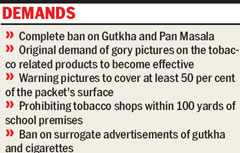
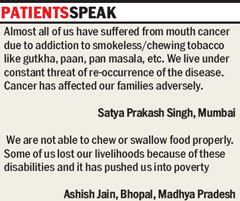
 February 15, 2011 - Frustrated by the lackadaisical approach of the government in fighting tobacco-related cancer, two doctors from Mumbai took 40 patients to Delhi to meet politicians, hoping that direct contact with victims would finally swing lawmakers into action.
The patients, being treated at Tata Memorial Hospital, were brought together by Dr Pankaj Chaturvedi of TMH and Dr P C Gupta of Healis Sekhsaria Institute of Public Health to voice their concerns and petition for effective bans on Gutkha and strict pictorial warnings on cigarette packets.They succeeded in meeting Leader of the Opposition Sushma Swaraj, Union Minister for Coal Prakash Jaiswal, and Minister of State for Health and Family Welfare Dinesh Trivedi.
"Last year, there was a government notification that stringent warnings were to be carried on cigarette packs. It was to come into effect on December 1, but on December 20, the government gave the tobacco companies two more years. (India - will delay for a year the use of scarier pictorial warnings on cigarette and bidi packs..)
Reference: Cancer docs take tobacco battle inside parliament, Bapu Deedwania and Lata Mishra, MumbaiMirror.com, 2/13/2011.
India - some related news briefs:
*http://snus-news.blogspot.com/2011/02/india-to-introduce-anti-tobacco.html;
*India - 80% of teenagers in metropolitan cities are addicted to smoking cigarettes..;
*India - despite govt ban, sale and advertising of tobacco products is rampant around educational institutions..;
*India - foreign cigarette companies could soon find it harder to sell their products..;
*Maharashtra, India - collecting fines from anti-tobacco drive..;
*India - health ministry formulating policy that is smokeless tobacco specific..;
*India - celebs shy away from endorsing tobacco and liquor..;
*Mumbai, India - students campaign to spread word on the dangers of tobacco products..;
*India - cigarette/bidis companies resume tobacco production..;
*India - will delay for a year the use of scarier pictorial warnings on cigarette and bidi packs..;
*India - cigarettes and bidis manufacturers halt production seek clarification on pictorial health warnings..;
*India - Tobacco Board warns farmers against planting unauthorized crop..;
*India - revised pictorial warnings on tobacco products will be implemented from December 1, 2010..;
*India - captions with pictorial warnings should use local languages..:
*India - pictorial warning will appear on every tobacco pack sold from June 1, 2010..;
*India - government set to ban foreign direct investment in tobacco..;
*India - despite tobacco control measure in place - tobacco sales increase..;
*India - still confusion pictorial warnings on cigarette packs..;
*Mumbai, India - NGO activists want closure of hookah bars..;
*India - gutkha and bidi companies NOT pictorial warnings..;
*India - cigarette packs with pictorial warnings are here..; *India - NO graphic pictorial warnings yet..;
*India - Still no pictorial warnings on cigarette packs..;
*India - pictorial warning on cigarettes and tobacco products effective May 31, 2009..;
*India - pictorial warning on cigarettes and tobacco products will be implemented from May 31 - no doubts about it..;
*India - will pictorial or graphic health warnings be implemented from May 30, 2009..;
*India - placing pictorial warnings on tobacco products delayed again... Read more...
New Zealand - study quitting results when smokers receive nicotine from a source other than cigarettes..
 February 15, 2011 - Auckland University researchers have tested the quit-smoking potential of low-nicotine cigarettes among 1400 heavily dependent smokers recruited through the Quitline. They say earlier trials have indicated that low-nicotine cigarettes may help people to quit the habit, but these studies had limitations, such as having too few participants to produce reliable results. The six-month follow-up check on quitting results in the trial is almost complete and the researchers expect to reveal their findings at a European conference in September.
The theory is that separating the ritual of smoking from the main addictive chemical in tobacco smoke may help break the "psychological addiction" and boost the chances of quitting.
The participants in the trial, funded by the Health Research Council, were given eight weeks' nicotine replacement therapy. As usual through the Quitline, they were all asked to stop smoking after their quit date. Half were also given low-nicotine cigarettes for six weeks and were told they could smoke them "if they find they simply must have a cigarette".
One of the researchers, Dr Chris Bullen, said yesterday that the idea behind the study was that using low-nicotine cigarettes in addition to nicotine replacement therapy might deal with the psychological addiction associated with smoking, leading to better quitting results overall.
"You receive your nicotine from another source rather than the cigarette. It starts to dissociate the pleasure, the satisfaction, from getting nicotine from a cigarette. It's coming from somewhere else. You are gradually weaning off the cigarettes as a source of nicotine and getting it from somewhere else.
"Also, these low-nicotine cigarettes have a reduced tar content. There's evidence that what's in tar may be addictive."
Dr Bullen said replacement therapy doubled a smoker's chance of quitting on any attempt - boosting it from 5-7 percent to 10-15 percent.
Cigarettes in this country contain around 13mg of nicotine on average, according to research published in 1997. The cigarettes used in the trial contain 1.5mg and also have a low tar content.
Reference: Trial gives low nicotine-cigarettes to quitters by Martin Johnston, nzherald.co.nz, 2/14/2011
New Zealand related news briefs:
New Zealand - are roll-your-own cigarettes more addictive than factory-made??;
New Zealand - more on smoking cessation - does it always require a drug(s)??;
New Zealand - massive push to get smokers to quit..;
New Zealand - cigarette display ban passes first reading..;
New Zealand - price goes up number of smokers goes down..;
New Zealand - Māori Affairs Committee Report released - November 2010..;
New Zealand - non-smokers offered incentives to test cigarettes..;
New Zealand - phase out tobacco sales over the next decade..;
New Zealand - Scandinavian Tobacco granted clearance to merge its cigar and pipe tobacco businesses with Swedish Match..;
New Zealand - tobacco industry whistleblower addresses the Maori select committee..;
New Zealand - a third of patients seeking treatment in the ED were smokers..;
New Zealand - the majority of New Zealanders support an end to commercial tobacco sales by 2020 - can it happen??;
New Zealand - study revives interest in keeping tobacco hidden..;
New Zealand - health board says no to psychiatric hospital smoking ban..;
New Zealand - report on illicit trade and options to control growth of illicit trade..;
New Zealand - ASH Year 10 Snapshot Survey - Dramatic youth smoking decline..;
New Zealand - plain cigarette and tobacco packs could turn teenagers off smoking..;
New Zealand - Tobacco companies target women..;
New Zealand - lobby group of small retailers formed to protest tobacco price hike..;
New Zealand - more than half of the people want to end tobacco sales by 2020..;
New Zealand - revenue department has begun a review of BAT financial transactions..;
New Zealand - increase in tobacco excise forced through Parliament by the Government..;
New Zealand - Christchurch prepares for meeting with tobacco select committee..;
New Zealand - biggest drop in smoking rates seen in a decade..;
New Zealand - Maori affairs committee continues to gather information..;
New Zealand - study quit-smoking products that are acceptabe and effective..;
New Zealand - smoking ban results in decrease in heart attacks..;
New Zealand - BAT attends Maori Affairs select committee meeting on tobacco..;
New Zealanders want cigarettes banned by 2020..;
New Zealand - Maori women - almost 50% smoke..;
New Zealand - more and more teenagers turned off by smoking..;
New Zealand - loophole in the law banning tobacco sponsorship..;
New Zealand - University of Auckland to go smokefree - 1st university in country..;
New Zealand - smoking ban in bars results in less smoking at home..;
New Zealand - study, tobacco displays leads to increase in youth smoking..;
New Zealand - graphic warnings cigarette maker selects less offensive images..;
New Zealand - Maori committee to investigate smoking..;
New Zealand - Tairawhiti Board wants tobacco sold only on prescription..;
New Zealand - health researchers calling on government to ban importation of tobacco..;
New Zealand - 1st trial ever of e-cigarettes..;
New Zealand - BAT reducing prices discouraging people from quitting..;
New Zealand - stop smoking campaigns NOT working..;
BAT awarded worst corporation in New Zealand..;
New Zealand - government may NOT support tobacco display bans..;
New Zealand More Evidence Needed to Ban Tobacco and Cigarette Displays..;
More evidence - tobacco displays increase the risk of teens smoking..;
Horror photos go on New Zealand cigarette packs..;
Country to Eliminate Smoking - The South Pacific nation of Niue;
Ireland to ban tobacco displays..;
Smokefree NZ within 10 years..;
By law, oral snuff cannot (but nasal snuff is allowed) be sold in New Zealand and can be imported only for personal use..
Read more...
Russia - seeing is believing, legislation coming to restrict spread of cigarette smoke..


February 15, 2011 - Smoking indoors in Russia could soon be virtually prohibited, according to Dmitry Yanin, chairman of the board of the international confederation of consumer societies.
He is planning to put forward new legislation which would – finally – restrict the spread of cigarette smoke. And he stated quite clearly that puffing away indoors is likely to become a thing of the past – perhaps within a matter of months. “We hope that these changes will happen in line with an approved anti-tobacco concept which was signed by Prime Minister Vladimir Putin last September,” he said. “Among other things, this means that virtually all indoor smoking will be banned.”
However, before stubbing out that last cigarette, it might be worth pausing for a moment. Russia has repeatedly come to the brink of banning tobacco in public, only to see the legislation slip away like a wisp of smoke. And voluntary efforts to curb dependence on the weed have struggled, with a planned Moscow no-smoking week lasting a mere 24 hours as venues feared they would drive out custom. And Yanin concedes that this problem needs to be dealt with. “You wouldn’t believe it, but in the last 20 years our Russian parliament has approved just one penalty against smokers,” he told Komsomolskaya Pravda. “That is a 100-rouble ($3) fine for smoking on a train.
“Thus the legislature has clearly expressed its position: we do not want to punish people who smoke wherever they want.” But Yanin believes that at last things are going to change – with Putin’s signature to back him up. He plans to review the laws on advertising and health warnings on cigarette packets. And he urges smokers to brace themselves for that last hit of nicotine. “Maybe now it makes sense to start slowly giving up smoking because we are not far off a complete ban on smoking in all buildings,” he warned. “There will be no more smoking rooms.”
Reference: 20 years on - smoking ban may finally reach Russia by Andy Potts, themoscownews.com, 2/14/2011
Russia related news briefs:
Russia - accepting funds from PMI to improve technical colleges..;
Russia - govt talks the talk but can't walk the walk..;
Russia - KT&G Corp. completes construction of plant..;
Russia - launches anti-smoking program, maybe they're serious this time..;
Russia - electronic cigarettes to be banned..;
Russia - strong plans to reduce the burden of tobacco use - will it come true??;
Russia - finance minister urges citizens to smoke and drink more to lift tax revenues..;
Russia - BATR has an alternative instead of banning cigarette sales from kiosks or by street vendors..;
Russia - health warnings on cigarette packs..;
Russsia - 73 percent of boys and 65 percent of girls smoke..;
Russia - Finance Ministry skeptical about raising taxes on tobacco..;
Russia - tax on tobacco may be quadrupled..;
Russia - tobacco epidemic with no solution in site..;
Russia - public health official discusses tobacco control..;
Russia - making it more difficult for servicemen to smoke..;
Russia - draft tobacco law being considered by Duma..;
Russia among top-10 smoking nations..;
Russian lawmakers discuss smoking ban for restaurants and bars..;
Russia passes new restrictions on tobacco..;
British American Tobacco (BAT) Misleading Russian Consumers..;
Russian State Duma (Parliament) ratified the framework convention of the World Health Organization (WHO) on tobacco control...
Read more...
US senators: ban tobacco use in Major League Baseball..
 February 15, 2011 - For two decades, there has been a fight to educate players on the danger and eradicate smokeless tobacco from baseball, both for the health of players and for the health of children who watch and idolize them. Several congressional hearings, including one last April, have addressed the issue. Major League Baseball (MLB) has urged players to not use it when on camera. Since 1993, all tobacco products have been banned in the minor leagues on fields, in clubhouses and during team travel. It's also banned in college and in every significant amateur association.
Tobacco has not been banned in the majors because MLB and the players' union view smokeless tobacco as a collective bargaining issue rather than a health issue. The players' association will not yield to a ban without a concession, and the league has been unwilling to cede anything to implement a ban.
Roughly 33 percent of major league players use some form of smokeless tobacco, a rate that has remained stagnant. More dispiriting, its use has risen among young males. The only significant increase of any tobacco product over the last five years, has been the use of smokeless among youths. It has increased to 25 percent, compared with 16 percent of the general population.
The next round of collective bargaining will take place this year, before the current Basic Agreement expires Dec. 11. Some momentum for a ban has gathered. During a House Energy and Commerce Committee Hearing, Rep. Henry Waxman (D-Calif.) called for baseball to ban all tobacco at the park. "Millions of young fans are exposed on a daily basis to the use of smokeless tobacco by their heroes," Waxman said during the hearing.
Two US senators on Tuesday, February 15th called for a ban on the use of tobacco, including smokeless products, in professional baseball, citing the athletes' role-model appeal to young Americans. Democratic Senators Dick Durbin and Frank Lautenberg made the appeal in letters to the sport's commissioner, Bud Selig, as well as the head of the players association, Michael Weiner. "We write to ask that Major League Baseball (MLB) prohibit the use of tobacco products on the field, the dugout, and the lockers rooms at all venues," wrote the lawmakers.
Senators Commend Young Pitcher for Choosing to Set a Good Example by Quitting. In the January 31st Washington Post article (see 1st reference below), Washington Nationals pitcher Steven Strasburg announced his effort to quit using smokeless tobacco – also known as chewing tobacco or ‘dip’. Strasburg pointed to his desire to emulate professional baseball players as a reason why he began using smokeless tobacco.
"Despite its long-standing use throughout the history of the game, the union discourages the use of smokeless tobacco and has worked with the Commissioner's Office to help make players aware of the health risks associated with these products," Weiner said in a statement. "We have discussed this issue with players in anticipation of our upcoming collective bargaining negotiations."
References: Stephen Strasburg attempts to quit smokeless tobacco by Adam Kilgore, The Washington Post, 1/31/2011; Lautenberg, Durbin Ask MLB Commissioner to Ban Tobacco UseLautenberg Press Office, 202-224-32242/15/2011.
Some related news briefs:
Tobacco deadly in any form or disguise - graphic warnings for cans of smokeless tobacco ..;
U.S. Congress discusses elimination of tobacco use by Major Leagne Baseball players..;
New York City youth baseball organization lets players use dip..;
Read more...
Philippines - PMFTC appealed for govt to keep present tax system for cigarettes..

 February 15, 2011 - Philip Morris Fortune Tobacco Corp. Inc (PMFTC) appealed yesterday, February 14th to the government to keep the present tax system for cigarettes. In a press conference, PMFTC president Chris Nelson said the current system is working because the Bureau of Internal Revenue (BIR) even managed to exceed their P25.9 billion target for the tobacco industry alone.
Directly related..
Philippines - PMFTC Inc. urges govt to extend existing tobacco tax on products...
Nelson said that BIR (Bureau of Internal Revenue) was able to collect P31.6 billion (1 USD = 43.7500 PHP) in tobacco taxes last year. This is 32 percent better than the P23.9 billion collected in 2009. “This clearly shows that the system works,” Nelson stressed.
Nelson said that the excise tax system that mandates increase in taxes every other year has worked well that is why this is not the time to change. He likewise said that there is no significant underdeclaration in the industry. He said these claims have been unsubstantiated and is totally baseless.
The current law, Republic Act (RA) 9334, is expiring this year and legislators are scrambling for their own House measures seeking to replace the old one. (Republic Act (RA) 9334, December 21, 2004 - an act Increasing the Excise Tax Rates imposed on Alcohol and Tobacco Products, amending for the purpose sections 131,141, 142, 143, 144, 145 and 288 of The National Internal Revenue Code of 1997, as amended
Nelson said it would be better to extend the system for another five to six years instead of completely restructuring it.
Nelson said that the tobacco industry has been flourishing and the gains in the industry are being passed on to tobacco farmers. “The farmers are growing more tobacco. The industry is in good shape.” The number of tobacco farmers has grown by 10 percent last year. There are 43,500 tobacco farmers.
He stressed that tobacco growing is an important trade in the country.
Last year, the industry produced 110 billion sticks and the local leaf growers were only able to supply 35 percent to 40 percent of the demand. The rest are imported. Nelson said this data just proves that the opportunity for local tobacco farmers are great and they need support from both the industry and the government.
Reference: a href="http://www.philstar.com/Article.aspx?articleId=657501&publicationSubCategoryId=66">Philip Morris asks government to keep present cigarette tax system by Ma. Elisa P. Osorio, The Philippine Star, 2/15/2011.
Philippines - some related news briefs:
Philippines - Navotas City clamps down on violators of smoking ban..;
Philippines - former health ministers petition Supreme Court - cigarette packs graphic warnings..;
Quezon City, Philippines - will strictly enforce anti-smoking measures..;
Baguio City, Philippines - “Hundred Percent Smoke-Free City” campaign..;
Philippines - lawmaker proposes bill to use graphic warnings on cigarette packs..;
Philippines - cigarette butts disposal is a major problem in the Philippines..;
Philippines - PMFTC Inc. urges govt to extend existing tobacco tax on products..;
Philippines - remarks at the Asia Pacific Conference on Tobacco or Health..;
Philippines - Commission on Human Rights (CHR) support placing graphic warnings on cigarette packs...;
Philippines - physicians told not to smoke and encourage their patients to quit..;
Philippines - Coloocan City smoking strictly prohibited in all public area..:
Philippines - anti-smoking group files case to push for graphic warnings on cigarette packs..;
Philippines - bill would require 75% of locally-grown tobacco in cigarettes..;
Philippines - lawmaker files bill to make cigarette-makers share in the health costs of smoking..;
Philippines - House of Representatives turns down proposal to hke tax on cigarettes by 400%..;
Philippines - PMI warehouse opens - former smokers that no longer have a voice are upset..;
Philippines - injunction regarding picture health warnings on cigarette packs nationwide..;
Philippines - more and more women dying of lung cancer..;
Philippines - tobacco companies don't want warnings on cigarette packs..;
Philippines - President Aquino has stated he will prioritize increase in the tax on cigarettes..;
Philippines - DOH pushing for hefty tax increase on cigarettes..;
Philippines - Muslim council says smoking is forbidden..;
Philippines - PMFTC has 90% of the tobacco market..;
Philippines - Philip Morris report sales higher than annual 2-3% growth..;
Philippines - National Tobacco Assoc. will oppose any move to reduce demand for tobacco unless govt..;
Philippines - tobacco industry has obtained temporary relief from placing graphic warnings on cigarette packs..;
Philippines - govt agencies and employees barred from unnessary interaction with tobacco industry..;
Philippines - Filipino Muslims forbidden to smoke, trade cigarettes..;
Philippine congress proclaims Aquino 15th president..;
Philippines - tobacco firms claim graphic warnings on cigarette packs are illegal..;
Philippines - new president smokes but this should not slow tobacco prevention activities..:
Philippines - Department of Health wants health warnings on cigarette packs within 90 days..;
Philippines - health groups want more protection from the dangers of tobacco..;
Philippines - DOH warns government agencies to avoid partnerships or accepting donations from tobacco manufacturers..;
Philip Morris Philippines..;
Philippines - DoH pushes for picture warnings on cigarette packs..;
Philippines - PMI - FTC merger may lead smokers continuing to smoke and lure children into a life of nicotine addiction..;
Philippines - PMI and Fortune Tobacco Corp. form new company called PMFTC..;
Philippines - Tanauan City names street Philip Morris..;
Philippines - DOH campaign for 100% smoke-free workplaces..;
Philippines - total tobacco industry could be down 10% to 15% this year..;
Philippines - 2003 ban on advertising and skirting the ban..;
Philippines - June is annually observed as 'No Smoking' Month..;
Philippines may be losing the war against smoking..;
http://snus-news.blogspot.com/2008/11/philippines-thai-cigarette-import-rules.html;
Philip Morris won't postpone Philippines Eraserheads Concert..;
Philip Morris could be criminally liable for its sponsorship of the event .in the Philippines..;
STOP PMI Sponsoring Concert in Philippines..;
Philippines - Smoker to be deported...
Read more...


To Provide Public Awareness
Purpose
About Us
Contact Us
2008 HIGHLIGHTS
TOPIX PAPERS - 2008 & 2009..