 January 3, 2009 - On January 1, 2009 an anti-smoking law in Austria goes into effect placing more restrictions on smoking in bars and restaurants. In line with the new law, restaurants and bars larger than 861 square feet have to create separate smoking sections. According to Agence France-Presse, if owners fail to comply with the new law, they will have to face a fine of up to E10,000.
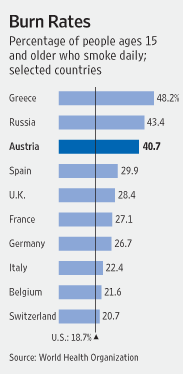
Austria has one of the highest smoking rates on the continent, but is one of the last European nations to implement such smoking legislation, and its restrictions contain many loopholes. One out of two teens and adults smokes in Austria, one of the highest smoking rates in Europe. In 2007, 14,000 people died from smoking-related diseases out of an overall population of 8.2 million. Smoking is common among women and teenagers as well as men. Austrian girls light up, on average, before their 12th birthdays, the youngest age in Europe, according to the World Health Organization.
In the case of those bars and restaurants that are smaller than 538 square feet, owners can decide whether or not they want to allow smoking. The authorities will determine if the creation of a separate room is feasible for those bars and restaurants between 538 and 861 square feet. Furthermore, smoking is still permitted in college dorms, and tobacco companies can still dispense cigarettes for free.
In addition, minors and pregnant women have been banned from working in spaces where they are exposed to smoke.
References: Europe's Smoking Culture Lingers, Despite Bans by CHRISTINA PASSARIELLO, Almut Schoenfeld and David Crawford in Berlin and Thomas Catan in Madrid contributed to this article, The Wall Street Journal, 1/2/2009; Austria approves new anti-smoking law,Datamonitor, 7/10/2008; Partial smoking ban in Austria: same difference, say critics, Agence France-Presse**
Read more...
Austria - January 1, 2009 - smoking ban large restaurants and bars..
Florida's $2.3 billion deficit - increase tax on cigarettes???
 January 3, 2009 - One option is to increase tax on cigarettes to close Florida's $2.3 billion deficit. A special session of the legislators will get underway Monday, 1/5/2009 to discuss options to resolve the deficit. It seems that Governor Charlie Crist, House Speaker Ray Sansom and Senate President Jeff Atwater favor raiding the Lawson Chiles Endowment Fund that pays for health programs for children and the elderly. The 3-government leaders decided to carve up the fund despite Christ saying earlier that the state's poor, sick and elderly will be spared cuts.
State Represenative Jim Waldman who introduced a special $1-per-pack in additional taxes on cigarettes said the tax would raise $700 million, half of which would go toward cutting the deficit, the other half for medical research on smoking related and other diseases. At present the tax is 34-cents per pack (now 4th lowest in nation) would be raised to $1.34 - a move that could raise about $1 billion and place Florida more in line with the average $1.12 levy among states nationally.
It would be the first time that lawmakers increased Florida's cigarette tax in almost two decades.
The increase in the tobacco tax would nearly save 100,000 Floridians from smoking-related deaths, help 123,600 adults quit smoking and prevent 209,000 youth from ever starting. Florida’s Medicaid program incurs an estimated $1.25 billion in costs due to smoking per year. All these positives would improve the state's fiscal health.
References: Holy Smokes - We Think: Tallahassee love its cigarettes more than citizen's health, Orlando Sentinel, 1/3/2009; Proposal To Up Cigarette Tax Draws Cheers, Jeers by JIM KONKOLY, Highlands Today, 1/2/2009.
Related news brief: States Need Quick Influx of Revenue – Think Tobacco Tax..
Read more...
Alberta - tobacco banned in pharmacies and grocery stores..
 January 3, 2009 - Effective January 1, 2009 pharmacies and grocery stores that carry pharmaceuticals are banned from selling tobacco except in gas stations, mall kiosks or separate enclosed spaces. Cigarette sales are also now outlawed in hospitals, universities and colleges.
Anti-smoking advocates applauded the Alberta government when it last year banned smoking in all public places and work sites, bringing the province's smoking laws up to par with several other provinces. Tobacco displays at convenience stores were drastically curtailed in the summer, as cigarette "power wall" were taken down and packages stored out of sight.
The government's most recent research shows smoking rates for Albertans 15 years and older have decreased slightly, from 23 per cent in 2002 to 21 per cent in 2007. The province estimates smoking costs the Alberta economy $1.8 billion annually, mostly in medical bills and sick days from work. More than 3,000 Albertans die every year from tobacco-related illnesses. (Alberta tobacco reduction strategy is working..)
Les Hagen of Action on Smoking and Health believes the government's smoking restrictions and recent cigarette tax hikes are making a difference. He points to the government's dwindling tobacco revenues, on track to tally $50 million less than expected this fiscal year.
Both Hagen and Tony Hudson, president of the Lung Association of Alberta, want the province to hike tobacco taxes further, adding at least $2 to a cigarette pack. "It's one of the biggest levers you can push," Hudson said. "It has a really strong effect on young people. It really hits them in the pocketbook." Also these individuals are pushing to outlaw flavored cigarettes and Hudson would also like to see the entire province, like the Town of Okotoks take aim at drivers and passengers who smoke in vehicles carrying children.
Bill 45 Smoke-free Places (Tobacco Reduction) Amendment Act/Smoke-Free Public Places & Workplaces Implementation - January 1, 2008..
Reference: Alberta limits sales in war on smoking by Renata D'Aliesio, Calgary Herald, 1/2/2009
Other Alberta related news briefs: duMaurier SNUS - Comments Regarding Smokeless Tobacco from Dave Hancock, Minister of Health & Wellness, Province of Alberta, Canada..; duMaurier SNUS - Edmonton, Alberta - Imperial Tobacco Canada...; Conflict Exists With the Acceptance of Tobacco Industry Money...
Read more...

New Brunswick - January 1, 2009 Tobacco products to be hidden from view..
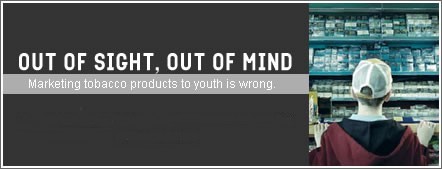 January 2, 2009 - Retailers who sell cigarettes and tobacco products have to "go dark" on advertising January 1, 2009. That's when new regulations come into effect under the Tobacco Sales Act. The government says that means large racks or displays of tobacco products and signs - sometimes called power walls - have to be out of sight.
But the province isn't telling gas bars, convenience store owners (2,000) or grocery stores what to do to hide the tobacco products from being in public view. "As long as it's hidden from the public's view, however the retailers want to accomplish that, that's fine," said Meghan Cumby, spokeswoman at the Department of Health. "It can be a curtain, a cupboard. However, they want to hide them, as long as it's hidden from the public's view."
Framework Convention Alliance - Tobacco Displays - The Facts
Reference: Tobacco products to be hidden from view new roles some retailers confused about changes to how they display items by HEATHER MCLAUGHLIN (mclaughlin.heather@dailygleaner.com), The Daily Gleaner, 1/1/2009.
Related news brief: New Brunswick to ban smoking in cars with children or youth present..; Tobacco displays are on their way out in an increasing number of countries..
Read more...

Netherlands - ban on smoking in bars and restaurants NOT enforced..
 January 1, 2009 - The pressure group, Clean Air Netherlands, says the ban on smoking in bars and restaurants that began July 1, 2008 has so far been a failure. It maintains a majority of bars are not observing the new legislation because the authorities are not enforcing it strictly enough.
The group wants establishments taken to court if they are regularly found flouting the ban, but it also wants individual smokers fined. Clean Air Netherlands says it received 3,000 complaints in a single month about people still smoking, mostly from people who work in bars and restaurants.
Reference: Group slams smoking ban, Radio Netherlands, 12/31/2008.
Related news briefs: Netherlands - ban on smoking in bars and restaurants NOT enforced..; Netherlands the smoking ban must be enforced - Ab Klink, Health Minister...; Congratulations are in order: Netherlands, Romania & Alberta...
Read more...
Malaysia - January 1, 2009 pictorial cigarette warnings..
 January 1, 2009 - On May 31, 2008, the Malaysian Minister of Health announced that pictoral warnings would appear on cigarette packages in that country and on September 15, 2008, the 6 required images were gazetted.
On January 1, 2009, each manufacturer must ensure that 2-brands display the warning messages and by March 1, 2009, all brands must display these warnings. From March 2009, all cigarette packs sold in Malaysia have to carry graphic pictures to warn people of the dangers of smoking. On June 1, 2009, all cigarettes without the new warnings must be removed from the market. (source: Dr. Mohamad Haniki Nik Mohamed)
More on picture based cigarette health warnings..
References: Pictorial image of health warnings on cigarette boxes from next year Written by zen, MalaysiaToday.com, 10/29/2008; Pictorial health warnings on cigarette packs by Jan 1, 2009 by SIM LEOI LEOI, the Star, 10/29/2008; Graphic warnings appear on Malaysian cigarette packsAsiaOneHealth, 1/13/2009; Pictorial health warnings on cigarette packs by Jan 1, saimatkong.com, 11/9/2008.
Related news briefs: Malaysia to hike cigarette prices..; Malaysia - 25% of all cigarettes sales are illegal...
Read more...

John Middleton challenges ban on single cigar sales..
 January 1, 2009 - John Middleton Co., operating company of Altria Group Inc., joined fellow cigar manufacturers Altadis U.S.A. Inc., Swedish Match North America Inc. and Swisher International, Inc., Maryland distributor Century Distributors Inc., and the Cigar Association of America Inc. in asking a Maryland circuit court to overturn a recently enacted Prince George County’s law that bans the sale of single cigars.
The law is aimed primarily at small cigars sold individually at convenience stores and gas stations. Such cigars are often marketed in youth-friendly flavors such as cherry, apple and lime and are sold for as little as 80 cents to $1.
Kathleen Dachille, Director of the Center for Tobacco Regulation at the University of School of Law: Studies have shown that the cigars have become increasingly popular among young people in predominantly black communities and can be a gateway to a lifelong cigarette habit. Many young people smoke cigars for the tobacco, but they can also be easily hollowed out and filled with marijuana. She said requiring that cigars be sold in packs of five will raise their price enough to deter some young people, who will also balk at having to keep and store the packs. If we can prevent children in Prince George's County from initiating smoking with a very popular attraction, we may prevent a tobacco user from growing up.
Black & Mild is the most popular brand of cigars for smokers 12 and older. Nearly a quarter of 18- to 24-year-old blacks in the Baltimore smoke B&M cigars.
Dachille and Quinton who works with the Suitland-based Substance Abuse Treatment Education Prevention Network, said they will again support a state law when the legislature meets in January 2009.
Dachille said she thinks that Prince George's is the only jurisdiction in the nation to ban the sale of single cigars, but New York City and Rhode Island are considering similar measures. A similar law in Philadelphia was struck down by a court for other provisions. Baltimore is also considering new health regulations that would have the same effect, and a District law targets cigar products, such as wrappers, as drug paraphernalia.
References: Council Bans Sale of Single Cigars in Bid to Curb Youths' Marijuana Useby Rosalind S. Helderman, Washington Post, 11/19/2008; John Middleton Challenges Sales Ban Joins others in fight for single cigars, Convenience Stores/Petroleum Daily News, 12/31/2008.
Click on image to enlarge..
Read more...
Smoking bans lower heart attacks..
 January 1, 2008 - A smoking ban caused heart attacks to drop by more than 40 percent in Pueblo, Colorado and the decrease lasted three years, federal health experts reported Wednesday (12/31/2008). In 2003 (July 1, 2003) this city passed a municipal law making workplaces and public places smokefree and the U.S. Centers for Disease Control and Prevention (CDC) tracked hospitalizations for heart attacks afterward.
They found there were 399 hospital admissions for heart attacks in Pueblo in the 18 months before the ban and 237 heart attack hospitalizations in the next year and a half -- a decline of 41 percent. The effect lasted three years, the team reported in the CDC's weekly report on death and disease.
"We know that exposure to second-hand smoke (SHS, passive, sidestream, environmental, involuntary) has immediate harmful effects on people's cardiovascular systems, and that prolonged exposure to it can cause heart disease in nonsmoking adults," said Janet Collins, director of CDC's National Center for Chronic Disease Prevention and Health Promotion. Long-term exposure to secondhand smoke can raise heart disease rates in adult nonsmokers by 25 percent to 30 percent, the CDC says. Secondhand smoke kills an estimated 46,000 Americans every year from heart disease and 3,000 lung cancer deaths among non-smokers each year. Smoking also causes a variety of cancers, as well as stroke and emphysema or chronic obstructive pulmonary disease.
This study adds to existing evidence that smoke-free policies can dramatically reduce illness and death from heart disease. Dr. Michael Thun, American Cancer Society: 'This is now the ninth study, so it is clear that smoke-free laws are one of the most effective and cost-effective (ways) to reduce heart attacks."
Reference: Smoking ban lowers heart attacks in one U.S. city, Reporting by Maggie Fox; Editing by Bill Trott, Reuters, 12/31/2008; Colorado study links smoking ban to major drop in heart attacks, Associated Press, 12/31/2008.
CDC Publication: Reduced Hospitalizations for Acute Myocardial Infarction After Implementation of a Smoke-Free Ordinance --- City of Pueblo, Colorado, 2002--2006
Some related news briefs: U.S. - Children Remain Especially Vulnerable to Secondhand Smoke; Massachusettes - Smoking ban drop in fatal heart attacks..; Nicotine Dependence in Kids Exposed to Second-Hand Smoke..
Read more...
Oregon Governor wants cigarette vendings machines banned..
 December 31, 2008 - Oregon's Governor Ted Kulongoski
submits legislation for 2009 Session..
The governor wants to prohibit the sale of tobacco products through vending machines. Currently tobacco vending machines are allowed in taverns, cocktail lounges, hotels and motels, providing easy access to tobacco products and increasing the likelihood children will begin smoking. This legislation prohibits the distribution of tobacco through vending machines as another way to keep tobacco products out of the hands of children. [HB 2136] Health officials say this proposal is to restrict accessibility of tobacco to minors. Also these officials say smoking is the most preventable cause of death and disease in Oregon.
In addition the governor wants to require landlords to disclose where smoking is allowed --and not allowed -- on a rental property as a standard part of the lease agreement.
On January 1, 2009 - Oregon's smoking ban expands to bars, restaurants and other indoor work sites.
Reference: Forget about Santa, Governor wants a lot from the 2009 Legislature by Michelle Cole, The Oregonian, 12/18/2008; Potential Ban on Cigarette Vending Machines by Amy Sienicki, KDRV News Watch 12, 12/29/2008.
Read more...

Utah Bars Go Smokefree January 1, 2009..
 December 31, 2008 - On January 1, 2009 Utah's progress in providing smoke free environments will reach a new milestone. At that time taverns and private clubs will join thousands of other businesses in the state that already provide smoke free air for their workers, customers, and visitors.
Initial concerns by bar and club owners in those states about the impact on their businesses have vanished and tax receipts clearly indicate no loss of business. In fact, clean air venues may be attracting new customers who previously refused to patronize taverns and private clubs laden with toxic secondhand smoke. Several taverns and private clubs across Utah have already gone smoke free and report business is better than ever.
Lawmakers passed a law banning smoking in private clubs and taverns in 2006, but it only applied to newly licensed clubs. At midnight, all bars must go smoke-free. Under the new law, anyone caught smoking in a bar could face a $100 fine for the first offense and up to a $500 fine for a second offense. The state health department says bars can also be fined up to $5,000 for allowing smoking.
References: Utah Taverns and Private Clubs Go Smoke-Free January 1, 2009, Utah Tobacco Prevention and Control Program, 12/30/2008; Smoking in Utah bars to be outlawed at midnight by Brock Vergakis - The Associated Press - Daily Herald, 12/31/2008.
Read more...
BAT China - downplayed the dangers of second hand smoke..
 December 31, 2008 - Three hundred million people smoke in China, accounting for one-third of the global “consumption” of cigarettes. Each year, about one million people die in China from tobacco-caused diseases, including cancer, heart disease, and lung disease. More than 100,000 deaths from tobacco-related causes occur annually among the 540 million Chinese people who are exposed to secondhand smoke (SHS, environmental smoke, passive smoking, involuntary smoking).
China became a party to the World Health Organization's Framework Convention on Tobacco Control (FCTC) Treaty in 2005 but restrictions on smoking in public places in China remain limited and ineffective. Previous analyses of internal tobacco industry documents have revealed that transnational tobacco companies (TTCs) have used a multifaceted approach to undermine the adoption of restrictions on smoking in many countries.
Based on an analysis of internal documents researchers have found beginning in the mid ’90s through at least 2002, British American Tobacco (BAT) downplayed smoking-related disease in China by suggesting air pollution was a greater public health threat than smoking and arguing that the focus should be on what it characterized as China’s top killer, liver disease. As recently as 2006, despite two decades of research into the harms of second-hand smoke, China’s State Tobacco Monopoly Association was issuing statements that more research was needed to determine the effects of smoke exposure.
Research article: Monique E. Muggli1, Kelley Lee, Quan Gan, Jon O. Ebbert, Richard D. Hurt, “Efforts to Reprioritise the Agenda” in China: British American Tobacco's Efforts to Influence Public Policy on Secondhand Smoke in China, published December 2008 in the online journal PLoS Medicine.
Reference: Tobacco Company Downplayed Risks in China, Report Says by RONI CARYN RABIN, The New York Times, 12/29/2008.
Read more...
Children are especially vulnerable to thirdhand smoke..
 December 30, 2008 - Thirdhand (third hand, 3rd) smoke is the term used for smoke contamination that lingers after the cigarette is stubbed out. Residual toxins remain in the air, on surfaces including clothing, and even in household dust. Children are especially vulnerable to thirdhand smoke exposure because they breathe near, crawl on, play with, touch, and put in their mouths contaminated surfaces.
Lead study author Dr. Jonathan Winickoff  said that particulate matter from tobacco smoke has been proven toxic and that according to the National Toxicology Program, these 250 poisonous gases, chemicals, and metals include hydrogen cyanide, carbon monoxide, butane, ammonia, toluene -- found in paint thinners, arsenic, lead, chromium, cadmium, and polonium-210 -- a highly radioactive carcinogen. Eleven of the compounds are classified as Group 1 carcinogens, the most dangerous, Winickoff said.
"When you smoke -- anyplace -- toxic particulate matter from tobacco smoke gets into your hair and clothing," Winickoff said in a statement. "When you come into contact with your baby, even if you're not smoking at the time, the baby comes in contact with those toxins. And if you breastfeed, the toxins will transfer to your baby in your breast milk."
Winickoff's team found that this was the case. In a survey of more than 1,500 households, 95.4 percent of nonsmokers versus 84.1 percent of smokers agreed that second-hand smoke harms the health of children, and 65.2 percent of nonsmokers versus 43.3 percent of smokers believed that third-hand smoke harms children. Strict rules prohibiting smoke in the home were more prevalent among nonsmokers – 88.4 percent versus 26.7 percent – but among both smokers and non-smokers, participants who agreed that environmental smoke was harmful to children's health were more likely to have restrictions on smoking in their homes.
PAPER:Jonathan P. Winickoff, MD, MPH et al., Beliefs About the Health Effects of "Thirdhand" Smoke and Home Smoking Bans, PEDIATRICS Vol. 123 No. 1 January 2009, pp. e74-e79 (doi:10.1542/peds.2008-2184), ABSTRACT..
Parental tobacco use is a serious health issue for all the family members. To learn more - Click.
Reference: 'Thirdhand' smoke beliefs linked to home smoking bans, Posted by Elizabeth Cooney,Boston.com, 12/29/2008; Survey Highlights Beliefs About Children's Risks from 'Third-Hand Smoke' by Michael Smith, North American Correspondent, MedPage Today, 12/30/2008 and Third-hand smoke: Another reason to quit smoking, EurekAlert, 12/29/2008.
Read more...
Oregon January 1, 2009 Smokng Ban Expanded..
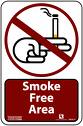 December 29, 2008 - On January 1, 2009 - the smoking ban expands to bars, restaurants and other indoor work sites. No smoking within 10 feet of doors, windows or ventilation. More than 35,000 Oregonians work in these establishments, and that a U.S. surgeon general's report issued last year made it clear that their health is put at risk by exposure to secondhand (passive, involuntary, side stream, environmental)smoke.
Oregon legislators approved the indoor smoking ban 18 months ago, deliberately setting a long lead time so businesses could prepare. The new law expands upon a 2001 ban and prohibits smoking at all indoor work sites. Smoking will not be allowed outside within 10 feet of doors or windows. Motels and hotels must designate at least 75 percent of their rooms as nonsmoking.
The new law does not apply to tribal establishments, such as casinos or restaurants. Businesses can be fined up to $500 a day and $2,000 a month by the state Department of Human Services for violating the law.
State officials say that at least two-thirds of affected businesses already prohibit smoking.
Related news brief: Oregon - smoking ban to expand, prepares for Camel Dissolvables..
Reference: Smoking ban tops list of new state laws for 2009 by Janie Har, The Oregonian, 12/27/2008; Oregon smoking ban wins final OK, KATU.com, 6/18/2007.
Read more...
Iowa - fire safe cigarettes - January 1, 2009..
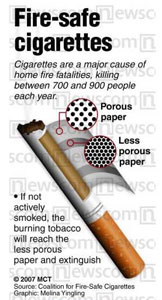 December 29, 2008 - Iowa - A law signed on May 21, 2007 requiring the sale of new cigarettes that are less likely to start fires goes into effect January 1, 2009.
As can be seen from the image fire-safe cigarette has a what's called a speed bump in the band, so if it is left unattended it will extinguish on its own.
The cigarettes cost the same price, but some smokers say the new cigarettes leave a bad taste in their mouths. The new cigarettes may provide further incentive to once and for all stop smoking. Comment from an Iowa smoker: “If it tastes horrible, I'll probably be more apt to quit sooner,” Timothy Miller said. Another comment: "If you're not constantly smoking them, they'll go out. Then, if you relight it, it flames up in your face because of the paper.” Dummies - Citizens Against Fire Safe Cigarettes.."
Nearly every other state in the nation already requires or is in the process of requiring retailers to sell fire-safe cigarettes Other states requiring the sale of fire safe cigarettes starting January 1, 2009 include: Delaware signed into law July 5, 2007; Oklahoma signed into May 12, 2008, Pennsylvania signed into law July 9, 2008 and Texas signed into law June 15, 2007.
Learn more: Coalition for Fire Safe Cigarettes, an arm of the National Fire Protection Association.
Reference: Safer cigarette law goes into effect Jan. 1, Chicago Tribune - Associated Press, 12/29/2008; Smokers React to New Fire-Safe Cigarette Law by Mark Geary, Reporter, KCRG-TV, 12/29,2009.
Read more...
Wisconsin - Increased Sales Tax Decrease in Smoking..

December 29, 2008 - Last January 2007, Wisconsin a tax increase that went into effect increasing the cigarette tax from 77 cents to $1.77 per pack (a 130 percent increase). One year after the tax increase, statistics show a considerable growth in state revenue brought in by tobacco products. Even with revenue growth, figures suggest the price hike may have nudged some people to snuff out their butts.
Through November of the last fiscal year, Wisconsin brought in $107 million through tobacco taxes, according to the state Department of Revenue. This year, the state collected more than $200 million, or an increase of 87 percent.
Wisconsin's rate of smoking is at 20 percent of the adult population, its lowest level in state history, according to the state Department of Health Services. The state's cigarette tax is now the 15th highest in the nation, according to an October report from the Campaign for Tobacco Free Kids. Wisconsin would have ranked 33rd had it maintained the 77-cent tax.
Reference: Tax increase on cigarettes contributes to decrease in smoking by Jim Collar for The Northwestern, 12/28/2008.
Related news briefs: Wisconsin's achieves the lowest adult smoking prevalence ever..; The primary reason to increase the tax on tobacco is to get smokers to quit and dissuade kids from starting..; Wisconsin cigarette tax and tax on other tobacco products to increase January 1, 2008..;Wisconsin to Increase Tax on All Tobacco Products..; Wisconsin voters overwhelmingly (2-to-1) favor upping cigarette taxes by $1.25 a pack..
Read more...


To Provide Public Awareness
Purpose
About Us
Contact Us
2008 HIGHLIGHTS
TOPIX PAPERS - 2008 & 2009..