November 19, 2010 -
Local crusaders against smoking predicted today that Buffalo is on the verge of adopting some of the toughest rules in the nation governing the advertising of tobacco products. Activists met at an East Side community center where speakers accused cigarette-makers of using "predatory" advertising tactics to attract young smokers.
The event was held as the part of the Great American Smokeout, the American Cancer Society's annual effort to discourage tobacco use. Nine easels were set up at the front of the Delevan-Grider Community Center, each holding an oversized photograph of East Side storefronts that were plastered with cigarette ads.
According to a recent survey that focused on randomly-selected tobacco retailers in Erie and Niagara counties, tobacco ads were found in 93 percent of the stores. Advocates were assisted by local college students in 80 retail outlets. Other studies have found that nearly 90 percent of regular smokers began the habit before they turned 18.
Tobacco marketers are on the prowl for "replacement smokers," said Gretchen Leffler, regional vice president of the American Cancer Society. "In our world, they're known as our children," Leffler said. Youngsters are especially susceptible to the "bright colors and flashy signs" that tobacco marketers use to hawk their products, Leffler added.
Buffalo officials are "on the verge" of passing tough new regulations that will regulate the sale and advertisement of tobacco products, said Anthony Billoni, coordinator of the Erie-Niagara Tobacco-Free Coalition.
Directly related news brief: June 30, 2010 - Buffalo, New York - considering the toughest tobacco control program in nation..
He introduced Masten Council Member Demone A. Smith, the sponsor of a draft proposal that would impose dozens of restrictions on tobacco marketing tactics and retailing activities. Stores would no longer be able to display outdoor ads for tobacco products. Some new businesses would be banned from selling tobacco products, including pharmacies, restaurants, bars and business that primarily serve minors, or businesses that are within 1,000 feet of schools.
Beginning in 2014, no tobacco products could be sold at any drugstores, bars, restaurants, game rooms or on school or college properties.
One key provision would create a new city license for all businesses selling tobacco products. Advocates said this would make it easier for the city to shut down irresponsible retailers.
Smith said the plan is currently being reviewed by city attorneys. He expects a final version to be presented to the Common Council in the near future, and he believes the plan will have enough support to pass.
Smith said the reason the bill has yet to be introduced and approved involves some people's concerns that the city could face enormous legal costs if the tobacco industry mounts a court fight to the regulations. Outside groups would likely assist the city with expenses in the event of a legal challenge, sources said.
A co-founder of 100 Black Men of Greater Buffalo, a community advocacy group, praised the efforts to crack down on cigarette advertising. Jim Anderson said tobacco marketers are engaging in "predatory" practices in many inner city neighborhoods, trying to entice young people into smoking. "They don't care about the old folks who might be stuck on it. They want the new money," he said.
Reference: Lawmakers 'on the verge' of Lawmakers adopting tough rules on tobacco ads by Brian Meyer, BuffaloNews.com, 11/18/2010.
Buffalo - related news briefs:
Buffalo, New York - considering the toughest tobacco control program in nation..;
Town of Tonawanda - smoking ban in town buildings and recreation areas..;
Buffalo - landlords must disclose to tenants whether they allow smoking..;
Read more...

 November 19, 2010 - Philip Morris International Inc. (PMI) and Serbian nonprofit
 November 19, 2010 - Just on Monday November 15th we reported that the state of Idaho is being pushed by many health groups to increase the tax that they currently have in place on cigarettes and other tobacco products. (



 November 18, 2010 - Bronson, Fla. -- Florida jury snaps tobacco’s recent winning streak with an $80 million award to the daughter of a deceased smoker in a lawsuit against R.J. Reynolds Tobacco Co. Dianne Webb claimed her father's 1996 death was caused by a 60-year smoking addiction fed by company manipulation and deception. The Levy County jury award Tuesday includes $8 million in compensatory damages and $72 million in punitive damages. (The lung cancer death of James Kayce Horner. Mr. Horner, who started smoking at the age of 17 in 1934 (decades before warning labels appeared on cigarette packages), smoked for over 60 years before dying of lung cancer on March 11, 1996, at the age of 78.) R.J. Reynolds, a unit of Winston-Salem, N.C.-based Reynolds American Inc., had no immediate comment on whether it will appeal the Levy County verdict.
 Click to enlarge..
 Paula Snowden, the Chief Executive of



 But seven of the nation's largest airports still allow indoor smoking in designated areas, the CDC reports. That includes Hartsfield-Jackson Atlanta International Airport, Dallas Fort Worth International Airport, and Denver International Airport, three of the five busiest airports in the country. The other four large airports that allow indoor smoking are: Las Vegas McCarran International Airport, Charlotte Douglas International Airport, Washington Dulles International Airport, and Salt Lake City International Airport.
 November 18, 2010 - The Los Angeles City Council unanimously directed its attorneys Wednesday to prepare an ordinance that would ban smoking in "all public areas and common areas where people congregate."
 November 17, 2010 -
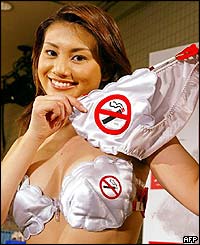
  British American Tobacco Plc (BAT), Europe’s largest cigarette maker, forecasts a 17 percent decline in the Japanese cigarette market next year

 November 17, 2010 - In a 400-page decision released late on Monday, a WTO (World Trade Organization) panel went on to order Thailand to set uniform taxes on both foreign and locally made cigarettes and to adopt more transparent policies for determining import values. The decision will become an official ruling in 60 days unless either side appeals or if the entire WTO membership rejects the findings.

 The Australian Council on Smoking and Health welcomed the move. Council president Mile Daube: "Cigarettes are now being heavily promoted on the Internet, and there are serious concerns that both online advertising and social networking sites are being used to promote tobacco to young people."
 U.S. Smokeless Tobacco Co. (in 2001 U.S. Tobacco Company changes its name to U.S. Smokeless Tobacco Company - UST)
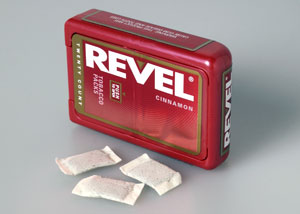 UST has had a Swedish-style SNUS product known as Revel since August 2001. In July 2006 UST came out with a similar product to Revel called
 Skoal Dry Tobacco Packs which was test marketed in Louisville, KY and in Austin, TX going head-to-head with Camel Snus. Skoal Dry came in three flavors: regular, menthol and cinnamon and was selling for $3.50 - $4. a pack or about the same as a pack of premium cigarettes. Each can continued 20 tobacco pouches. (Tobacco Journal International August 3, 2006)
 As of August, 2008, Skoal Dry was discontinued and replaced by Skoal SNUS available in three flavors: mint, cinnamon, and citrus blend..


 November 16, 2010 - The


 Rights Action/Friends of the Earth Nigeria (ERA/FoEN) has called on the federal government to emulate Australia’s move to ban the promotion of tobacco. (


 According to the new Cancer Plan, the Danish Health Ministry will spend six million kroner to re-run the campaign in 2011, while providing 2.5 million kroner to finance STOP-Line, a helpline for people wanting to quit smoking. “The number of smokers has gone down, and we must push forward with our endeavours in this area, regardless of whether this figure is a result of the campaign,” Bertel Haarder, Health Minister, told Berlingske Tidende newspaper.
 The Danish Cancer Society supports the campaign’s re-launch, describing last year’s effort as “predominantly positive”, as it sparked great interest in smoking cessation. Despite its success, project leader Niels Them Kjær acknowledged that it was “very aggressive”.