Click to enlarge..
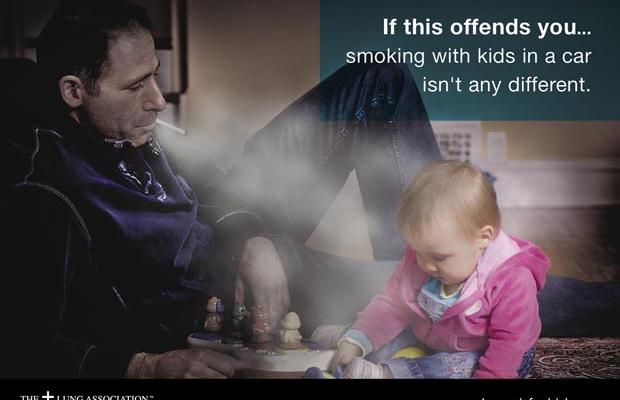 January 15, 2011 - A new study is urging lawmakers not to let science get in the way of sound policy when it comes to laws on children's exposure to second-hand smoke (passive smoking, shs, environmental tobacco smoking, ets, sidestream smoke, involuntary smoking) in cars. Smoking in cars carrying children should be banned whether or not science can prove exactly how risky it is, according to an article penned by Ray Pawson of the University of Leeds and published in the Canadian Medical Association Journal.
An international study by the World Health Organization (WHO), which analyzed data from 192 countries, estimates that in 2004 passive smoking was responsible for the demise of over 600,000 people, including 165,000 children. (Passive smoking kills over 600,000 a year worldwide—WHO report..)
PAPER: Myths, facts and conditional truths: What is the evidence on the risks associated with smoking in cars carrying children? , Ray Pawson, Geoff Wong, and Lesley Owen,University of Leeds, United KIngdom, Can. Med. Assoc. J., Jan 2011. The authors conclude that there is enough evidence to make a valid decision to legislate against smoking in cars with children.
Supporting information: Every parent wants their children to lead healthy and happy lives. There's an abundance of evidence that children are more susceptible to the negative effects of second-hand smoke (ETS, environmental tobacco smoke, involuntary smoking, sidestream smoke, passive smoking).The banning of smoking in cars carrying children has already been answered by eight Canadian provinces and territories that have outlawed the practice. Nova Scotia was the first to ban smoking in cars with children, introducing its bill in 2007. (Nova Scotia to start enforcing a law that bans smoking in vehicles with children in them..)
As pointed out by Action on Smoking and Health (ASH) Australia in a February 2009 paper the evidence of second-hand smoke harm to children in enclose spaces is extensive and irrefutable. A 2004 survey of over 1300 Australians in 800 households showed over 90 percent (including 73 percent of smokers) support banning smoking in cars carrying children. A Harvard School of Public Health report indicated that secondhand smoke in cars can be up to 10 times more of a health risk than secondhand smoke in a home.
UK - Brits to petition govt to put a stop to adults smoking in cars when youngsters are present...
Vehicles have been found to be the most dangerous space for second-hand smoke levels. Kids exposed to smoke are at higher risk since they breathe in more air by weight than adults. Both the respiratory rate and heart rate are higher in children below the age of 13 than in adults. The younger the child, the greater the potential for exposure. Since the lungs of children are still developing, exposure to second-hand smoke can lead to ear infections, asthma, bronchopneumonia and other illnesses.
Northern Ireland - 9 of 10 households would welcome a ban on smoking in cars with children present..
Comments from prominent physicians: Just about every physician in the United Kingdom insists that smoking should be banned in cars when a child is present.
Wales - Chief Medical Officer Dr. Tony Jewell we must protect children from second-hand smoke, especially in cars..;
Professor Steve Field, chairman of the Royal College of General Practitioners (GPs), has has stated, parents that smoke in front of their children at home at in cars are "committing a form of child abuse." Professor Field, represents 42,000 GPs across the United Kingdom (UK). (United Kingdom - head GP physician calls smoking in front of children "child abuse"..);
Twenty of Britain’s most senior doctors call today for a ban on smoking in cars as part of a sweeping expansion of laws to protect children against the effects of inhaling smoke. (Senior British Doctors demand banning smoking in vehicles when children are present...)
Comment from Philip Morris: David Sutton, a spokesman for Philip Morris USA said the company believes the public "should be guided by the conclusions of public health officials regarding the health effects of secondhand smoke" and "particular care should be exercised where children are concerned."
Smoking in cars with children is still legal in Alberta, Quebec, the Northwest Territories and Newfoundland Labrador.
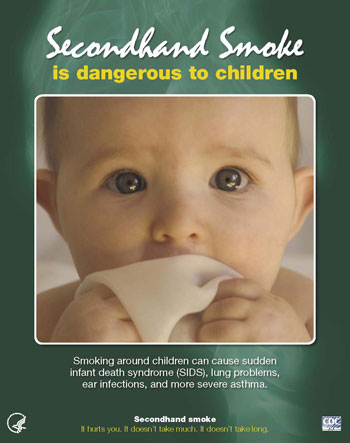 "This issue has unstoppable momentum," said Rob Cunningham, a senior policy analyst with the Canadian Cancer Society. "These laws have enormous public support and they have been easily adopted with all party support in provincial legislatures."
Pawson's article was written to ensure that momentum wasn't thrown off track by the discrediting practice of "sound bite science." The sound bite in question was the oft-quoted statistic that smoking in a car is 23 times more toxic than smoking at home — a statement that has been disproven. "There is good evidence to show that children's exposure to second-hand smoke in cars is dangerous," he said.
For Cunningham, the debate was over long before Pawson's article. "There is no debate," he said. "There's much greater knowledge of the dangers of second-hand smoke than there was in the past and people, even smokers, don't want to expose their kids in a car."
Three countries — Mauritius, South Africa and Bahrain — have banned the practice.
Reference: Science shouldn't stand in the way of sound smoking policy: study by Rebecca Lindell (rlindell@postmedia.com), Postmedia News, montrealgazette.com, 1/10/2011
 Timeline of Canadian provinces and some municipalities that banned smoking in the car with children: April 1, 2008 — Nova Scotia; May 15, 2008 — Yukon Territory; July 31, 2008 — Surrey, British Columbia, Sept. 1, 2008 — Okotoks, Alberta, Nov. 1, 2008 — White Rock, British Columbia, Nov. 30, 2008 — Richmond, British Columbia, Jan. 21, 2009 — Ontario, Apr. 7, 2009 — British Columbia, Jan. 1, 2010 — New Brunswick, Sept. 15, 2009 — Prince Edward Island, July 15, 2010 — Manitoba, Oct. 1, 2010 — Saskatchewan, July 2, 2011 — Leduc, Alberta. (kids, child, youngsters)
Read more...
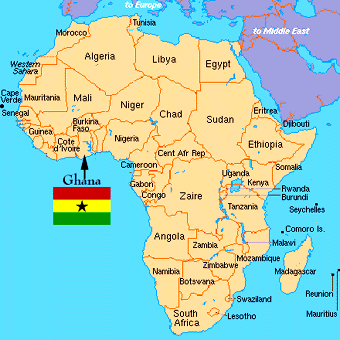
 January 14, 2011 - The Tobacco Control bill has been scrapped. In its place the Attorney General’s Department has drafted a Public Health bill, under which strategies for tobacco control have been listed.



 January 13, 2011 - The United States District Court Eastern District of New York today, January 13th dismissed a lawsuit by a group of New York plaintiffs seeking class certification in a medical monitoring lawsuit filed against Philip Morris USA.
 January 14, 2011 - The Altria Group will host a live audio webcast at www.altria.com from 09.00 hours Eastern Time on January 27 to discuss its 2010 fourth-quarter and full-year business results. The business results will be issued through a press release at about 07.00 hours on the same day.
 SDS party logo..



 January 14, 2011 - Reynolds American Inc. (RAI) announced today, January 14th that it has reached an agreement to sell Lane Limited, to


 Viet Nam is a member of the
  January 13, 2011 - Combined Internet and telephone treatment of smoking cessation outperform static and dynamic Internet interventions, according to the results of a 3-group, randomized controlled trial reported in the January 10 issue of the Archives of Internal Medicine.



 January 13, 2011 - Roll-your-own cigarettes (Rollies) may be more addictive than factory-mades, a study has suggested. The New Zealand study builds on research indicating these cheaper smokes are potentially more harmful. Rollies' potentially greater addictiveness is attributed to their higher tar/nicotine ratio.


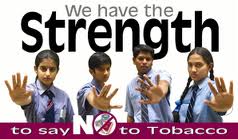 January 12, 2011 - With the tremendous pressure being put by the anti-tobacco lobby and the health ministry when it comes to smoking or drinking liquor, celebrities are now shying away from endorsing tobacco and liquor products. Sources say that the tobacco and liquor companies have apparently decided to loosen their purse strings to the tune of Rs 25-30 crore (1 crore = 107 = 10,000,000.00 INR = 221,018.88 USD) for a single ad-deal to get a celeb on board, but find themselves up against a wall.
 January 12, 2011 - Bhutan police can raid homes of smokers in a search for contraband (illegal,illicit) tobacco and are training a special tobacco sniffer dog in a crackdown to honor a promise to become the world's first smoke-free nation.

