September 22, 2008 - On May 31, 2008 the British Government's Department of Health (DH) released a paper on the the future of tobacco control. Interested parties have 12-weeks period (until September 8, 2008) to provide comments that should be considered before formalizing a National Tobacco Strategy.
The article British doctors talk up Swedish 'snus', The Local, 9/8/2008, the aim of the report, was to suggest radical ways to effectively eliminate tobacco smoking in the UK. Here's a radical approach - the tobacco advisory group of the Royal College of Physicians (RCP) recommended that snus should be marketed as a product aimed at helping smokers kick the habit. Except for Sweden, snus is outlawed by the European Union mainly because it was deemed an attraction to children, who would become easily hooked and could move on to cigarettes. Swedish Match (the world's second largest maker of snuff and chewing tobacco and market leader in Sweden - volume share of 90% at the end of 2006) anxious to market snus throughout Europe is trying their hardest to reverse the EU's decision and the RCP is helping them out.
"There is no scientific evidence whatsoever that smokers are able to switch to smokeless tobacco and remain switched," Dr.Thomas Glynn, the Director of Cancer Science and Trends at the American Cancer Society (Snusing: the new way to give up smoking, Susie Rushton, The Independent, October 9, 2007) "There is no evidence smokeless tobacco can help people quit smoking. There are no studies we would consider sufficient." Dr. Terry Pechacek, Associate Director of Science at the Centers for Disease Control Office on Smoking and Health. (SNUS the BUMP, Nordic Reach (The Scandinavian Lifestyle Quarterly}, No.17 Volume XIX, 2007, p53)Dr. Gunilla Bolinder, Director of Education at Stockholm's Karolinska University Hospital points out, "To sing the praises of SNUS is a deathblow to over 20 years of hard tobacco preventive work. SNUS only saves the life of the tobacco industry" (SNUS gets the thumbs-down NEWS-24 1/31/2007).
Professor John Britton, chair RCP tobacco advisory group, "It's their [tobacco companies] job to sell as much tobacco as possible, so they will be targeting non-smokers rather than current ones, that's the worry." According to the DH the focus is on the need to protect children and reduce health inequalities. A YOGOV poll shows strong support for tough measures to protect children for the harm caused by tobacco. The test marketing of snus products in the U.S. has been a big disappointment. Those that purchase the product are young adults and kids that want to be young adults; here's the Camel SNUS tag line, "Pleasure for where ever, whenever.." – no one will ever know.
Dr. Lars E. Rutqvist, the Vice President for Scientific Affairs at Swedish Match has stated the drive in Snus sales in Sweden has been in response to the smoking ban rather than the perceived advantage to user’s health.
The European Court of Justice ruled on (December 2004) that an EU ban on the sale of snus - Swedish snuff tobacco - should remain in force. Noting the risk that young people would become addicted to nicotine if they begin to use snus, the Court said that its decision was motivated by a desire to protect the health of European citizens. EU Scientific Committee Concludes: Insufficient Evidence to Lift Ban on SNUS..
Smoking cessation specialists in the UK from hospitals, primary care and management within the National Health Service from all over the UK, voted strongly against the proposal to make SNUS more available in their practice.
The summary of a new report by RCP entitled, "Ending tobacco smoking in Britain: Radical strategies for prevention and harm reduction in nicotine addiction" forms part of the RCP's response to the Department of Health's consultation on the future of tobacco control. At least in this summary there was no mention of "SNUS." (Royal College of Physicians: Ending tobacco smoking by 2025, politics.co.uk, 9/8/2008.
From the article in The Local - the availability of snus in Norway, a non-EU country, had NOT led to any measurable drop in the prevalence of smoking. Those that use snus in Norway are young adults and kids that tobacco companies have convinced to give it a try. According to Dr. Karl E. Lund, research director at the Norwegian Institute for Alcohol and Drug Research over the past decade, daily use of snus has tripled among teens and young adults. Swedish Match, makes what Dr. Lund calls "starter kits." "This is snus sold in glamorous metal boxes in which the snus is seasoned with different kinds of fruit flavors," he explains. "[They are] easy to use for snus novices." (NCI Cancer Bulletin, Feb 20, 2007 vol 4 number 8)
TobaccoWatch.org
Read more...
 September 23, 2008 - Health experts have proposed a sharp rise in cigarette prices to curb Albania's addiction to tobacco. "If the price of cigarettes was raised by 10 per cent, we estimate consumption among youths might drop by 8 per cent," Roland Shupreka, of Albania’s Public Health Institute.

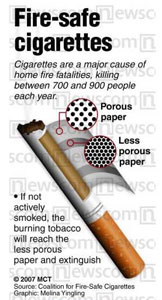 September 22, 2008 - Cigarette makers will be required to change their products to ensure that cigarettes self-extinguish more readily, before the regulations come into force in March 2010.