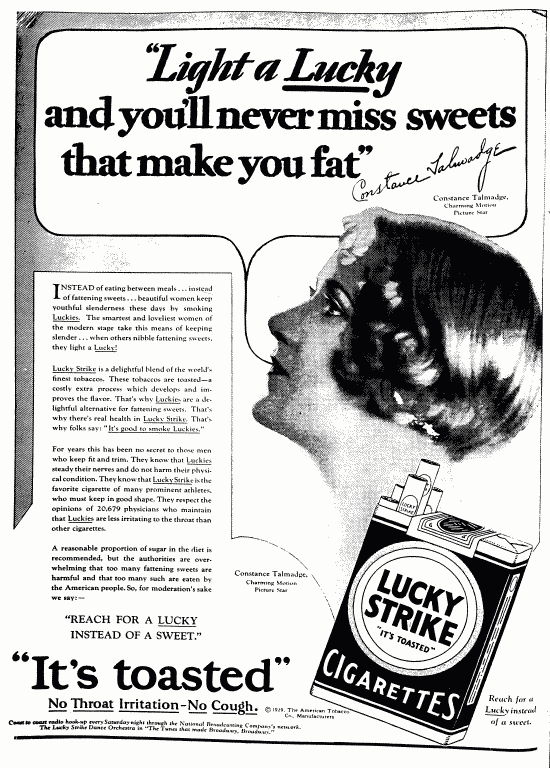
 October 21, 2008 - Gallaher's (owned by Japan Tobacco International) Silk Cut cigarttes will next month launch in the United Kingdom a range of "Superslims", which will be sold in "perfume-shaped" boxes designed to appeal to image-conscious women. Deborah Arnott, director of the Action on Smoking and Health (ASH), "Silk Cut is using the terminology 'super slim' to make the link between smoking their product and losing weight."
Many tobacco companies have tried to forge a link between smoking and slimness. The first ad which emphasized the "benefits" of smoking for weight control was brought out in the late 1920s, with the slogan Reach for a Lucky instead of a sweet.
The popular US brand Virginia Slims hammers the message home with varieties Virginia Slims Super Slims Lights and Virginia Slims Super Slims Ultra Lights.
In early 2009 the Philip Morris Tobacco company will also launch sleek pink "Purse Packs" aimed at women.
Silk Cut's new marketing ploy is just the latest device that tobacco companies are using to appeal to women. Newly released industry documents show tobacco firms paid huge amounts for endorsements from the stars of Hollywood's "Golden Age".
Reference: Tobacco firms target teenage girls with 'super slim' products cigarettes
Charities accuse companies of exploiting young women's fears about weight by Rachel Shields, 10/19/2008.
Japan Tobacco International (parent of Gallaher) and Imperial Tobacco, dominate the UK tobacco market with an 80% share by value. British American Tobacco (BAT) is the world's second-largest cigarette company and is increasingly focused on fast-growing developing markets rather than advanced economies where smoking is in decline. BAT has a 5% share of the UK market largely through its Rothmans brand. (Research and Markets: Examine the Challenges and Opportunities for the Cigarettes & Tobacco Market as Companies Focus on Developing Markets as Demand Falls in Developed Countries Market Watch - Wall Street Journal, 10/21/2008.)
Read more...
Gallaher targets teenage girls with 'super slim' Silk Cut cigarettes..
Saudi court set to hear tobacco compensation case..
 October 21, 2008 - A Saudi court will begin hearing a lawsuit on Tuesday, 10/21/2008 filed by the Ministry of Health against agents of international tobacco companies in the kingdom. Health chiefs will demand compensation of $2.6 billion and an annual compensation of $133 million for the expenditures incurred on the treatment of smokers when the General Court in Riyadh opens.
Health Minister Hamad Al-Manie said he was confident that his ministry would win the lawsuit since it provided statistics and medical data that showed how smoking destroys people’s health and eats away at social spending connected with smoking-related medical treatment of citizens. “We’ll go ahead with the lawsuit unless the tobacco companies paid the full amount of compensation ... I will not and neither will the ministry forsake the rights of patients,” he said.
Arabian Gulf states in general and Saudi Arabia in particular are some of the biggest tobacco importing and consumer countries in the world. Saudi Arabia tops the list of tobacco importers, according to 2007 statistics. Iran is placed second, followed by Jordan, Turkey, Morocco and Egypt.
Smoking leads to self-destruction, against which Islam has strongly warned. It incurs a waste of money and Islam forbids excessive expenditure. It irritates the throat and it fouls the breath, in addition to its other health hazards. (The late Dr Al-Hussaini Abdulmajid Hashem Former Deputy Rector of Al-Azhar- Islamic Ruling on Smoking...
Related news brief: Saudis to sue tobacco firms for more than $2.7 billion Ryadh, Saudi Arabia.
Reference: Saudi Arabia sues cigarette agents by P.K. Abdul Ghafour, Arab News, 10/21/2008 and Saudi court set to hear tobacco compensation case
by Andy Sambidge, ArabianBusiness.com, 10/21/2008.
Read more...

Egypt, CAPMAS Study Graphic Photos on Cigarette Packs - NOT EFFECTIVE..
 October 20, 2008 - In Egypt, as of August 2008, cigarette packs have featured graphic images about the dangers of smoking; death, lung disease and impotence (covering 50 percent of the pack on both sides). A study by the Central Agency for Public Mobilization and Statistic (CAPMAS) found that pictures on cigarette packs has not affected the number of smokers, nor cigarette sales.
The study by CAPMAS also found that more than 5 percent of an Egyptian family’s income is spent on cigarettes versus 2 percent of the income which is spent on health. In addition, the study also stated that developing nations spend $2,000 billion annually on cigarettes and citizens below the age of 35 represent 67 percent of total smokers in the Egypt.
Egyptians are among the heaviest smokers in the world. Egypt is one of the top fifteen countries with smoking problems - nearly 60% of its adult male population smoke in a country of 79 million people. An estimated 2 percent of Egyptian women smoke — though most researchers believe female smoking is greatly under reported due to social taboos against it that push female smoking into private areas. Egypt has the highest consumption of tobacco in the Middle East and North African Region. Egyptians smoke 19 billion cigarettes a year, spending LE 3 billion (USD533,289,379.38) annually, and smokers in Egypt increases by 6 to 9 percent every year as compared to 1 percent in the West. Metal cigarette boxes are popular in Egypt.
According to Dr Wael Safwat, a gastroenterologist and smoking cessation specialist, prices and warning signs alone will not affect cigarette sales; there needs to be a change in the society’s perception of the smoker. He recommended increasing non-smoking areas as well as anti-smoking campaigns. He also suggested the formation of support groups that can help smokers quit.
In May 2008 smokers were hit with a 10 percent rise in the cost of a pack of cigarettes. A young construction worker buying the domestically-made Cleopatra cigarettes said he has no choice but to pay the difference for the cigarette cost.
He said smoking is one of the few ways he can relax. He was at a corner shop buying five packs of Cleopatra cigarettes at about 75 piasters extra a box, or about 14 cents more per pack. "How can I quit smoking. People who smoke can't just give it up," he said, "What are we supposed to do but pay the difference?" ) Egyptians Concerned After Parliament Votes to Increase Fuel Costs, Taxes, Voice of American by Aya Batrawy, 5/7/2008.)
Relate news briefs: Egypt - warning pictures on cigarette packs - INEFFECTIVE.. and Egypt's fledgling anti-tobacco program to place images and warnings on cigarette packs..
Reference: Graphic photo on cigarette packs has zero effect on smokers, says CAPMAS study by Safaa Abdoun, Daily News - Egypt, 10/19/2008 and Egypt Passes National Anti-Smoking Law, vitabeat health & wellness, 6/21/2007.
Read more...

San Francisco - cigarette sales rise sharply in c-stores..
 October 20, 2008 - In the 18 days since San Francisco banned pharmacies from selling tobacco products, convenience-store retailers (c-stores)have seen cigarette sales rise sharply. But many believe the good fortune will be temporary. "My sense is that they will go after convenience stores," Ray Huff, president of Denver-based HJB Convenience Corp.
Beginning October 1, pharmacies in San Francisco were barred from selling tobacco products, temporarily giving an advantage to the c-store industry but raising the specter that other channels of retail, too, could one day see cigarette marketing efforts curtailed.
The ban could spread; elected officials in nearby Marin County are considering a similar prohibition. And across the country, Boston city officials also are mulling a curb that would cover pharmacies, as well as any retailer operating on the campus of that city's numerous colleges.
Philip Morris said that 20% of its sales come from pharmacies, including Walgreens, Rite-Aid and Long Drugs. So far both Walgreens and Philip Morris have struck out with their lawsuits, though both have them on appeal in separate challenges to the ordinance in California courts.
Reference: Good Fortune or Awful Omen? For now, sales are up, but San Francisco's pharmacy tobacco sales ban likely to grow by Steve Dinnen, CSP (Convenience Store/Petroleum) Daily News, 10/20/2008.
Read more...
Women Smokers Prone to Dangerous Blood Vessel Condition..
 October 19, 2008 - As part of the Women's Health Initiative** (WHI) the association between potential risk factors and subsequent clinically important abdominal aortic aneurysm events (repairs and ruptures) in women was assessed. It was found that women who smoke are eight times more likely to suffer a potentially fatal rupture of the body's largest artery, the aorta, or require surgery to repair the weakening that can cause such a rupture, than nonsmokers. (The aorta is the main artery carrying blood from the heart. An aneurysm is a weakening or ballooning of the blood vessel, a process that can take years to develop, often without symptoms. Some 15,000 Americans die each year when an abdominal aortic aneurysm ruptures, 40 percent of them women.)
Research paper: Frank A. Lederle et al., Abdominal aortic aneurysm events in the women’s health initiative: cohort study, British Medical Journal 2008;337:a1724 ((Published 14 October 2008). Full Text
The large prospective observational cohort study with mean follow-up of 7.8 years found events occurred in 184 women and were strongly associated with age and smoking. Ever smoking, current smoking, and amount smoked all contributed independent risk.

Reference: Women Smokers Prone to Dangerous Blood Vessel Condition by Ed Edelson, HealthDay, 10/15/2008.
Read more...


To Provide Public Awareness
Purpose
About Us
Contact Us
2008 HIGHLIGHTS
TOPIX PAPERS - 2008 & 2009..