 July 20, 2009 - Owners of some entertainment venues are saying business at their establishments has plummeted in the past two weeks because of the smoking ban. Full enforcement of the ban on smoking in public areas came into effect on July 1, meaning people now have to butt out, at bars, nightclubs, bathhouses, massage establishments and mahjong/tin kau parlors. No one is allowed to smoke in public venues of any description, since universal enforcement of the law. Owners claim customer turnout just isn't the same as it was before the ban went into effect.
Under the law, people caught smoking in indoor public areas are subject to fines up to HK$5,000 (645.169 USD). A spokeswoman for the Department of Health said in the first half of this year, the Tobacco Control Office had issued 3,206 summonses for smoking offence. And 13 summonses had been issued to offenders so far this month after the full enforcement of the ban. Tobacco control officers are not going away. The spokeswoman said more are coming on board, with 14 more smoke police being added to the existing staff of 85.
Chin Chun-wing, vice chairman of the Hong Kong Bar and Club Association, which represents about 200 bars in the city, estimated that the number of customers turning up has plunged 40 to 50 per cent over early July last year. "The business on the past weekend was terrible. I saw many empty seats when I toured around bars in Tsim Sha Tsui and Causeway Bay on Saturday night. They used to be packed with people," he said.
Chin said the decline in business probably traces to the smoking ban. "Some smokers would gather and drink with friends at home rather than going out as they fear to be caught lighting up in pubs by law enforcers," he said.
He added that the bar trade already has been having a hard time since late last September because of the global financial meltdown. Now business has gotten worse, he said.
Chin said he is unsure whether the business will return but for the time being, he said, many smokers have not gotten used to the ban yet and are not accepting it. He estimated that some 80 to 90 percent of bar-goers are smokers and some are still trying to sneak a puff here and there despite the law. "We generally won't ask them to leave unless someone complains, or we will lose the customers," Chin said.
He said some bars have laid off staff to keep costs in line. Many are offering discounts on drinks in the hope that will bring in customers.
Edward Yuen Ho-yan, the owner of several spas, massage and sauna parlors, said his businesses had seen a drop of about a quarter in the past two weeks, compared with business last month. "Taking a sauna is a kind of enjoyment. Smoking is another kind of pleasure. Some would rather puff at home to enjoy himself in view of the ban," he said. Yuen said his spa in Cheung Sha Wan started cutting prices in half late last month in a bid to bring in more clients. He said his outlets no longer provide ashtrays but will not stop clients from smoking if workers serving them and customers nearby raise no objection.
Kenny Shek, the manager of Club Paris, a nightclub in the east of Tsim Sha Tsui, said it had 20 to 30 percent fewer customers in the past two weeks compared to last month's traffic. He's holding on to his staff for the time being. He said its staff will ask smokers to butt out at the club but will not ask them to leave even if they refuse to put out their cigarettes. "They have to be responsible for their act," he said. He said the ban has had a deterrent effect on his staff. At least they no longer light up while at work.
It's been against the law to light up in most indoor public places since January 2007. Hong Kong's 1,346 bars, nightclubs, bathhouses, massage establishments and mahjong/tin kau parlors enjoyed a long exemption but it's all over now. No one is allowed to smoke in public venues of any description, since the beginning of this month.
Reference: Profits up in smoke after complete ban takes effect
by Colleen Lee, China Daily - HK Edition, 7/17/2009.
Hong Kong related news briefs:
Hong Kong - total smoking ban in effect - Wednesday, July 1, 2009..;
Hong Kong - smoking statistics..;
Hong Kong - movie poster woman smoking - NOT ALLOWED..;
Hong Kong - bar owners an employees march to protest smoking ban starting July 1, 2009..;
Hong Kong - attempt to delay July 1, 2009 smoking ban fails..;
Hong Kong - cigarette smuggling soars after tax increase..;
Hong Kong - Tax on cigarettes pushed up by 50 percent..;
Honk Kong - smoking increase raise tobacco duties??;
Hong Kong - temporary smoking ban exemption ends July 1, 2009..;
Hong Kong - after smoking ban cigarette consumption up 14 percent..;
Hong Kong - public smoking ban - smoking rooms??;
Shanghai Tobacco's Golden Deer Cigarettes - Hong Kong..;
More on Philip Morris International of the Future...
Read more...
Hong Kong - total smoking ban in full force no exceptions..
Swedish Match - Longhorn Snuff primary sponsor of truck series..
 July 19, 2009 - Three time truck series champion Ron Hornaday Jr spent Thursday working on a tobacco assembly line in Owensboro, Kentucky. Hornaday was visiting the Swedish Match Assembly Plant where they make Longhorn Moist Snuff who is one of his primary sponsors on his Kevin Harvick Inc Chevrolet Truck. The always fun Hornaday also did a meet and greet with the employees and was happy to sign autographs.
NASCAR Kentucky Truck race preview by Dave Grayson, AutoRacing1.com, 7/18/2009.
Read more...
AdweekMedia Poll - majority favors ban on tobacco ads
 July 19, 2009 - Poll conducted for AdweekMedia among members of LinkedIn (a fast-growing professional networking site that allows members to create business contacts, search for jobs, and find potential clients. Individuals have the ability to create their own professional profile that can be viewed by others in their network, and also view the profiles of their own contacts).
Participants were asked whether, when it comes to marketing tobacco, the government should ban advertising altogether, regulate it more strictly or leave the rules as is. A majority, 56 percent, said they'd favor an outright ban on tobacco advertising -- a step Congress has shown little if any sign of daring to take. Nineteen percent said they'd like the government to regulate it more strictly, while 23 percent favored leaving the rules as is.
While the poll's younger respondents were less apt than their elders to favor a ban on tobacco advertising, that position still commanded a majority among the 18-24-year-olds (52 percent) and the 25-34-year-olds (53 percent). It also was backed by 61 percent of the 35-54s and the same proportion of those 55 and older. There was just a slight gender gap in the results, with 58 percent of women and 55 percent of men saying the government should ban tobacco advertising altogether.
Though they have their own problems with government regulation, business owners in the poll weren't cutting the tobacco industry any slack: 61 percent said they'd favor a ban on tobacco advertising, with another 13 percent saying the government should regulate it more strictly. Among the poll's "C-level & vp" executives, 62 percent favored an outright ban. There was just a bit less support for such a measure among respondents in "management" posts (57 percent) and those at "all other" job levels (55 percent).
Nor was there much sympathy for Big Tobacco among people whose job function falls into the "marketing" category, as 52 percent of these poll participants said they'd favor a ban on tobacco advertising, with another 18 percent saying the government should regulate it more strictly. Among people in "sales" jobs, 47 percent favored a ban and 24 percent backed stricter regulation. As for people in "creative" positions, 54 percent were pro-ban and another 15 percent favored stricter regulation.
Reference: Majority Favors Ban on Tobacco Ads, Mark Dolliver, ADWEEK.com, 7/15/2009.
Click on image to enlarge..
Read more...
Arkansas - more and more smokers are quitting..
 July 19, 2009 - New survey information shows that there are nearly 100,000 fewer smokers in Arkansas since the beginning of the Arkansas Department of Health’s (ADH) Tobacco Prevention and Cessation Program in 2002. When the program started in 2002, 25.1% adults smoked in the state; more current data show that those numbers have decreased to approximately 20.7%.
“This news is also good for Arkansas’s economic health,” Governor Mike Beebe said. “When fewer people smoke, we have healthier employees, healthier families and less demand for health-care services. It all adds up to a healthier workforce, which will help us in our efforts to attract new business and industry to Arkansas.”
The ADH Tobacco Prevention and Cessation Program (TPCP) funded through the Tobacco Master Settlement Agreement, works to reduce tobacco use in Arkansas. Through community and school prevention programs, a media and public relations campaign known as Stamp Out Smoking, and cessation services for tobacco users looking to quit, TPCP continues to see the positive effects of its efforts.
Arkansas has made significant strides over the past year to provide more services for tobacco users who want to quit, and Arkansans have overwhelmingly responded. Since 2008 the toll-free Arkansas Tobacco Quitline has received more than 22,000 calls. The Quitline, found at 1-800-QUIT-NOW, now offers free motivational coaching with a QuitCoach by phone or online and free medications while supplies last.
While helping tobacco users quit smoking provides maximum benefits for the state and the individual, it is equally as important to ensure youth never start. Arkansas has been successful in continuing a decline in youth smoking despite national statistics remaining stagnant. In Arkansas, youth smoking has decreased from 34.7 percent in 2001 to 20.7 percent in 2007.
A decline in tobacco use in the state benefits all Arkansans. It means lower health care costs due to smoking-related illness, less exposure to secondhand smoke and longer life expectancy resulting in more time with loved ones. Smoking is a major cause of heart disease, stroke, emphysema and chronic bronchitis. Since the Tobacco Prevention and Cessation Program began in 2002, the number of hospital admissions in Arkansas for heart attack, stroke, chronic bronchitis and emphysema has declined progressively each year resulting in substantial savings in healthcare costs.
Reference: Adult Smoking Drops In Arkansas, Submitted by ruzik_tuzik, EmaxHealth.com, 7/9/2009.
Some related news brief - Arkansas: Arkansas - Border Zone Cigarette Taxation..; Arkansas governor signs tobacco tax increase..; Arkansas Governor's proposed tobacco tax increase..; U.S. States Considering Tobacco Tax Increase...
Read more...
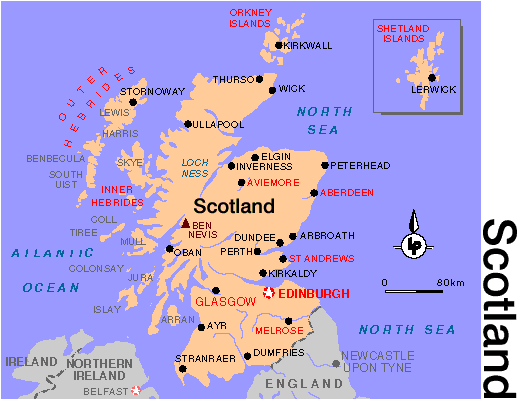
"Glasgow effect" - prevalence of cigarette smoking impact on poor health..
 July 19, 2009 - The ‘Glasgow effect’ - Smoking rates are higher in Glasgow than in the rest of Scotland. Glasgow is known to have a poor health record. Prevalence of cigarette smoking, known to impact on the risk of heart disease, cancer, and stroke, is higher there than for the Rest of Scotland (RoS). However, Glasgow has comparatively high levels of deprivation (a state of extreme poverty), which is associated with unfavourable health-related behaviours. Linsay Gray and Alastair H Leyland assess the existence of a ‘Glasgow effect’ of smoking status by investigating whether differences can be explained by socioeconomic factors. It was concluded that increased smoking levels in Glasgow can be explained by individual and area socioeconomic circumstances.
PAPER: Is the "Glasgow effect" of cigarette smoking explained by socio-economic status?: a multilevel analysis, Linsay Gray and Alastair H Leyland, BMC Public Health 2009, 9:245doi:10.1186/1471-2458-9-245, ABSTRACT...
Glasgow City Council Smoking Statistics...
Another factor: Scotland's unexplained high mortality rate compared with other industrial countries, may be due to a lack of sun. A lack of sunshine in Glasgow and the West of Scotland reflects levels of chronic illness that which cannot be explained by deprivation alone. A lack of sunshine on Orkney and Shetland – only 24 per cent of the maximum number of hours possible – corresponds to the highest prevalence of MS in the world. By contrast, the South Coast of England, where such diseases are much less common, receives 400 more hours of sunshine a year than Scotland. (Scotland’s poor health ‘caused by a lack of sunshine’, TimeOnline.co.uk, 9/15/2008)
Reference: The ‘Glasgow effect’? Smoking and socioeconomic status in Scotland, Linsay Gray, European Journal of Public Health, Vol. 16, 9/1/2006.
Some related news briefs - Scotland: Scotland - tobacco industry will try to stop attempts to curb sales to young people..; Scotland - cigarette vending machines removal..; Scottish politicans most have the courage to protect the health of their constituents..; Scotland - small businesses given extra 2-years to remove tobacco displays..; Northern Ireland - assembly approves ban on display of tobacco items..; Scotland to ban cigarette displays and outlaw cigarette vending machines..; Bar workers who smoke also benefit from smoking ban..; 17 countries in the world ban indoor smoking - ENFORCEMENT..; England, Wales to ban tobacco displays in shops..; Definite Health Benefits of Smoking Bans..; Northern Ireland raising age for sale of tobacco from 16 to 18 joining the other three United Kingdom (UK) countries..; Scotland proposes to implement more measures to discourage tobacco use including the banning of tobacco displays..; Raise Age to 21 to Purchase Tobacco Products...
Click on image to enlarge, Coat-of-Arms Glasgow, Scotland..
Read more...


To Provide Public Awareness
Purpose
About Us
Contact Us
2008 HIGHLIGHTS
TOPIX PAPERS - 2008 & 2009..