 July 13, 2009 - Included in the new tobacco tax bill signed into law by Governor Crist state lawmakers created a system so native Indians won't have to pay the tax but non-Indians purchasing cigarettes at reservation shops must pay the tax .
Legal precedent seems to back up the state's system. A 1985 U.S. Supreme Court decision, based on a California dispute, held that states could collect cigarette taxes from sales on tribal lands, but only from non-Indian customers.
Smokers, beware: If you have relied on the Seminole and Miccosukee tribes' smoke shops as a tax-free haven for cigarettes, think again. The tribes have begun charging the state tax on cigarettes for the first time since Florida imposed it 66 years ago, coinciding with the $1-a-pack state tax hike that took effect July 1. The new tax is $1.34 a pack. Florida began taxing cigarettes in 1943, but no Indian tribe collected it until now.
Gary Bitner, spokesman for the Seminoles, said the tribe hoped to reach an agreement with the state on how to divvy up the tax revenues, a concept similar to the gambling compact now being negotiated with Gov. Charlie Crist. ''While that process is coming together, I think the tribe just in good faith has moved ahead to charge the tax,'' Bitner said.
Cigarette sales at Indian smoke shops are a big business. About 25 million packs of cigarettes a year are sold on tribal reservations in Florida, the state Department of Business and Professional Regulation says. State economists estimate tribal cigarette sales could produce an extra $20 million in revenue, based on 15 million packs being sold with the $1.34 tax.
Reference: Florida Indian tribes levying cigarette tax bY JOSH HAFENBRACK, Sun Sentinel, 7/13/2009.
Related news briefs: Florida's New Tobacco Law - non-Indian tribe members on Indian reservations may no longer dodge the tax..; Florida - besides tobacco tax increase Senate wants to restrict tax-free sales..
.
Read more...
Florida - non-Indian customers pay tax on tobacco at reservation shops..
Nicotine induced prediabetes, a known risk factor for cardiovascular disease..
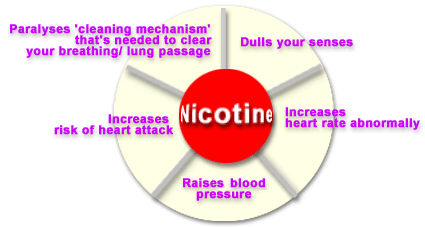 July 13, 2009 - Researchers at Charles Drew University have found that nicotine promotes prediabetes, also known as insulin resistance, in smokers, which is a risk factor for heart disease and stroke.
This study has been previously reported: Nicotine induces prediabetes, likely contributes to high prevalence of heart disease in smokers..
The study’s lead author, Theodore Friedman, chief of the endocrinology division at Charles Drew University, suggests previous theory that nicotine and cigarette smoking induce high levels of the stress hormone cortisol was correct. As cortisol excess is known to induce insulin resistance, it has been suggested that glucocorticoids, such as cortisol, are the missing [causative] link between cigarette smoking and insulin resistance”.
The study authors were also able to undo some harmful effects of nicotine in mice to some extent by treating them with the nicotine antagonist mecamylamine, a drug that blunts the action of nicotine.
Friedman said: “Our results suggest that reducing tissue glucocorticoid levels or decreasing insulin resistance may reduce the heart disease seen in smokers. We anticipate that in the future there will be drugs to specifically block the effect of nicotine on glucocorticoids and insulin resistance.”
Reference: Why smoking increases heart stroke risk, The Times of India, 7/12/2009.
Read more...
Ghana - Tobacco Control Bill to parliament this month, July 2009..
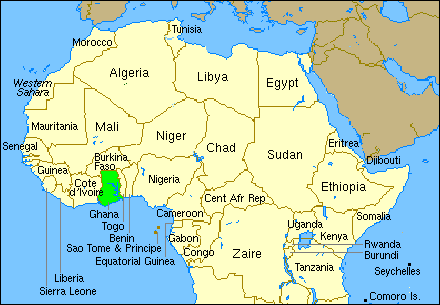
 July 13, 2009 - Though Ghana was the 39th country to ratify the WHO Framework Convention on Tobacco Control (FCTC) in 2004, it is yet to pass a Bill on tobacco use.
Dr. Sipa Yankey, the Minister of Health, pledges that government will give the Bill greater attention. He says he will ensure that the Tobacco Control Bill is sent to parliament this month. Dr. Yankey press release by the Ghana Health Service (GHS): “The passage of the bill is long over due since Ghana ratified the FCTC as the 39th country some years ago.”
The Tobacco Control Bill was drafted by Ghana’s Food and Drugs Board (FDB) and the coalition of anti-smoking organisations. It was then handed over to the then Minister of Health in June 2005. However, the draft Bill has not moved beyond Cabinet. A Cabinet approval of any Bill is necessary before it can be sent to Parliament for scrutiny and debate. The Minister’s pledge has come four years after the Bill was sent to cabinet through the then Minister of Health.
Government has been severely criticised for its apparent lack of commitment and political will to the passage of the Tobacco Control Bill. But the Health Minister says nothing will stop them from passing the bill since it is in the public interest.
Dr. Yankey: “I will shepherd it [the Bill] in and out of parliament to make sure it [the Bill] is passed,” he said in an interview with Joy FM.
In line with the FCTC, the Minister explains that the Bill will serve as a legal framework for the enforcement of tobacco related activities. “Advertising tobacco products will not be in place when the Bill is passed into Law,” he says, “It will also ban smoking in public place.” Besides, Dr. Yankey also says, in accordance with the FCTC protocol, the bill will bar tobacco companies from sponsoring public events.
Dr. Yankey explains that since other countries, both developed and developing, have been able to put in place mechanisms to regulate tobacco use, Ghana should be able to do so. “Kenya, Tanzania, Gambia and Benin have succeeded in enacting laws banning smoking at public places,” the GHS press release states.
According to a publication in the Gye Nyame Concord newspaper, a survey conducted by the Health Research Unit (HRU) of the Ghana Health Service in 2007 found out that many Ghanaians are concerned about tobacco use. “Out of 300 respondents in Accra who were interviewed, 200 expressed concern and gave reasons such as its health hazards, effect on nation’s economy, its effect on non-smokers and the fact that smoking leads to the use of hard drugs,” the report says.
Contrary to a popular misconception that the Bill seeks to ban the sale and use of tobacco, Professor Agyeman-Badu Akosah says that is not he case. He is a former Director of the GHS and one of the advocates of the Bill. “We’re not saying you cannot smoke; we’re simply saying let’s ensure that you do not endanger non-smokers by smoking near them”, he is cite by the Gye Nyame Concord newspaper to have said.
Related news briefs: Ghana to ban smoking in public places in November 2008..; FCTC Member Ghana - NO Law Banning Sales of Tobacco to Minors.. and British American Tobacco (BAT) - 100 years in Africa..
Reference: Ghana’s Tobacco Bill to go to Parliament Soon by senyo ofori-parku, UPIU.com, 7/7/2009.
Click on image to enlarge, Coat-of-Arms Republic of Ghana..
Read more...

U.S. - Effect of April 1st FET increase on tobacco retailing..
July 13, 2009 - This is the first story in a three-part series analyzing the effect this spring's federal-excise-tax (FET) hike has had on tobacco retailing thus far.
In an exclusive report by Convenience Store / Petroleum (CSP) Daily News and  UBS Tobacco Analyst Nik Modi—the first significant survey to study the Federal Excise Tax's (FET) effect on the c-store channel—several critical findings are emerging: 90% of survey respondents say cigarette trends have performed in line or better than expected. There have been certain shifts: Premium and fourth-tier brands (Definitions vary, but basically a fourth-tier cigarette is a low-end, subgeneric brand whose greatest attraction is price) continue to hold their stakes, while the mid-tier segment has lost important market share; Retailers are scaling back inventory due to the higher costs; More than one-third of those retailers surveyed said they have reduced shelf space for cigarettes.
What we're seeing is that the traditional price-to-volume relationship has held up," Modi said. "Over the past few decades, the price-to-volume relationship has been about -0.3x for cigarettes. That means for every 10% increase in price, volumes fall by only 3%. Based on feedback from the industry and a look at recent scanner data, it seems that nothing has really changed."
Looking at who's gaining and hurting from the FET, Modi said the answers are clear: "Lorillard is by and far the clearest winner among the Big Three (via share gains).
"The segment really taking a hit is the middle tier, where Reynolds American has a big chunk of its cigarette portfolio" Modi continued. "With that being said, they are seeing some good growth on their Pall Mall brand due to a 'pulse promotion' that ran for much of the June quarter."
The survey included 10 questions examining how the convenience channel specifically is responding to the FET increase and what effect the tax has levied on the channel.
Responding were more than 50 chains, operating upwards of 20,000 convenience stores and representing a cross-section in size and demographic and featuring many of the industry's biggest outfits.
Remarkably, while volume appears to be down between 5% and 10%, retailers remain optimistic about the short- and long-term prospects of their No. 1 in-store category. Underscoring this spirit is the natural resilience of the c-store channel and also the run-up time that enabled retailers to eliminate slow-selling SKUs and recalibrate inventory to avoid the one-time floor tax.
Weeks before the FET increase of April 1, retailers told CSP Daily News of plans to scale back cartons, push promotions and drive discount brands, as well as othe r tobacco products (OTP).
Cigarettes are divided into four price categories or tiers. The most expensive, first-tier or premium, cigarettes are manufactured by defendant RJR (Camel and Winston cigarettes), as well as Philip Morris USA, Inc., Lorillard Tobacco Company, Liggett-Vector Brands, and Commonwealth Brands. Second-tier and third-tier cigarettes are also produced by the major manufacturers, but their prices are substantially lower than first-tier cigarettes. Fourth-tier brands are produced by smaller manufacturers (including Liggett and Commonwealth) and sell at prices somewhat lower than third-tier brands. (Smith Wholesale Co., et al. v. R.J. Reynolds Tobacco Co., UNITED STATES COURT OF APPEALS FOR THE SIXTH CIRCUIT, April 21, 2006)
Reference: Exclusive Tobacco Analysis, Part 1: Three Months into SCHIP CSP-UBS convenience store survey unveils category's winners, losers by Mitch Morrison, CSP Daily News, 7/13/2009.
Some related news briefs: Tobacco Update CyberConference: more spending money for low income consumers/worry entry of big tobacco in OTP..; Fitch Ratings - U.S. cigarette sales volume declines..; U.S. - with increase in taxes will reduce smoking rates /prevent people from starting...
Read more...
West Saint (St.) Louis County - NO Smoking - firefighters or EMS personnel..
 July 12, 2009 - Fire officials in west St. Louis County want to make sure all that's smoking are the fires. In what's thought to be the most aggressive anti-smoking policy among fire departments in the state (of Missouri), firefighters and other employees of the West County EMS and Fire Protection District won't be allowed to smoke on the job or in uniform starting in January.
Also, all employees hired after January 1, 2010 must agree not to smoke or chew tobacco while on- or off-duty. "The spirit of the policy is not to get anybody in trouble," district spokeswoman Kim Bacon said. "Everybody knows it's in their best interest."
We felt we owed it to our taxpayers to be in the best shape we possibly could," said Rich Minda, West County fire captain and a vice president of the local firefighters' union. "We just don't feel that it's proper to be doing something so bad for yourself when you're viewed as a role model."
Reference: West County firefighters put out the (cigarette) smoke by Blythe Bernhard, Saint Louis POST-DISPATCH, 7/11/2009.
Read more...


To Provide Public Awareness
Purpose
About Us
Contact Us
2008 HIGHLIGHTS
TOPIX PAPERS - 2008 & 2009..