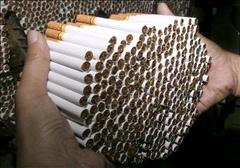
 September 7, 2009 - Smuggling of illegal cigarettes has hit an all-time high as the Federal Government considers introducing heavier taxes on tobacco products. International flight crews bringing illegal cigarettes through Sydney Airport account for part of a major spike in Australia's tobacco black market.
Desperate attempts to avoid high tax rates are leading to unregulated tobacco products – often containing contaminates such as rat droppings and metal shavings – being sold under-the-counter at general stores.
 For years, the major cigarette companies have regularly tried to block efforts to raise cigarette taxes or import fees by claiming that they will spark massive increases in cigarette smuggling and black markets.
(THE BIG CIGARETTE COMPANIES AND CIGARETTE SMUGGLING)
Figures obtained by The Daily Telegraph revealed customs detected 11 shipments of illicit tobacco products comprising 65 tonnes of leaf and 22 million cigarettes during the first three months of this year – an attempted tax evasion of more than $27 million. That was already more than half the $50 million worth of possible tax evasion from seizures in all of 2008.
Customs national investigations manager Richard Janeczko said smugglers were going to extreme lengths. "Anything from airline crews bringing them in, people trying to order them in on the internet, or full container loads disguised as things like pretzels," he said. "But the big smuggling is done by full container load – you're talking $4-$6 million dollars in revenue foregone in every one that's gone through."
In July, Customs arrested four men over an attempt to smuggle more than 4.8 tonnes of tobacco into Australia from Lebanon concealed within plastic tubs.
"Most of the illegal stuff is made in unregulated factories," Mr Janeczko said. "So you can't be sure exactly what's in them."
Earlier this month a report by the National Preventative Health Taskforce called for higher taxes on tobacco products. Rudd government is widely expected to announce a sharp increase in taxes on cigarettes following the Preventative Health Task Force's final submission to Health Minister Nicola Roxon this week. There has been no increase in the tax for a decade.
The price of a pack of 30 cigarettes would jump to $20 within three years if the Government adopts the plan.
Reference: Illegal cigarettes being smuggled into Australia, HeraldSun.com.au, 9/7/2009.
Australia related: Australia - illicit tobacco, do what's right increase the tobacco tax..; Australia - illegal cigarettes readily available...
Read more...
Australia - Smuggling of illegal cigarettes has hit an all-time high..
Australia - government's plan to reduce preventable illness will soon go to Parliament..
 September 7, 2009 - Health Minister Nicola Roxon said legislation for a National Preventative Health Agency would be introduced into Parliament within the next fortnight (a period of 2-weeks), forming a key part of the Government's plan to reduce preventable illnesses such as diabetes, heart disease and some cancers.
The independent but publicly funded agency will be responsible for a major preventative health advertising push, policy advice, health surveillance, consultation and research. The agency will begin in January, staffed by government-appointed population health experts. The new agency will initially be given $17.6 million of federal funding to cover operating costs over four years, although that does not include any additional cash set aside for specific advertising campaigns and other programs.
But it is also likely that some of the more extreme policy interventions recommended by the high-profile Preventative Health Taskforce will not be adopted. National Preventative Health Strategy..
Ms Roxon said the Government's strategy would be to take a leadership role, without "necessarily always having to regulate and tax".
Although declining to comment on specific proposals, Ms Roxon said: "I am absolutely focused on how Government action can leverage change within the community rather than pretending that a regulatory approach on its own will solve these quite complex social problems."
Her comments follow the release last week of the taskforce's 300-page blueprint for preventive health, with a raft of policy prescriptions, including the possibility of higher taxes for unhealthy foods, higher cigarette and alcohol taxes, phasing out television advertising of junk food to children, a ban on all tobacco advertising and phasing out alcohol advertising during sports events.
Ms Roxon said the Government's approach would be to "engage the whole community" and "push, cajole and lead" families, schools, workplaces, industries, clubs and community organisations to encourage healthier living.
The report said about 32 percent of Australia's total burden of disease was linked to smoking, drinking, obesity and other preventable risks. Chair of the National Preventative Health Task Force, Rob Moodie said the preventative health community had been waiting for more than 20 years for such an agency, but it would need to be independent and well-funded to make a difference. Professor Moodie said that while he did not think Ms Roxon's comments were out of step with the taskforce's recommendations, regulation and higher taxes would have to be an important part of the strategy.
Moodie: "The point to be made is that in many of the regulatory issues, there is extremely high community support. I mean, if you look at the work around licensing of alcohol outlets or promotion of junk food to kids, then you've got landslide victories in support of greater government regulation."
Ms Roxon said a recommendation that the average price of a packet of 30 cigarettes be lifted to $20 within three years would be considered as part of the Government's review of the taxation system being conducted by Treasury secretary Ken Henry. An overhaul of the alcohol excise regime will also be considered by the Henry review.
VicHealth chief executive Todd Harper said it was correct that the "whole-of-community approach" favoured by Ms Roxon would be needed to tackle obesity and excessive alcohol and cigarette consumption.
Reference: Health watchdog unleashed, JOSH GORDON, The Sydney Morning Herald, 9/6/2009.
Task Force related news briefs:
Australia - Comments on the National Preventative Health Taskforce's Proposal..;
Australia - health blueprint to be unveiled by the Rudd Government..;
Western Australia - major tobacco companies were worried about tobacco controls..;
Australia - illicit tobacco, do what's right increase the tobacco tax..;
Australia - illegal cigarettes readily available..;
Australia - More on federal tobacco tax increase..;
Australia - federal government is currently analyzing recommendations for reducing smoking..;
Australia - providing cigarette ingredients to smokers won't help them quit...
Read more...

Australia - banning cigarette sales in pubs and clubs may help smokers quit..
 September 7, 2009 - Cigarette sales should be banned from pubs and clubs, say anti-smoking campaigners, who point to the results of world-first research carried out in Sydney. The combination of being in the company of smokers at a venue where tobacco is also for sale softens the resolve of would-be quitters and can turn a one-off cigarette into a full-blown relapse, a study has found.
 Wendy Oakes, tobacco control manager for the Cancer Council NSW, which funded the research, said long-term smokers would not be disadvantaged if cigarettes were removed from sale in licensed premises. "Smokers have very habitual buying patterns. Smokers don't run out of cigarettes," she said. Such a move would instead "support people to keep the resolve they've already made … not constantly harassing people and tempting them" as they tried to quit.
The new results revealed "a very strong association amongst people who said they had quit between having a cigarette and buying a pack of cigarettes", Ms Oakes said.
Outdoor smoking areas in otherwise smoke-free pubs meant people "clustered there in social groups [allowing] people to continue to smoke in very socialised ways", and borrowing a cigarette from a friend could quickly lead to a purchase.
Cigarette machines in pubs may be operated only by token and only by a staff member, but this might not be enough to break the nexus, Ms Oakes said. "We would like to see vending machines removed from pubs and clubs because the work done shows that it is a trigger area," she said.
In world-first research, Suzan Burton from the Macquarie Graduate School of Management asked smokers intending to quit to record their smoking and cigarette purchases in a diary over four days. She found they were much more likely than non-quitting smokers to buy them at bottle shops and bars rather than supermarkets, suggesting impulse buying.
Their smoking was disproportionately influenced by the presence of other smokers. If family or friends smoked around them, they were three times as likely to light up.
"Allowing cigarettes to be sold in pubs is allowing people to be targeted at their most vulnerable," said Associate Professor Burton, a consumer behaviour expert who conducted the study with colleague Lindie Clark.
Tobacco availability seemed to conspire with alcohol and relaxation to knock people off the wagon and stopping such sales "might be a relatively efficient method of preventing relapse".
The study is the first to track the behaviour of people as they try to give up smoking, letting the researchers see how consumption aligned with cigarette availability and social behaviour. Previous research has been based on quitters' retrospective recollections, which are notoriously unreliable.
Most smokers say they would prefer not to smoke. About half make a quit attempt in any six-month period.
Reference: Pub cigarette sales under fire, JULIE ROBOTHAM,
The Sydney Morning Herald,September 6, 2009.
Read more...
Turkey - with expansion of smoking ban cigarette sales drop..
 September 7. 2009 - The July 19 expansion of the smoking ban to include restaurants, cafes, teahouses and bars has resulted in a significant drop in cigarette sales, which were 5.4 percent lower in July 2009 than a year ago.
According to data from the Tobacco and Alcohol Market Regulatory Agency, or TAPDK, the July decrease in sales amounts to 89,478,000 fewer packages of cigarettes sold.
Professor Elif Dağlı, the chair of the National Committee on Cigarettes and Health, or SSUK, said the implementation of similar laws in other countries has been shown to reduce consumption by 8 to 10 percent in the first six months. In the United States, she said, long-term decreases in sales have climbed to 27 percent.
“A 5.4 percent decrease in the first stage is much lower than our target but inspires hope for the future,” said Dağlı, who added that the organization believes the results will improve in a few years through the continued implementation of the ban.
“Cigarettes are a product that affect lung health very negatively. Reduced consumption is pleasing for us, but it is not enough because there is no safe dose of cigarettes: each one increases the risk to the lungs,” said professor Muzaffer Metintaş, the chair of the Turkish Thoracic Society.
Three million people in Turkey have suffered from chronic obstructive lung diseases due to smoking, which is also the cause of 90 percent of the lung-cancer diagnoses annually, Metintaş added.
If the rates of cigarette purchases continue to decline, the rates of health problems caused by smoking will also become lower, said professor Nazmi Bilir, a scholar at Hacettepe University’s public-health department. Bilir also noted the economical impact of the decreasing sales, saying: “Since a package of cigarettes costs approximately $2.5 in Turkey, that means $225 million has been saved just in one month. It is possible to use this kind of resource in much more beneficial areas.”
Reference: Smoking ban decreases cigarette sales, Hürriyet Daily News, 9/3/2009.
Turkey - related news briefs:
Turkey - smoking ban, cafes (teahouses) losing business, owners threaten to strike..;
Turkey - hundreds of cafe owners demonstrate against smoking ban..;
Turkey - small--scale retailers to demonstrate against smoking ban..;
Turkey - anti-smoking advocates happy with early results of smoking ban..; Turkey - smoker wounds manager and kills his friend when asked to stop smoking..
Turkey - cafe owners complain about smoking ban..;
Turkey - dangers of secondhand smoke media campaign..;
Turkish Government - makes major move to improve the health of its citizens..;
Turkey - smoking ban starting July 19th will be enforced - these guys are serious..;
Turkey - poll indicates employers, their employees and customers support smoking ban in cafes, bars and restaurants..;
Turkey - July 19th total smoking ban, will employees lose jobs..;
Turkey - on July 19, 2009 will mark the beginning of “100 percent smoke-free air” in this country..;
Turkey - national smoking ban starts July 19, 2009..;
Turkey - quit smoking photo displayed in İstanbul's Taksim Square..;
Turkey - data on tobacco usage - Turkish Statistics Institution..;
Turkey - smoking ban in all bars, restaurants and coffeehouses starting July 19, 2009..;
Smoking ban in Turkey lowers cigarette consumption..;
Turkey's ban on pubic smoking goes into effect on Monday, May 19, 2008..;
British American Tobacco (BAT) reported group volume sales up for first quarter 2008..;
More on the quick fix for outdoor smokers..;
BAT to Acquire Most of Denmark's ST..;
More on Philip Morris International of the Future..;
WHO Report on the Global Tobacco Epidemic 2008...
Read more...
Indonesia - an NGO commission assists cigarettes must be banned in films ..
 September 7, 2009 - The National Commission for Child Protection (Komisi Nasional Perlindungan Anak, NCCP) - a non-government organization (NGO) said Thursday, September 3rd that politicians had to ban the advertising of cigarette in movies.
Muhammad Joni, the vice chairman of the Commission: "We demand that the House of Representatives insert an article in the bill on films banning cigarette promotions in movies." The Commission said the bill must forbid cigarette companies from sponsoring the production of films, ban scenes where actors are shown smoking and prevent companies from marketing tobacco brands in the film.
Joni said the current bill, if passed into law, would possess weaker measures on prohibiting cigarette advertising compared to the laws on broadcasting and the press. "At least in both those laws, companies cannot display or broadcast cigarette products through their advertising," Joni said.
In the bill on films, Joni said, no article regulating the advertisement of cigarettes had been included.
The Commission has sent letters voicing their concerns and recommendations to the House and would try and arrange a meeting with lawmakers, Joni said. Currently, politicians at the House are still discussing the content of the bill.
Observers have speculated that the reason Indonesia has not devised a law banning cigarette ads or promotions could be that tobacco companies pay millions of rupiah in tax every year. The government has issued a regulation banning cigarette ads at sporting events and during certain hours in electronic media, like television.
In 2008, the tobacco industry paid Indonesia Rupiah (IDR) 60 trillion (EUR 4.2 billion) in taxes or about 10 per cent of total government earnings from taxes. Tobacco companies spent IDR 375 billion on advertising in the first quarter of this year (2009), according to AGB Nielsen Media Research. (Indonesia Finance Ministry to cap tax deductions for tobacco companies..) Dina Kania, policy advocacy coordinator of the National Commission for Child Protection: "There was a film for teenagers last year where one of the actresses, who is still in junior high school, was smoking in scenes.” Such an effort to glamorize smoking goes to extremes, at times.
Heri Akhmadi, a member of the bill's working committee, said the committee had agreed to devise an article which would ban any advertisements or persuasive efforts to promote addictive products. That includes narcotics, alcohol, and cigarettes, he said. "The Indonesian Censorship Agency can later make specific recommendations about what can and cannot be shown during films," he told The Jakarta Post.
Heri said if the bill was passed, the Agency would become an independent commission.
"It would not be controlled by the government and its members would deal with complaints and suggestions directly from the people," he said.
Child protection groups have argued that children and teenagers - one of the largest consumer groups of films - deserved to be protected from tobacco advertising in films and encouraged to think about their health before smoking a cigarette.
"Currently, many films, even children's films, are being used to advertise tobacco products," he said, adding that many purposely targeted certain age groups. "They are trying to find new consumers, with their current market dying, deciding to quit or not having the money to purchase their product," said Joni.
Tobacco companies have also been accused of trying to build brand loyalty by advertising certain products to young people. "If someone starts smoking a certain brand at a young age, they are likely to continue smoking that brand in the future," he said.
Movies are an effective advertising tool because children and teenagers tend to be heavily influenced by actors, he said.
"Research has shown that more often than not, young people are persuaded to smoke because their idols or role models smoke," he said.
Smoking among younger generations in Indonesia is steadily on the rise.
The 2006 Global Youth Tobacco Survey, conducted by the World Health Organization, showed that 25 percent of males aged 13 to 15 had smoked. The percentage of women for the same age bracket was 2 percent. The Central Statistic Agency (BPS) reported in 2004 that nearly 20 percent of teenagers aged 15 to 19 were smokers, higher than the 13.7 percent recorded in 2001. The age at which people are beginning to smoke is dropping as well. The BPS reported that in 2001, the average age at which smokers began smoking was 15.4 years old, while in 2004 it was 15 year old. (mrs)
Reference: Cigarettes in films must be banned: Commission, The Jakarta Post, 9/5/2009.
Indonesia related news briefs:
Indonesia - a paradise for tobacco companies..
Indonesia - after buying cigarettes very little left for food..;
Indonesia - will they ratify the first world public health treaty..;
Indonesia - last paradise to smoke in public places in Southeast Asia..;
Indonesia - Industry minister to close tobacco to new foreign investment..;
Indonesia Finance Ministry to cap tax deductions for tobacco companies..;
Indonesia - Smoking hits poor families the hardest, making the poor even poorer..;
Indonesia - Cigarette makers defy crisis, grows stronger..;
Indonesia - government may raise cigarette excise tax next year..;
WHO - Indonesia is crying out for your help..;
Indonesia - dispute with U.S. over banning the use of clove in cigarettes..;
Indonesia 'cash cow' for Philip Morris International..;
Tobacco industry has long targeted young people as "replacement smokers";
Indonesia - district court dismisses request to ratify FCTC..;
Asean Countries - Tobacco Industry Blocking Global Treaty On Tobacco..; Indonesia - farmers hold rally protest tobacco controls..;
Indonesia - tobacco farmers reject Islamic council's edict..; Indonesia - Ulema Council - debate results is split on smoking..;
Indonesia - Withdraw Sponsorhip of Another Rock Concert..;
Indonesia to increase tax on tobacco products..;
Semarang, Indonesia - Cigarette Smoking Areas to be Prepared..;
Jakarta, Indonesia - Malls help enforce non-smoking ban..;
Indonesia - federal anti-smoking laws in one year - MAYBE..;
Indonesia - NGO's (non-government organizations) Demand the Government Ratify WHO's FCTC.;
Indonesia to raise cigarette tax by 6 to 7% in 2009..;
Surabaya, Indonesia - anti-smoking bylaw 10/2009 - FOR REAL??
Indonesians smoking more than ever before..;
Indonesia further rise in the excise tax would hurt the cigarette industry..;
Alicia Keys - Jakarta Concert (July 31st) tobacco companies forced to withdraw sponsorship.. and
Most Indonesians support moves to ban tobacco advertisements...
Read more...
Risk of Cardiovascular disease - smoking 3-cigarettes per day or exposure to secondhand smoke..
 September 4, 2009 - Risk of cardiovascular disease (CVD) increased 64 percent by smoking three cigarettes a day. Risk doubled by smoking a pack a day, according to data on more than one million adults prospectively collected by the American Cancer Society, as part of the Cancer Prevention Study II of 1982.
Using this database, Dr C Arden Pope (Brigham Young University Provo, UT) and colleagues calculated adjusted relative risks of mortality according to an estimated average daily dose of fine particulate matter (PM) from active cigarette-smoke inhalation, as well as the PM doses from secondhand cigarette-smoke exposure and from exposure to air pollution.
The researchers report: "There were substantially increased cardiovascular mortality risks at very low levels of active cigarette smoking and smaller but significant excess risks even at the much lower exposure levels associated with secondhand cigarette smoke and ambient air pollution. Our results suggest that the exposure-response function is relatively steep at very low levels of exposure, flattening out at high exposure levels."
The researchers note several limitations of the study, among them the large exposure gap between ambient air pollution, secondhand-smoke exposure, and active smoking. And, the authors say, there are no prospective cohort or related studies of long-term exposure across the range of exposure that would fill this gap.
Even with its limitations, the study findings have important public-health implications, Pope's team comments. Most studies of the effects of fine PM on cardiovascular disease risk have been conducted in areas where the annual average PM concentrations rarely exceed 30 µg/m3. Recent estimates indicate average concentrations of particulate air pollution in urban areas of China, India, and other developing countries often exceed 100 µg/m3.
PAPER: Cardiovascular Mortality and Exposure to Airborne Fine Particulate Matter and Cigarette Smoke. Shape of the Exposure-Response Relationship, C. Arden Pope III PhD, Richard T. Burnett PhD, Daniel Krewski PhD, Michael Jerrett PhD, Yuanli Shi MD, Eugenia E. Calle PhD, and Michael J. Thun MD, Circulation. 2009 Published online before print August 31, 2009, ABSTRACT...
Relatively low levels of fine particulate exposure from either air pollution or secondhand cigarette smoke are sufficient to induce adverse biological responses increasing the risk of cardiovascular disease mortality.
Reference: Only three cigarettes a day significantly increases cardiovascular disease risk, Martha Kerr, 9/3/2009.
Read more...
Laos - capital city Vientiane to go smoke-free for SEA Games..
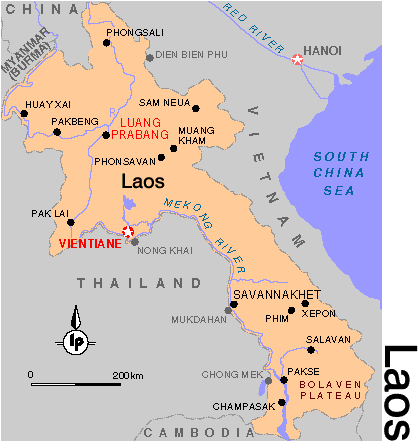
 September 4, 2009 - Laos government officials have launched a smoke-free Vientiane to help address health and environmental concerns in the lead-up to the Southeast Asian (SEA) Games. Vientiane Vice-Mayor Somvandy Nathavong said the new initiative will target local businesses and people, in particular students and teenagers.
Vientiane is the capital city of Laos, situated in the Mekong Valley. It is Laos's largest city with an estimated population of the city is 200,000 (2005). The number of people living in the Vientiane metropolitan area (the entire Vientiane Prefecture and parts of Vientiane Province) is believed to be over 730,000. Vientiane will host for the first time the 25th SEA Games in December celebrating the 50 years of SEA Games.
World Health Organization Representative Dr Dongil Ahn explained that there are two methods to address the problem of smoking. One way is encouraging smokers to stop smoking. Another effective approach is to limit peoples' exposure to tobacco smoke by banning smoking in public areas, both indoors and outdoors.
Dr Ahn said for the benefit of all, in February 2009 the Vientiane governor signed the Implementation of a Smoke Free Policy in public places such as office building, schools, hospital and restaurant in Vientiane city.
Dr Ahn: "Following today's smoke free initiative, I hope the government will continue to strengthen its anti-tobacco efforts by emphasising the health warnings on cigarette packs, banning advertisement of tobacco and increasing the tax on tobacco products. Such regulations would go far in making Vientiane an even healthier place to live and work," he explained.
Adventist Development and Relief Agency Programme Director, Ms Karmen Till added that the the upcoming SEA Games will be a great opportunity for Laos to show its neighbouring countries that they are serious about the problem. Next year, Vientiane will have another opportunity to maximise the benefits of being a smoke-free capital - during the 450th anniversary of Vientiane as the capital of Laos.
Related news brief: Laos - possible smoking ban coming..
Reference: Laos launches smoke-free city, Vientiane Times/Asia News Network, 9/2/2009.
Luang Stupa - the single most important monument in Laos,
click to enlarge..
Read more...
Israel - 10,000 die each year from smoking (8,664 smokers and approximately 1500 from secondhand smoke..
September 4, 2009 - About 10,000 Israelis die each year from smoking, 8,664 actual smokers and the rest from other people's cigarette smoke, according to Dr. Gary Ginsberg and colleagues who just published an article in the European Journal of Public Health.
PAPER: Issues in estimating smoking attributable mortality in Israel,
Gary M. Ginsberg, Eli Rosenberg and Laura Rosen, The European Journal of Public Health Advance Access published online on August 19, 2009, ABSTRACT...
Around 23 percent of the population over 18 smokes, and about half of all smokers eventually die of tobacco-related diseases.
The former head of the Health Ministry's Center for Disease Control, Prof. Manfred Green, who is now head of the University of Haifa's School for Public Health, had previously set the estimate considerably lower. The previous official estimate of deaths among active smokers was 3,859 per year; the new calculation puts the real figure at more than twice that.
Ginsburg, an expert on health statistics at the Health Ministry, Dr. Eli Rosenberg of the ministry's health promotion unit and Tel Aviv University tobacco control expert Dr. Leah Rosen concluded from their calculations that the total annual rate is actually 20 times that of the road accident toll.
The US Centers for Disease Control supplies a widely used online user-friendly computational program called SAMMEC (Smoking Attributable Mortality, Morbidity and Economic Costs) to produce estimates of tobacco-related mortality.
However, the SAMMEC tool, write Ginsberg and colleagues, "loses accuracy because it lacks flexibility in deciding which diseases enter into the calculations, has estimates of relative risk attributable to smoking based on old studies and does not allow for the latency period that occurs between initial exposure and mortality."
The difference between the old estimates and the new one is attributable to expansion of the list of diseases included, updating the estimates of relative risk for smoking-attributable death and the use of smoking prevalence from previous years to more accurately reflect the effect of tobacco use on disease occurrence, the researchers write.
They add that "there is a need to establish an "authority‚ to implement a multi-faceted intervention strategy to decrease the considerable burden from smoking in Israel."
Amos Hausner, a prominent tobacco-control lawyer who heads the Israel Council for the Prevention of Smoking, commented that much publicity is given by the media to less than two dozen deaths from swine flu. But smoking has a much more devastating toll among people of all ages.
"Preventing road accidents is very important, but that cause gets a great deal of state money, while reducing the number of deaths from tobacco gets almost nothing. Much more money must be allocated to reduce the death rate from smoking, and cigarette companies should be forced to pay for the health damage they cause," Hausner stated.
Reference: Smoking kills 10,000 Israelis annually, new research states by JUDY SIEGEL-ITZKOVICH, The Jerusalem Post, 9/1/2009.
Read more...
Lorillard - - webcast, Barclays Capital Consumer Conference..

September 4, 2009 Lorillard to Participate in Barclays Capital Back-To-School Consumer Conference on Thursday, September 10, 2009 at 3:00 P.M. Eastern.
The presentation will be broadcast live over the Internet under the Investor Relations part of Lorillard's website at www.lorillard.com/.
The presentation will be available in an archived format for thirty days following the event.
Reference: Lorillard to Participate in Barclays Capital Back-To-School Consumer Conference, Lorillard Inc., 9/3/2009.
Read more...
Reynolds American (RAI) - - webcast, Barclays Capital Consumer Conference..

September 4, 2009 - RAI to webcast presentation at Barclays Capital Back-To-School Consumer Conference in Boston on Thursday, Sept. 10, 2009, at approximately 10:30 a.m. Eastern Time.
Thomas R. Adams, RAI’s chief financial officer, will provide a business update on the
company.
The webcast will be available online on a listen-only basis at www.ReynoldsAmerican.com. Registration will be available as of Sept. 3. Please visit the Investors section at www.ReynoldsAmerican.com to register. A replay of the webcast will be available on the Web site for 30 days.
All remarks made during the webcast will be current at the time of the webcast and will not be updated to reflect subsequent material developments.
Reference: RAI to webcast presentation at Barclays Capital Back-To-School Consumer Conference, Reynolds American Inc., 9/3/2009.
Read more...
Avis Rent A Car and Budget Rent A Car - a 100% smoke-free fleet...
 September 4, 2009 - Avis Budget Group, Inc. today announced that beginning next month Avis Rent A Car and Budget Rent A Car vehicles in the United States and Canada will be smoke-free under a new policy that prohibits smoking in its rental vehicles effective October 1, 2009.
Will the others follow Avis Budget Group, Inc. - lead..
"Tobacco smoke leaves a residue on fabrics, fibers and surfaces of vehicles, which emits odors that many people find unpleasant," said Larry De Shon, executive vice president of operations for Avis Budget Group. "In fact, we receive more customer requests for smoke-free vehicles than any other 'special request.' This new policy is designed to ensure that we are enhancing the comfort of our customers, which is a top priority at Avis and Budget."
To ensure compliance with the new smoke-free policy, Avis and Budget have established new inspection processes and will assess customers a cleaning fee (up to $250 if the vehicle is returned and it smells of smoke - Becky Alseth, Senior Vice President, Marketing, Axis Budget Group) just to guarantee that your vehicle really is clean and smoke-free.if the vehicle is returned with tobacco odor or residue. In addition, the Company has instituted a smoke-free policy for all employees and contractors who drive its vehicles.
"When a vehicle must be cleaned of tobacco smoke odor and residue, the process takes considerably longer and requires the vehicle to be removed from the rental fleet until it is odor-free," said Mr. De Shon. "With this new policy, we encourage customers to refrain from smoking in or near the vehicle at all times."
Reference: Avis and Budget Rent A Car ban smoking in vehicles starting Oct. 1, AutoNorth.ca, 9/4/2009.
Read more...
Thailand unit of Philip Morris International faces charges that it violated custom tax rules..
 September 3, 2009 - The Thai unit of Philip Morris International Inc (PM.N)
  faces charges that it violated customs tax rules by understating the prices of imported cigarettes, a Thai police official said on Thursday, September 3rd.
Philip Morris (Thailand) denied the allegations and stated it was confident it had declared the correct customs values. No one at Philip Morris (Thailand) was immediately available for comment, but the company issued a statement saying it was confident the prosecutor would conclude that its actions were in accordance with international and Thai customs valuation methods. "The DSI's allegations concerning our declared customs values are no different than those first reported in the press in 2006 and we believe they have no merit," it said.
Philip Morris, the distributor of Marlboro and L&M cigarettes is accused of deception from 2003-2007, causing a loss of 69 billion baht ($2.03 billion) in taxes.
The head of the Department of Special Investigation (DSI), Thewee Sodsong, told Reuters the case had been submitted to the public prosecutor, adding: "It's up to the prosecutor what the next step will be." If the Attorney General's office agrees with the DSI's submission, the case could go to court. Thailand’s attorney-general’s office will decide on October 2nd whether to charge Philip Morris’ local affiliate over claims it evaded import taxes on its cigarettes, reports The Bangkok Post.
Thai media reported that 10 Thai executives of Philip Morris had been summoned by the DSI to acknowledge charges of breaching the Customs Act and the Tobacco Act on Oct. 2. The DSI has also obtained arrest warrants for four foreign executives who have fled. ($1=34.03 Baht)
The same matter, concerning cigarettes exported by a Philip Morris plant in the Philippines to Thailand, is the subject of a trade dispute.
Reference: Philip Morris Thai unit faces tax charges -police, Alibaba.com, 9/3/2009; Philip Morris Thai unit faces tax charges -police, reporting by Arada Kultawanich; editing by Alan Raybould, Reuters UK, 9/3/2009, PM Thailand could face tax-evasion charges, Tobacco Reporter, 9/3/2009; Thai police push tax charges against Philip Morris by AMBIKA AHUJA, Associated Press, 9/3/2009.
Some Thailand news briefs:
Thailand - hosting major tobacco promotion event in November 2009..;
Thailand Tobacco Monoploly - union concerned about privatization..;
Thailand - monks sickly from tobacco smoking and/or smoke exposure..;
Philippines - Thai cigarette import rules..;
Thailand - cigarette and liquor prices are expected to rise once new measures for calculating excise taxes take effect..;
Congratulations.. Thailand Joins Developed World With Total Ban On Smoking..;
Discouraging Tobacco Use - Horrific Images on the Packaging..
Click on image to enlarge.. In 1946 the King of Thailand, His Majesty King Bhumibol Adulyadej, came to the throne. He is now the longest reigning monarch in the world.
Read more...

Graphic Warnings cigarette packs: Canada revising warnings, U.S. pictorial warnings within 4-years..
 September 3, 2009 In 2001 Canada became the first country to introduce pictorial warnings warnings on tobacco packages. Now approximately nine years later Health Canada is in the process of revising these health warnings.
Health Canada is now testing 49 new health warnings for possible placement on cigarette packages, including two with photographs of an emaciated Barb Tarbox on her deathbed. Six years after her death from cancer attributed to tobacco smoking, anti-smoking activist Barb Tarbox is closer to realizing her ultimate goal, warning millions of smokers about the chilling and possibly fatal implications of their addictions.
Click on image to enlarge..

Health Canada is considering ordering cigarette companies to put deathbed photos of an emaciated cancer victim on every package. Health Canada first used Tarbox in antismoking public service messages that aired in movie theatres.
In February 2008, Decima Research conducted 60 focus groups with adults smokers in Toronto, Calgary and Montreal. Of the seven new warnings that received the highest possible mark for impact and effectiveness from the groups, two had Tarbox on them. One warning showed Tarbox with the title "Dead at 42" and the caption, "Barb Tarbox died of lung cancer from smoking." The warning also quoted Tarbox, saying, "When you die, you leave behind so much pain for the people that continue living. It hurts me so much to think of the pain I'll cause to my daughter."
The Tarbox warnings are part of an attempt to include testimonials or true stories about the health impacts of smoking on cigarette packages. There is no set timetable for when the new warnings will appear on packages. The warning also quoted Tarbox, saying, "When you die, you leave behind so much pain for the people that continue living. It hurts me so much to think of the pain I'll cause to my daughter."
Christelle Legault, media relations officer for Health Canada: "No decision has yet been made on which testimonials, images, or health information will appear on cigarette packages. Health Canada is committed to building on the success of the current labeling requirements to continue to improve their potential to influence behavior change among tobacco users."
Health Canada cigarette warning labels are a model for other countries.
In the United States, the authority to force packaging changes was granted on June 22, when President Barack Obama, who has struggled with cigarette addiction since he was a teen, signed into law the Family Smoking Prevention and Tobacco Control Act. The landmark legislation gives the U.S. Food and Drug Administration broad new authority to regulate the marketing of tobacco products.
Under the law, the FDA has two years to issue specifics about the new graphic warnings tobacco products will be required to carry. Tobacco companies then have 18 months to get them onto packages.
Currently, the United States has some of the weakest requirements for cigarette package warnings in the world, said David Hammond, an assistant professor in the department of health studies at the University of Waterloo in Ontario, Canada. The text-only warnings on packages have changed little since 1984.
The more frightening the image, the greater the anti-smoking effect, says Dr. Stanton Glantz, a professor of medicine at the University of California, San Francisco and director of the university's Center for Tobacco Control, Research and Education.
 Physicians for a Smoke-Free Canada: Warnings Countries and Laws; Warnings-Europe.
The impact of pictures on the effectiveness of tobacco warnings..
Reference: Smokers recoil at deathbed photos
Even from the grave, Tarbox 'still doing some good'David Staples, Edmonton Journal, 9/1/2009; Stunning New Warnings Headed for Cigarette Packs, Jennifer Thomas, HealthDay, wibw.com, 8/27/2009.
Read more...
FACEBOOK - Tobacco products being promoted..
 September 3, 2009 - Chandigarh, India: Popular social networking website Facebook has been caught in a 'smoky' row.
Anti-tobacco activist Hemant Goswami today said he has served a notice to Facebook Inc. in California (US) and Facebook Ireland Ltd, which run the social networking website facebook.com, for violation of Indian laws that ban advertisement and promotion of tobacco products.
"Apparently, Facebook claims to have a policy of not advertising tobacco products through paid advertisement on its website. However, this claim remains ineffective as it allows all brands and tobacco products to be promoted through member pages and groups," said Goswami, who is a member of the union health ministry's National Steering Committee on Tobacco Control.
"Contrary to the claims, Facebook allows promotion of smoking culture through advertisements. We have sent a copy of links of such examples which are considered an offence under the Indian law to M/s Facebook," he added.
Goswami said India's law on tobacco control has a provision for imprisonment of up to five years for violations relating to prohibition of promotion or advertisement of tobacco products and brands. "We are very serious in our pursuit to end this kind of promotion of tobacco brands and tobacco products on social networking sites like Facebook. To achieve this we will do everything possible," he said.
"Governments across the globe are spending billions to end tobacco and have joined hands by way of the international treaty ... but it is unfortunate that small opportunistic companies allow promotion of tobacco products for petty gains. Such companies need to be punished and civil damages too should be claimed from them to offset any profits these people might be making," Goswami said. (Indo-Asian News Service IANS)
Reference: Facebook gets notice for tobacco promotion Indo-Asian News Service, HeadlinesIndia.com, 9/1/2009.
Read more...

Connecticut - cigarette tax increase becomes law..
 September 3, 2009 - On August 30th we reported August 30, 2009 that Republican Governor M. Jodi Rell and top Democrats still sharply disagree on many budget issues, but they have reached an accord on the cigarette tax: It needs to go up $1 a pack. (Connecticut - budget issues, governor and democrats agree on $1.00 cigarette tax increase..)
The state legislature approved the tobacco tax increase this week and Governor Rell is allowing the budget to become law without her signature. (Governor Rell said Tuesday, September 1st, she will allow a $37.6 billion budget bill approved by the Democrat-led General Assembly to become law without her signature but will use her line-item veto to eliminate about $8 million in what she called pork projects. Wall Street Journal, 9/2/2009 - hard copy). The one-dollar increase in the cigarette tax was included in the budget that became law.
Beginning October 1, 2009 the cigarette tax will increase by $1 to $3.00 per pack.
 From Matt Myers, Campaign for Tobacco Free Kids - Connecticut's leaders have taken action that will improve the health of Connecticut residents for generations to come and continue the state's leadership in the fight against tobacco use, the No. 1 cause of preventable death in the United States.
By failing to raise taxes on other tobacco products to match its new cigarette tax, Connecticut's legislators have chosen not to take advantage of a golden opportunity to raise a lot more money; money that could be used to increase funding for the state's tobacco prevention program and to help provide cessation assistance through the state's Medicaid program. Connecticut continues to be one of the last states to not provide any cessation coverage for its Medicaid recipients, and is still near the bottom of all the states with regard to tobacco prevention funding.
Pat Checko chairs the group Mobilizing Against Tobacco For Connecticut’s Health, also known as MATCH. She said Connecticut ranks at the bottom when it comes to states spending money on tobacco prevention. She said 21 percent of Connecticut high school students smoke – more than double the number of high school smokers in New York City.
Increasing the cigarette tax is one of the most effective ways to reduce smoking, especially among kids. Studies show that every 10 percent increase in the price of cigarettes reduces youth smoking by more than six percent and overall cigarette consumption by about 4 percent. Connecticut can expect the $1 cigarette tax increase to prevent 24,000 Connecticut kids from becoming addicted adult smokers; spur 10,000 current adult Connecticut smokers to quit for good; save more than 10,500 Connecticut residents from future smoking-caused deaths; lock in more than $520 million future health care savings; and raise about $60 million a year in new state revenue.
An action plan is needed to slow the sale of contraband (black market, bootleg, illegal, illicit) cigarettes avoiding the payment of taxes in the state where the tobacco is consumed.
Reference: Connecticut Cigarette Tax Increase Delivers Victory for Kids and Taxpayers; $1 Increase, Matthew L. Myers, President, Campaign for Tobacco-Free Kids - Reuters, 9/2/2009.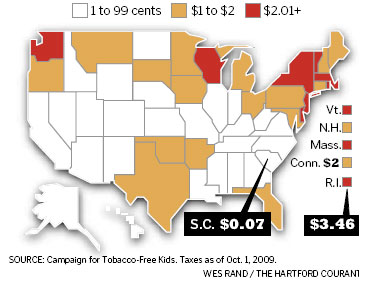
Conn. - the tax on a pack of cigarettes will be $3 a pack as of October 1, 2009..
Read more...
Indonesia - a paradise for tobacco companies..
 September 2, 2009 - In most western countries the Marlboro Man rode off wheezing into the sunset years ago, but in Indonesia he's riding high into a new dawn. The country's massive population and lax laws still offer a bonanza to big tobacco.
The Marlboro Man is alive and well, adorning bill boards around Indonesia. (Marlboro ads use the established icon, Indonesian reason there were probably no suitable cowboys in Indonesia who could replace him.)
David Stanford of the Indonesia Consumers Foundation says "from the tobacco company's perspective Indonesia is a paradise". It's estimated that more than 80 million Indonesians smoke. Many favour clove cigarettes known as kreteks. They are immensely popular among locals.
In 2005 Philip Morris, the world's biggest tobacco corporation, bought Sampoerna, one of Indonesia's tobacco giants, and last year it launched the world's first clove-flavoured Marlboro.
So proud is Sampoerna of its legacy and history that it's established a tobacco museum. It's a popular tourist attraction in the east Java city of Surabaya, complete with guides offering personal tours and telling the story of how a nation became hooked on kreteks. With more nicotine and tar than regular tobacco, kreteks account for 90 per cent of the hundreds of billions of cigarettes sold in Indonesia each year.
As the museum guide recounts, smoking cloves started as a health tonic. "A man who had problems with his throat, mixed tobacco with cloves and it healed him and that's how the kretek began," the guide said.
There is even a curiosity cabinet dedicated to the ghoulish health warnings Sampoerna's cigarettes are forced to display when they are sold in countries like Australia.
Aggressive marketing
In Indonesia there are precious few rules and regulations. And unlike in western countries there are fewer restrictions on advertising. Television, cinemas, magazines, billboards, sporting events and concerts all flog tobacco.
In recent years, pop stars Mariah Carey and Alicia Keys have had their names associated with cigarettes. Marketing campaigns aggressively target the young as companies strive to increase sales.
In Indonesia advertising encourages young people to believe that smoking is 'cool!' Ujang Widodo is typical of millions of Indonesians who took up smoking as a teenager.
"There were cigarette advertisements shown during a movie show at the soccer field one night," he said. "I bought one pack first, then continued buying. I felt cool, like I had authority and style. It never crossed my mind that there was disease associated with smoking."
Now in his mid 40s, Ujang is suffering from lung cancer and his future looks bleak.
"My life is uncertain," he said. "My fear is that I'll leave my young child. One of my children is still very young."
Every year 400,000 Indonesians die from smoking-related diseases but the cynics argue Indonesia cannot afford to give up smoking. The government collects billions in taxes and the tobacco industry is one of the country's major employers.
Along with Zimbabwe, Indonesia is the only place that still allows cigarette advertising on television.
One of Indonesia's religious leaders, Cholil Ridwan, says the government's refusal to act is "evil". "Cigarette advertising is an invasion of Indonesia's young," he said. "Cigarette advertisements enter homes through television. They are very extravagant. This is a crime from the perspective of Islam's teaching."
The new boss of Philip Morris in Indonesia John Gledhill, who has just moved from Australia, says his conscience is clear. "I work for a company which I believe not only follows the law by the letter but also the spirit as well," he said.
However his claim that the aim of Philip Morris's advertising is to persuade existing smokers to switch to his brand is challenged by anti-smoking crusader Matthew Myers, president of the Campaign for Tobacco Free-Kids in the USA.
Myers: "Philip Morris has no credibility when it argues that all it's trying to do is switch adult smokers from one brand to another," he said. "It's exactly the same lie they told in the US and other countries until their own documents exposed that that simply isn't the case."
Indonesia remains, along with North Korea, the only country to shun the World Health Organisation's treaty on Tobacco Control, a treaty that would impose severe restrictions on advertising and ban tobacco sales to youngsters.
Myers: "Millions of Indonesians don't have to die prematurely from tobacco use. If only the government would stand up for the people of Indonesia - not for the tobacco companies - and say the lives of Indonesia's kids are worth as much as the lives of kids in Australia, the US and the rest of the world.
Reference: 80 million a day: big tobacco's new frontier by Geoff Thompson for Foreign Correspondent, ABC News, 9/1/2009.
Indonesia related news briefs:
Indonesia - after buying cigarettes very little left for food..;
Indonesia - will they ratify the first world public health treaty..;
Indonesia - last paradise to smoke in public places in Southeast Asia..;
Indonesia - Industry minister to close tobacco to new foreign investment..;
Indonesia Finance Ministry to cap tax deductions for tobacco companies..;
Indonesia - Smoking hits poor families the hardest, making the poor even poorer..;
Indonesia - Cigarette makers defy crisis, grows stronger..;
Indonesia - government may raise cigarette excise tax next year..;
WHO - Indonesia is crying out for your help..;
Indonesia - dispute with U.S. over banning the use of clove in cigarettes..;
Indonesia 'cash cow' for Philip Morris International..;
Tobacco industry has long targeted young people as "replacement smokers";
Indonesia - district court dismisses request to ratify FCTC..;
Asean Countries - Tobacco Industry Blocking Global Treaty On Tobacco..; Indonesia - farmers hold rally protest tobacco controls..;
Indonesia - tobacco farmers reject Islamic council's edict..; Indonesia - Ulema Council - debate results is split on smoking..;
Indonesia - Withdraw Sponsorhip of Another Rock Concert..;
Indonesia to increase tax on tobacco products..;
Semarang, Indonesia - Cigarette Smoking Areas to be Prepared..;
Jakarta, Indonesia - Malls help enforce non-smoking ban..;
Indonesia - federal anti-smoking laws in one year - MAYBE..;
Indonesia - NGO's (non-government organizations) Demand the Government Ratify WHO's FCTC.;
Indonesia to raise cigarette tax by 6 to 7% in 2009..;
Surabaya, Indonesia - anti-smoking bylaw 10/2009 - FOR REAL??
Indonesians smoking more than ever before..;
Indonesia further rise in the excise tax would hurt the cigarette industry..;
Alicia Keys - Jakarta Concert (July 31st) tobacco companies forced to withdraw sponsorship.. and
Most Indonesians support moves to ban tobacco advertisements...
Read more...
Australia - Comments on the National Preventative Health Taskforce's Proposal..
September 2, 2009 - Health experts have praised the National Preventative Health Taskforce's proposed crackdown on cigarettes, alcohol and junk food. Industry, meanwhile, has called for more time for new self-regulation measures to take effect. The Australian Medical Association (AMA) says the report, delivered on Tuesday to federal Health Minister Nicola Roxon, represented a 'national strategic approach' to preventative health. The measures, if implemented, could 'deliver health benefits' across the community, it said. AMA president Dr Andrew Pesce said the association welcomed the taskforce's recommendations to introduce simple nutritional labeling on food, restrict alcohol and junk food promotion to young people and children, and ban all remaining forms of tobacco promotion along with a hike in cigarette costs. 'People need help to be convinced to adopt the lifestyle changes that will provide better health and better quality of life, Dr Pesce said, adding that frontline doctors also would play a vital role.
One key recommendation is for all tobacco products to be sold in plain packaging, and to increase the cost of a packet of 30 cigarettes from $13 to at least $20 within three years. Tobacco control expert Simon Chapman, the University of Sydney's Professor in Public Health, said the price hike would move Australia more into line with other western countries. In Ireland a packet costs $20 while in Norway it was $23. Cancer Council Australia said the Rudd government was elected to office after campaigning for a 'major shift in health policy towards disease prevention' and it was now time to deliver. 'The recommendations are an urgently required blueprint for preventing cancers attributed to smoking, obesity and alcohol, as cancer incidence in Australia is likely to increase by around 30 per cent every decade until the middle of the century,' said the council's chief executive officer, Professor Ian Olver.

The Royal Australasian College of Physicians (RACP) welcomed the further recommendation to introduce Australia-wide legislation to ban smoking in all motor vehicles carrying children. 'Our bars are actually now smoke free almost across the country - so why on earth do we continue to allow people to smoke in cars with kids?' said RACP president Professor George Rubin. The Perth-based Telethon Institute for Child Health Research said the measures were needed as 'current approaches are unsustainable'. 'We cannot continue to absorb spiraling costs when many of the most burdensome health conditions are lifestyle-based and preventable,' said the director, Professor Fiona Stanley. 'There is a history of industry opposition to these types of initiatives, but now is the time to stand firm and commit to a pathway that will bring real quality of life to so many people, particularly our children.'
 The Australian Association of National Advertisers (AANA) said the fast food chains had already agreed on a new self-regulated code on advertising to children, and this should be given more time to 'become fully operational and demonstrate its effectiveness'. 'By contrast, any ban or new, strict regulations on marketing would be costly and burdensome for governments to implement, monitor and enforce with no corresponding health benefit,' said AANA's chief executive Scott McClellan.
 The Australian Food and Grocery Council (AFGC) also said it had moved to introduce 'a number of self-regulated measures' including new front of pack nutrition labelling and moves to reduce salt and trans-fats in processed foods.
 The Brewers Association of Australia said it was now looking forward to talks with government on how to 'improve drinking choices for that minority of Australians whose excessive consumption may put them and others at risk'. But the association's executive director Stephen Swift also pointed to 'career anti-alcohol activists' who he said were working behind the scenes and who 'often have an economic interest in pushing further research'. 'They will have lobbied hard in the preparation of these recommendations,' Mr Swift said. 'So our industry looks to government to moderate this ongoing debate and ... that policies in this area should be squarely based on demonstration of the facts, not just demonisation of an industry and its consumers.
Reference: Bad habits crackdown backed by experts, BIGPOND.com, 9/2/2009.
Task Force related news briefs:
Australia - health blueprint to be unveiled by the Rudd Government..;
Western Australia - major tobacco companies were worried about tobacco controls..;
Australia - illicit tobacco, do what's right increase the tobacco tax..;
Australia - illegal cigarettes readily available..;
Australia - More on federal tobacco tax increase..;
Australia - federal government is currently analyzing recommendations for reducing smoking..;
Australia - providing cigarette ingredients to smokers won't help them quit...
Read more...
South Africa - tobacco control legislation signed into law..
 September 2, 2009 - Cape Town - Two pieces of legislation that dramatically increase smoking fines and crack down on tobacco companies have been signed into law, the South Africa's National Council Against Smoking said on Monday, September 1st. (22% of South Africans smoke)
The acts also make it illegal for adults to smoke in a car where there is a child under 12, and pave the way for picture warnings such as diseased lungs on cigarette packs. "The new laws will have dramatic, important and far-ranging effects on public health and the tobacco industry's marketing activities," said council director Yussuf Saloojee (The Quest for a Tobacco-Free Africa by Yussuf Saloojee..)
The acts were passed by Parliament in 2007 and 2008. Tobacco Products Control Amendment Act 23 of 2007 and Tobacco Products Control Amendment Act 63 of 2008.
Saloojee said fines for smoking or allowing smoking in a non-smoking area increased with immediate effect. Illegal in public places - the fine for the owner of a restaurant, pub, bar or workplace that breached the smoking laws was now a maximum of R50 000 (6,384.56USD), and for the individual smoker R500 (63.84USD).
Smoking was now illegal in "partially enclosed" public places such as covered patios, verandas, balconies, walkways and parking areas. Nor was it allowed on premises, including private homes that are used for commercial childcare activities, or for schooling or tutoring.
The tobacco industry was no longer permitted to hold "parties" or use "viral" marketing to target young people. Although tobacco advertising was banned in 2000, the cigarette companies found other ways to promote cigarettes. It used the Internet, SMS and '"buzz" or "viral" marketing to get its messages to teenagers. In viral marketing, cigarette company reps go with a trunk-full of cigarettes to clubs, discos, coffee bars, college campuses and invite teens to parties, pop concerts or a major sporting event, at which they are lured into smoking.
The sale of tobacco products to and by people under 18 years was prohibited, as was the sale of confectionery or toys resembling tobacco products.
The use of picture-based health warnings on tobacco packaging would come into effect only later this year, because the health ministry was still finalising regulations.
Cigarette vending machines must sell tobacco products exclusively and cannot be used to sell other products like crisps and chocolates. The vending machines can only be located in areas to which minors do not have access.
Also in the pipeline were rules to keep smoking away from entrances to buildings, and restrict it in sports stadiums, railway platforms, bus stops and outdoor dining areas.
Saloojee said tobacco killed 44,000 South Africans every year, three times more than vehicle accidents. "Our efforts to reduce the death toll will be helped by the new legislation," he said. Prevalence of adult smoking in South Africa had fallen by a third in the past decade, from 32% in 1995 to 22% in 2006. Four out of five people (78% adults) did not smoke and did not want to be exposed to tobacco smoke in public places.
Reference: Tobacco acts signed into law, South African Press Association, News24.com, 8/31/2009; South Africa: Govt Tightens Tobacco Laws Further, Lungi Langa,allAfrica.com, 9/1/2009.
South Africa related: South Africa - survey of youngsters smoking and drinking hablits..; Reynolds Tobacco is now providing coupons for a free can of Camel SNUS; British American Tobacco (BAT) - 100 years in Africa..; BAT Marketing Tobacco Products Using Text Messaging...
Click on tobacco control image to enlarge..
Read more...
Rwanda - accepts donation from BAT for needy students..
 September 1, 2009 - Kigali — British American Tobacco, Rwanda (BAT) Friday, August 28th awarded over Rwf 5 million to twelve needy students at the Kigali Independent University(ULK).
The Rwf 5,430,000 (9,627.660 USD) will cater for the students' education needs, scholarships and internships. The company's sub-Saharan Africa Area Regulatory Affairs Manager, Kabir Kaleechurn, underscored the role of the private sector in promoting community development.
He said BAT believes in adding value to the community in which it operates not only by being one of the major contributors in terms of taxes but also through helping the needy in Rwanda.
"By opening a door of opportunity to students and providing them with a platform for internships in private companies, the private sector allows them to bridge the theoretical skills acquired in school to the practical aspects of the ever changing business world," Kaleechurn said.
ULK Rector, Alphonse Ngagi, expressed his gratitude to BAT for the support and called upon other private organizations to emulate the company.
According to BAT, this is part of the company's partnership with the Ministry of Education.
Reference: Rwanda: BAT Donates to Needy Students, Fred Ndoli, The New Times - allAfrica.com, 8/30/2009.
Rwanda - related news briefs: Rwanda - retailers hike cigarette prices..; Rwanda public smoking down...
Read more...
Health conscious actress refuses to smoke on screen..
 September 1, 2009 - Bipasha Basu is an Indian film actress who appears in Bollywood (informal term popularly used for the Hindi-language film industry based in Mumbai, India) films and a former model. She has refused to smoke a cigarette or even hold it for a scene in her forthcoming film, Pankh.
“Sudipto Chattopadhyay, the director of the film, wanted Bipasha to smoke on screen. However, Bipasha flatly refused as she does not encourage smoking and hates it. She was not in favour of the scene and if she smokes, it meant that she would be promoting smoking. After that, Sudipto even gave her the option of holding a cigarette, but she refused that as well. Sudipto understood her point of view and agreed to shoot the scene differently.”
Bipasha Basu confirms the story and maintains her anti-smoking stance. She said, “I don’t smoke and I don’t encourage smoking. Director Sudipto, though forced to alter the scene, decided to respect Bipasha’s wishes. Sanjay Gupta, the producer of the film, said, “It’s the question of an actor being comfortable. Bipasha had some inhibitions about it and it’s perfectly fine.”
Photogallery - Bipasha Basu..
Reference: No smoking, please: Bipasha, Kunal M. Shah, Mumbai Mirror, The Times of India, 8/29/2009.
Click on image to enlarge, note: no wrinkles..
Read more...
Lithuania - September 1st - excise duty on cigarettes increased..
 September 1, 2009 - On Tuesday, September 1st a new excise duty on cigarettes comes into force in Lithuania. Under Lithuania's EU accession treaty, the excise duty on cigarettes is raised to 132 litas (38.948 euros, 54.33 USD) from 95 litas (28.03 euros, 39.10 USD) as of September 1.
From now on, a pack of the most popular cigarettes will cost around 1.25 litas (0.3620 euros, 0.514 USD)or 20% more, reports ELTA/LETA.
The excise duty on cigarettes is raised for the second time this year; firstly it was raised on March 1. During 2009, the price of a pack of the most popular cigarettes will go up 47%, a highest increase in an excise duty in Lithuania over a year ever.
According to the data of the Finance Ministry, the state budget is to receive additional revenues of around 165 million litas (47.8 million euros, 67.9 million USD) in 2009 due to the raised excise duty on cigarettes.
This increase in the excise duty is the last step in meeting the minimum requirement for taxing cigarettes in the European Union. Lithuania is obliged to reach the minimum requirement for the excise duty on cigarettes which is that the excise duty should comprise at least 57% of the retail price of the most popular cigarettes and reach at least 64 euros (221 litas, 91 USD)) for 1,000 cigarettes. In order to satisfy the minimum EU requirements Lithuania still has to raise its excise duty on cigarettes 29% by the end of this year.
European Country Profiles on Tobacco Control - Lithuania..
More - Tobacco in Lithuania..
Reference: Excise duty on cigarettes increased 132 litas, Danuta Pavilenene, BC, Vilnius, The Baltic Course, 9/1/2009.
Related news brief: Baltic finance ministers reject EC suggestion to raise tobacco..
Read more...

Finland - Court of Appeals Hears Cigarette Liability Case, Decision Spring 2010..
 September 1, 2009 - A lawsuit against two tobacco companies went to the Helsinki Court of Appeals on Monday, August 31st. The plaintiffs are two women who have smoked for a long time, and who are seeking damages from the American Group and the Finnish subsidiary of British-American Tobacco (BAT).
While some American victims of smoking-related diseases have managed to successfully sue tobacco companies for their smoking-related illnesses, this has not happened in Finland.
In the first phase of the lawsuit, Helsinki District Court found for the defendants, saying that the plaintiffs were aware of the dangers of smoking.
Court cases against tobacco companies have become a specialty of Erkki Aurejärvi, Professor Emeritus of Civil Law. Appearing on YLE’s morning television programme on Monday, Aurejärvi was very critical of the Finnish justice system, which he said is not capable of making important decisions. “Courts in Finland do not make decisions which they fear might lead to something important”, Aurejärvi said on YLE.
Tobacco Industry Documents as Evidence: Aurejärvi has acquired documents from the tobacco industry, which came up during court trials in the United States. The documents focus on the risks linked with smoking.
The plaintiffs argue that tobacco companies have deliberately marketed their products to children. Aurejärvi says that cigarettes have contained additives to make smoking easy even for young children. The tobacco industry has developed additives that expand the bronchial tubes, making it easier for children to inhale smoke.
Aurejärvi also alleges that tobacco companies have deliberately tried to maximize nicotine addiction. “It is science that has been practiced in laboratories behind closed doors since the 1950s.”
Deceptive Advertising of Light Cigarettes Alleged The plaintiffs in the ongoing appeal are two smokers, one of whom suffers from emphysema and the other has lung cancer. They smoked light cigarettes, and a major issue in the case is whether or not the tobacco companies have engaged in deceptive marketing. “Light cigarettes were marketed as light products. ‘You can smoke these with a good conscience’.” Auerjärvi notes that light cigarettes were created as an alternative to quitting cigarettes.
Snuffed Out Probing the myth that 'light' cigarettes are better for you by Thijs Niemantsverdriet, Newsweek, 11/20/2007.
A decision in the case is expected next spring.
Reference: Court of Appeals Hears Cigarette Liability Case, YLE.fi, 8/31/2009.
Finland some related news briefs: Finland banning shops from displaying cigarettes..; Finland - proposal to ban tobacco display, total ban on SNUS.., European Health Commissioner reprimands Astrid Thors for snus liberation campaign..; Aland Islands Dispute Over Sale of SNUS On Board Ships Threatens Finland's Ratification of the EU's Treaty of Lisbon (The Reform Treaty)..; Finnish Ferry Goes Swedish Over Snus Ban.. and EU Takes Finland to Court Again For NOT Banning the Use of Oral Tobacco..
Click on image to enlarge, Finish flag and coat-of-arms..
Read more...
North Carolina tobacco tax increase as of September 1, 2009..
 September 1, 2009 - Starting today September 1st the tax on a pack of cigarettes will increase 10 cents to 45 cents a pack. The tax rate for other tobacco products will be increased to 12.8% (from 10%) of the cost price (means the actual gross purchase price of the other tobacco products before any discounts, rebates, or allowances and before the excise tax is applied) of the product.
Every person subject to the excise tax on other tobacco products under G.S. 105-113.35 are required to pay an additional tax equal to the difference between the previous tax rate and the new tax rate on all other tobacco products held in inventory on the effective date of the tax increase. The additional tax is equal to the difference between the former tax rate of 10% of the cost price of other tobacco products and the increased tax rate of 12.8% (2.8% is the difference between the previous rate of 10% and the new rate 12.8%). The inventory and the additional tax are due to the Department of Revenue 20 days after the effective date of the increase. (Important Notice Regarding Other Tobacco Products Excise Tax Rate Increase and Tax on Inventory on Effective Date of Increase, North Carolina Department of Revenue, 8/2009)
Purchases of alcoholic beverages will also increase with a sales tax increase that varies based on the type of alcohol it is. The tax on a six-pack of beer goes up five cents.
Reference: North Carolina Sales Tax and Sin Tax Increase on September 1st, Denise Clay, Huliq News, 8/31/2009.
North Carolina - related news briefs: North Carolina Governor Purdue signs budget that includes an increase in the cigarette tax.; North Carolina - tax on a pack of cigarettes to increase 10 cents..; North Carolina - may get a slight increase in cigarette tax..; North Carolina - 50 cents increase in cigarette tax back in the news..; NC - Reynolds American employees protest any increase in cigarette taxes..; North Carolina House panel deletes cigarette tax increase..; Reynolds American - NC Governor's tobacco tax increase - Outrageous..; NC Governor calls for an increase in the tobacco tax..; North Carolina - may consider raising taxes on alcohol and cigarettes..; North Carolina tobacco companies and growers oppose possible tax increase..
Read more...


To Provide Public Awareness
Purpose
About Us
Contact Us
2008 HIGHLIGHTS
TOPIX PAPERS - 2008 & 2009..